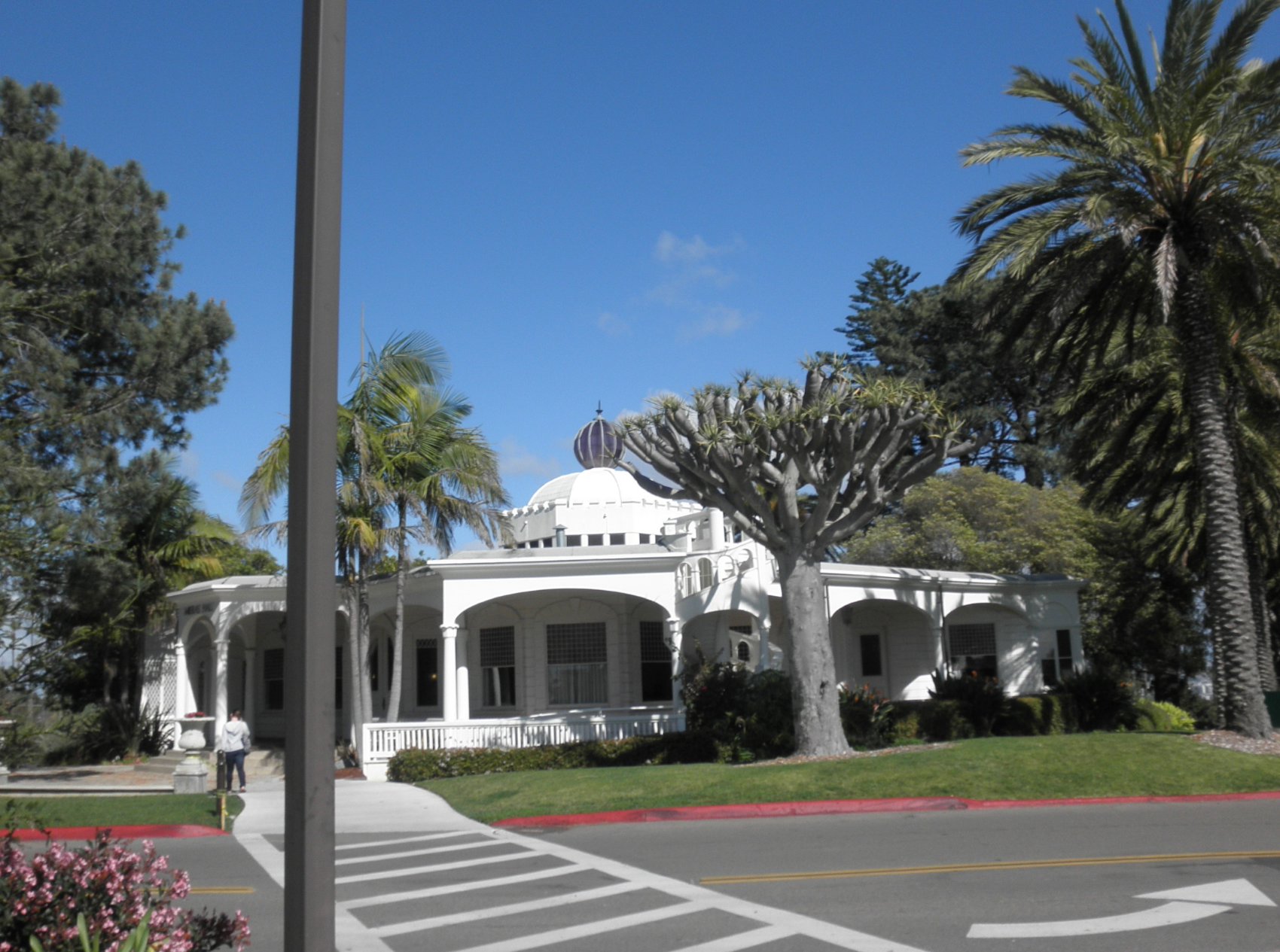
The Amethyst Domes of Point Loma
Sailors approaching San Diego in the early 1900s saw something unexpected on the western cliffs: domes. Not the white or gray domes of government buildings, but amethyst-colored domes, glinting purple in the California light, rising above a complex of gardens and temples on the Point Loma peninsula. The place was called Lomaland, and it was home to one of the most ambitious utopian experiments in American history.
Katherine Tingley's Vision
Katherine Tingley arrived in Point Loma in 1897 as the leader of the Theosophical Society, a movement that combined Eastern philosophy, mystical Christianity, and a conviction that human society could be consciously improved through spiritual discipline and community living. She had chosen this clifftop location deliberately: the panoramic Pacific views, the mild climate, the distance from what she saw as the corrupting influences of urban life.
Construction began almost immediately. By 1900, Lomaland was a functioning community of several hundred people — teachers, students, craftspeople, artists — living according to Theosophical principles. Tingley governed it with considerable force of personality. She dressed theatrically, kept a menagerie of exotic animals, and pursued her educational and cultural vision with the intensity of someone who believed she was building a model for how all humanity might eventually live.
Firsts and Experiments
Lomaland's cultural contributions were surprising in their range. In 1901, Tingley built the first Greek theater in North America on the property — an outdoor amphitheater designed for productions of classical drama, an amenity that most American cities would not have for decades. The community staged Shakespeare and Greek tragedy under the open California sky, before audiences who traveled from San Diego and beyond.
The Raja Yoga School established at Lomaland was among the most progressive educational institutions of its era. Students were taught languages, music, drama, and philosophy alongside conventional subjects. The school maintained what may have been the first student orchestra in the United States, a remarkable fact for a community that most people beyond San Diego had never heard of.
Albert Spalding, the baseball magnate and sporting goods entrepreneur, built his home at Lomaland in his later years — evidence that the community attracted people of accomplishment and means as well as idealists.
The Domes and the Sea
The amethyst and turquoise domes that distinguished Lomaland's skyline were visible for miles, particularly from the water. Sailors who passed Point Loma on their way into San Diego Bay could not miss them. Whatever they made of what they saw — curiosity, skepticism, something approaching wonder — the domes announced that something unusual had taken root on that clifftop.
The community's relationship with San Diego was complicated. Tingley was a charismatic figure who attracted both admirers and enemies, and the Theosophical philosophy was sufficiently eccentric to generate skeptical coverage in the press of the era. But Lomaland was also a genuine contributor to San Diego's cultural life, opening its Greek theater to the public and hosting events that the city's residents attended in significant numbers.
From Utopia to University
Tingley died in 1929, and the community she had built began to struggle without her commanding presence. The financial pressures of the Depression accelerated the decline. In 1942, the Theosophical Society sold the Point Loma property and moved its headquarters to Covina.
The land passed eventually to Point Loma Nazarene University, which today occupies the clifftop site. A few of the original buildings remain, altered and adapted to academic purposes. The domes are gone. The Greek theater's footprint has largely vanished. But the view that Tingley chose — the sweep of ocean, the approach to San Diego Bay, the quality of light that made those amethyst domes visible from miles away — is unchanged. Whatever Lomaland was trying to build, it chose an extraordinary place to try.
From the Air
The Point Loma clifftop site of former Lomaland, now Point Loma Nazarene University, is visible from the air as a distinctive campus on the peninsula overlooking the Pacific and San Diego Bay.