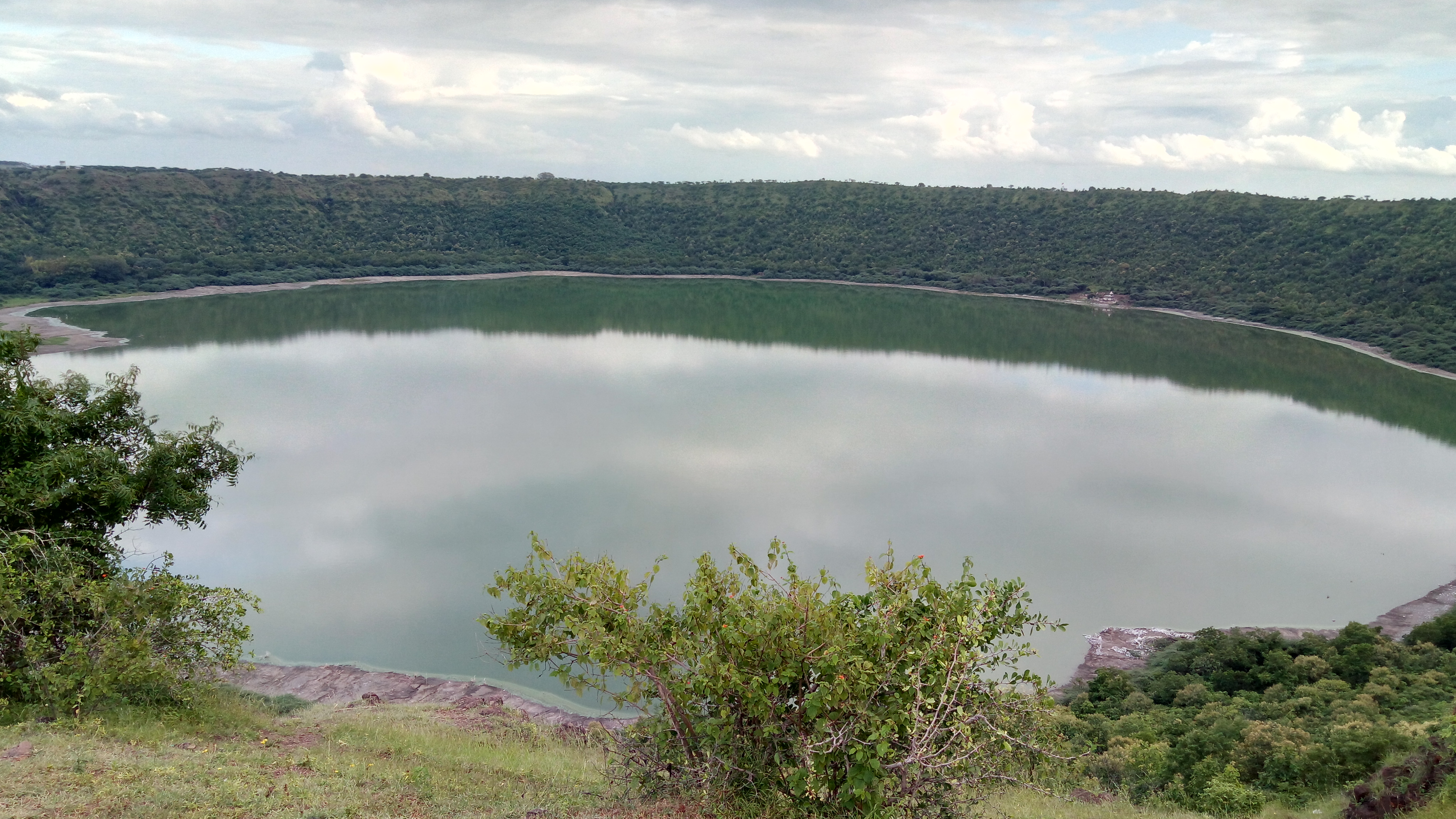
Lonar Lake
Something fell from the sky and hit the Deccan basalt at an angle of 35 to 40 degrees, arriving from the east. The impact excavated a crater 1.8 kilometers across and 137 meters deep. That was roughly 570,000 years ago, give or take 47,000 -- the kind of error bar that applies when you are measuring events on geological timescales. Today the crater holds a saline, alkaline lake unlike anything else on the Indian subcontinent. It is one of only four known hyper-velocity impact craters in basaltic rock anywhere on Earth, the other three being in southern Brazil. Ancient scriptures mention it. The Mughal-era Ain-i-Akbari describes its saltpetre works. A 2019 study by IIT Bombay found that its soil minerals closely resemble Moon rocks brought back by the Apollo missions. Lonar Lake is a place where cosmic violence, deep time, and living biology converge in a single bowl of strange water.
The Wound in the Basalt
The Deccan Traps -- the vast basalt plain left by volcanic eruptions roughly 65 million years ago -- cover much of western India in dark, heavy rock. Lonar crater is the only known extraterrestrial impact crater within this entire formation. For years, geologists debated whether it was volcanic in origin, which would have been tidy, given the surrounding geology. But the evidence settled the question: shocked breccia inside the crater, shatter cones in the rock, and plagioclase minerals transformed into maskelynite -- a glass-like substance that only forms under the extreme pressures of hypervelocity impact. The crater has an oval shape because the impacting body arrived at an angle rather than straight down, carving an asymmetric wound that has been eroding slowly for over half a million years.
Two Lakes in One
What makes Lonar chemically remarkable is that the lake contains two distinct zones that do not mix. The outer ring of water is neutral, with a pH around 7. The inner lake is intensely alkaline, with a pH as high as 11 -- caustic enough to sting skin. Each zone supports its own separate ecology. The alkaline waters host dense blooms of cyanobacteria that tint the lake green for most of the year, along with diverse archaea including methanogens and sulfur oxidizers that thrive in conditions lethal to most life. The neutral zone supports more conventional flora and fauna. Two small streams, the Purna and Penganga, feed the lake. During dry weather, evaporation concentrates the salts enough for them to crystallize on the shoreline -- not common salt, as at Rajasthan's Sambhar Lake, but sodium carbonates that seem to originate from an unknown source deep in the lake bed.
The Day the Lake Blushed
In early June 2020, satellite imagery captured something startling: Lonar Lake had turned from green to vivid pink in the span of just two or three days. The color change was visible from space. Investigations by the Agharkar Research Institute, the National Environmental Engineering Research Institute, and the Geological Survey of India converged on the same explanation. Lowered water levels had increased salinity to the point where Halobacterium -- salt-loving microorganisms that produce red and pink carotenoid pigments -- bloomed explosively. The event was temporary; as water levels recovered, the green returned. But for those few weeks, Lonar looked as alien as the Martian landscapes it is often compared to. NASA's Earth Observatory published satellite images of the transformation, and the lake's reputation as a planetary analog site was cemented.
Temples at the Crater's Edge
Humans have lived around the crater for millennia, and the evidence rings the rim. The Daityasudana Temple, built by the Chalukya dynasty and modeled in the Hemadpanthi style, stands in the town of Lonar as one of the finest examples of early Hindu architecture in Maharashtra. Its star-shaped plan and carved exterior walls draw comparisons to the temples at Khajuraho. The temple honors Vishnu's defeat of the demon Lonasura -- a mythological explanation for the crater that predates any geological one. Additional temples dedicated to Shiva, Brahma, and other deities once surrounded the lake, though most are now ruins. During the Mughal period, many of the temple sculptures were destroyed or mutilated. The beheaded remains of carved figures still stand, a reminder that sacred sites accumulate not just devotion but also the violence of successive eras.
Fragile Cosmic Relic
Lonar Lake was declared a National Geo-heritage Monument and a protected Ramsar wetland site in November 2020. It supports over a hundred species of resident and migratory birds, from black-winged stilts and brahminy ducks to European shelducks and hoopoes. Yet the crater faces mounting pressures. Household effluents enter through the streams. Cattle graze the inner slopes, contributing to erosion. Illegal construction encroaches on the rim. The percolation dam that once fed the lake has dried up, and several feeder streams have been closed off, dropping water levels. Civic groups like "Save Lonar" work to protect the site, but the challenge is fundamental: this is simultaneously a geological treasure, a biological laboratory, an archaeological site, a religious pilgrimage destination, and a community's water source. Balancing those demands around a hole punched by a meteorite half a million years ago is its own kind of impact.
From the Air
Located at 19.98°N, 76.51°E in Buldhana district, Maharashtra, India. From altitude, Lonar Lake is unmistakable: a near-perfect circular crater roughly 1.8 km in diameter set in the flat basalt terrain of the Deccan Plateau. The lake appears green (or occasionally pink) and sits 137 meters below the crater rim. The surrounding terrain is flat agricultural land with scattered villages. The small Ambar Lake, believed to be from a fragment of the same meteorite, is visible as a smaller circular depression nearby. Nearest major airport is Dr. Babasaheb Ambedkar International Airport (VAAU) at Nagpur, approximately 170 km northeast. Aurangabad Airport (VAAU) is roughly 140 km southwest. Best viewed in clear conditions at moderate altitude where the circular crater shape is most dramatic.