The London Beer Flood: When a Tidal Wave of Porter Drowned a Slum
George Crick noticed the iron band slip from the giant wooden vat at 4:30 in the afternoon, but he was not concerned. The hoops came loose two or three times a year at the Horse Shoe Brewery. An hour later, while still holding an undelivered note about the problem, Crick watched the entire vessel explode. A wall of dark porter beer, over 100,000 gallons of it, erupted through the brewery's back wall and poured into the narrow streets of the St Giles rookery, one of London's most notorious slums. Within minutes, houses collapsed, cellars flooded, and eight people lay dead in what would become known as the London Beer Flood.
The Brewery and the Rookery
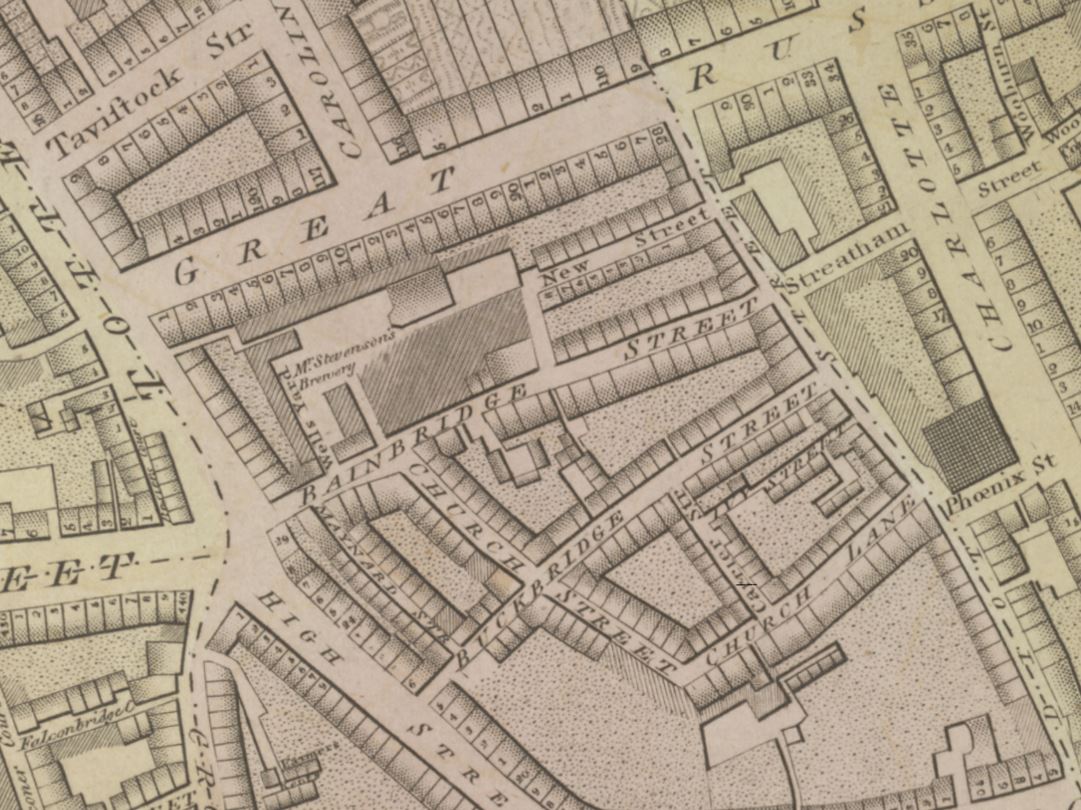
The Meux Brewery sat at the junction of Tottenham Court Road and Oxford Street, one of the two largest brewing operations in early nineteenth-century London. Sir Henry Meux had constructed a massive wooden vessel capable of holding 18,000 barrels, strengthened with 80 long tons of iron hoops. The brewery produced only porter, a dark beer that was London's most popular alcoholic drink, left to mature in these enormous vats for up to a year. Directly behind the brewery ran New Street, a cul-de-sac in the St Giles rookery. Contemporary writers described the area as 'a perpetually decaying slum' and 'a rendezvous of the scum of society.' William Hogarth had used this very neighborhood as inspiration for his print Gin Lane.
The Burst
When the vat gave way on October 17, 1814, it contained 3,555 barrels of ten-month-old porter. The force knocked the stopcock from a neighboring vat, which also began emptying. Between 128,000 and 323,000 imperial gallons of beer surged outward, destroying the brewery's rear wall, which stood two and a half bricks thick. A wave of porter some fifteen feet high swept into New Street. Two houses collapsed entirely. In one, four-year-old Hannah Bamfield was having tea with her mother when the flood carried the mother and another child into the street. Hannah did not survive. In the second destroyed house, an Irish family was holding a wake for a two-year-old boy. Five mourners died, including the boy's mother.
The Victims
Eight people perished in the flood. Eleanor Cooper, a fourteen-year-old servant, was buried under the collapsed brewery wall while washing pots in the yard of the Tavistock Arms pub. Three-year-old Sarah Bates was found dead in another house on New Street. The beer flowed into cellars throughout the low-lying neighborhood, many of which were inhabited by the area's poorest residents, who had to climb on furniture to avoid drowning. Three brewery workers were rescued from the rubble, but all employees survived. The coroner's inquest named the victims: Eleanor Cooper, Mary Mulvey, her three-year-old son Thomas Murry, Hannah Bamfield, Sarah Bates, Ann Saville, Elizabeth Smith, and Catherine Butler, who ranged in age from three to sixty-five.
The Aftermath
The coroner's jury returned a verdict that the eight had died 'casually, accidentally and by misfortune,' ruling the disaster an act of God. This meant Meux & Co faced no legal obligation to compensate the victims' families. Stories later emerged of crowds collecting the free-flowing beer and mass drunkenness, though historians note that contemporary newspapers reported no such revelry. The brewery charged admission to view the destroyed vats, drawing hundreds of spectators. The mourners killed in the cellar were given their own wake at The Ship public house. Other bodies were laid out in a nearby yard, where the public donated money for funerals.
Legacy of the Flood
The disaster cost Meux & Co approximately 23,000 pounds, nearly bankrupting the company. A petition to Parliament resulted in a rebate of about 7,250 pounds from HM Excise on the lost beer, saving the business. The Horse Shoe Brewery continued operating until 1921, when Meux relocated to Wandsworth. The site was demolished the following year, and the Dominion Theatre now stands where the giant vats once towered. The accident led the entire brewing industry to phase out large wooden vessels in favor of lined concrete. The London Beer Flood remains one of history's most unusual industrial accidents, a reminder that in the densely packed neighborhoods of Regency London, even a brewery could become deadly.
From the Air
The London Beer Flood occurred at the Horse Shoe Brewery, located at what is now the intersection of Tottenham Court Road and Oxford Street (51.52N, 0.13W). The site is approximately 1km north of Trafalgar Square and 2km east of Hyde Park. The Dominion Theatre now occupies the location. Nearest airports are London Heathrow (EGLL) 25km west, London City (EGLC) 12km east, and London Luton (EGGW) 45km north. From the air, the location is in central London's West End, identifiable by the distinctive curved facade of the Dominion Theatre and the junction of Oxford Street with Tottenham Court Road.