London Bridge (Lake Havasu City)
"That's the craziest idea I have ever heard." Robert McCulloch's initial reaction to his real estate agent's suggestion became the foundation for one of America's strangest landmarks. McCulloch had a problem: he owned thousands of acres of desert land on the shores of Lake Havasu, but no one wanted to buy property in a place far from population centers with punishing summer heat. His agent, Robert Plumer, learned that London Bridge was for sale. Not a replica, not a theme park attraction, but the actual bridge that had spanned the River Thames since 1831, the last project of engineer John Rennie the Elder. McCulloch paid $2.46 million, for the privilege of dismantling a piece of British history and reassembling it in Arizona. It was indeed crazy. It also worked spectacularly.
A Bridge Too Weak
By 1962, the London Bridge that had served the city for over 130 years could no longer handle modern traffic. It was sinking, slowly but measurably, under the weight of cars and buses it was never designed to carry. The City of London put it up for sale in April 1968, planning to replace it with a new structure. McCulloch's purchase attracted immediate skepticism, including a persistent urban legend that he had confused London Bridge with the more famous Tower Bridge. Both McCulloch and Ivan Luckin, who arranged the sale, vehemently denied this. What McCulloch bought was an elegant granite bridge, five arches wide, designed in the early nineteenth century and completed by John Rennie the Younger after his father's death. Now it belonged to a chainsaw manufacturer with a development scheme in Arizona.
Stone by Numbered Stone
The logistics of moving a bridge across an ocean seem impossible until you realize you only need the skin. Workers removed the facing stones, numbering each one and cataloguing its position. The granite was shipped to a quarry in Merrivale, Devon, where sections were sliced off to reduce weight. Plumer negotiated a clever deal with a cargo company about to sail a newly built ship, empty, from the UK to the US. He offered to pay all operating costs in exchange for carrying the bridge stones as cargo, saving a fortune on shipping. The vessel traveled through the Panama Canal to Long Beach, California. From there, trucks carried the numbered stones overland to Lake Havasu City, where reassembly began in 1968. On September 23, Sir Gilbert Inglefield, Lord Mayor of London, laid the foundation stone at the reconstruction site.
Building a Channel for a Bridge
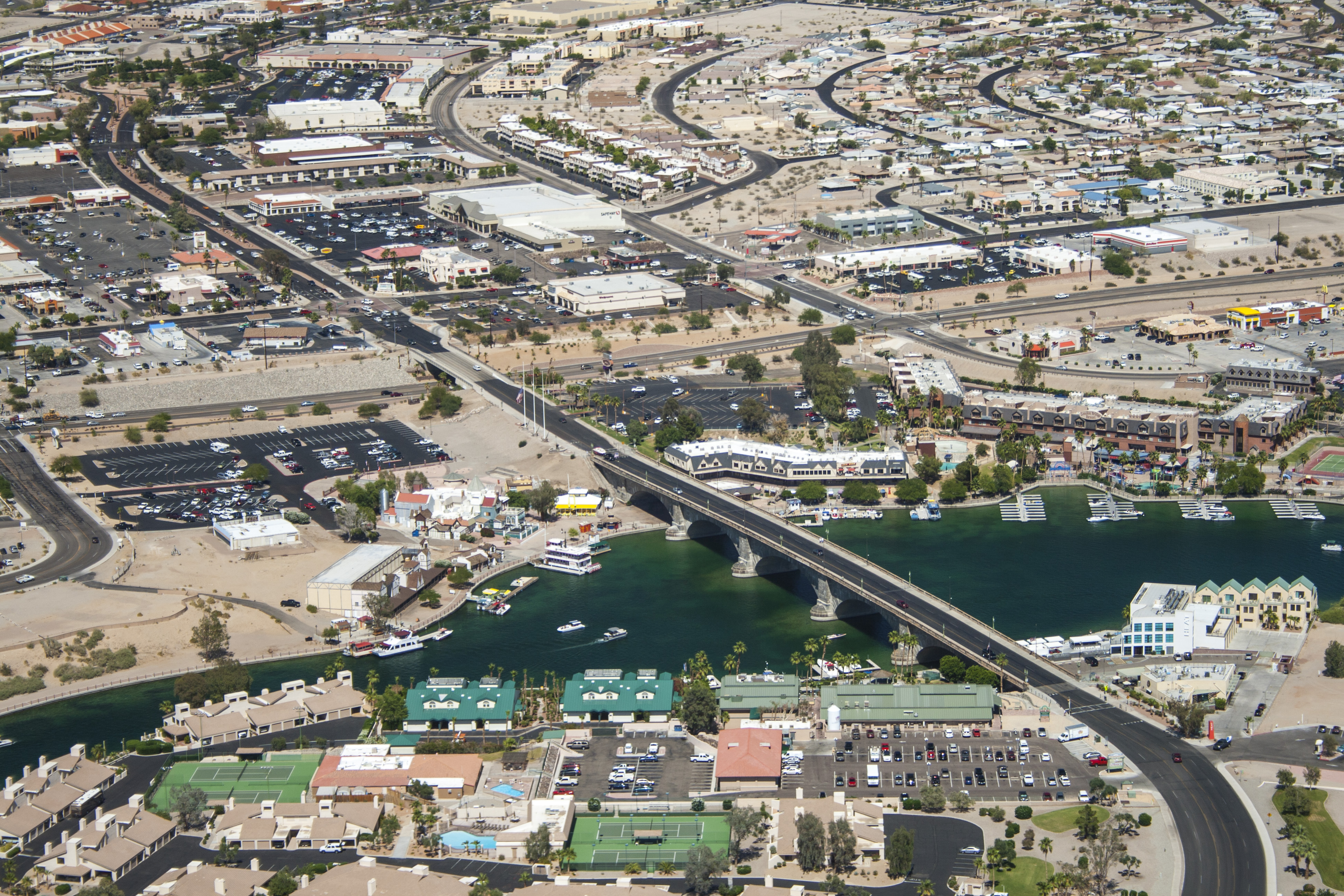
Here is where McCulloch's scheme turned truly audacious. The bridge was not rebuilt over water. It was erected on dry land between the main city and Pittsburgh Point, a peninsula jutting into Lake Havasu. Only after construction finished did a company dredge the Bridgewater Channel Canal beneath it, cutting through the peninsula's neck to create an island. The bridge now spans a navigable waterway connecting Thompson Bay to the northern lake, boats passing under arches that once carried London's horse-drawn traffic over the Thames. The rededication ceremony took place on October 10, 1971, three years after the move began. The Arizona bridge is technically a reinforced concrete structure clad in the original 1830s masonry, a modern core wearing Victorian skin.
The Scheme That Paid Off
McCulloch's gamble worked beyond expectation. Prospective land buyers who would never have considered remote desert property came to see the famous bridge and stayed for tours of available lots. Sales improved dramatically. Because McCulloch had acquired the land at essentially no cost through an earlier deal, the property sales more than covered his expenses on purchasing and shipping the bridge. An "English Village" grew around it, an open-air mall with a hedge maze and museum in faux-English style. The village has deteriorated and been partially leveled over the decades, though revitalization efforts continue. In 2014, The Sun published a false story claiming the bridge was being demolished to build a marijuana dispensary. The paper retracted the story after two weeks of international coverage of the controversy.
Hollywood Comes to the Desert
The incongruity of London Bridge in Arizona has attracted filmmakers since its arrival. In 1972, a television special starring Tom Jones and Jennifer O'Neill celebrated the relocation. The 1985 TV movie "Bridge Across Time" imagined the spirit of Jack the Ripper transported to 1980s Arizona along with a cursed stone. "The Return of Sherlock Holmes" in 1987 had the detective, lost in the desert, stumble upon the bridge and believe he had entered heaven. The paranormal show Ghost Adventures investigated in 2019. Musicians noticed too. The 1969 Bread song "London Bridge" references the removal: "London bridge is finally fallin' down, they packed it up and shipped it outta town." Gary P. Nunn's "London Homesick Blues," theme song for Austin City Limits from 1977 to 2004, notes that "even London Bridge has fallen down and moved to Arizona." The bridge endures, numbered stones still visible to those who look, proof that the craziest ideas sometimes become landmarks.
From the Air
London Bridge is located at 34.472N, 114.347W in Lake Havasu City, Arizona. The bridge spans the Bridgewater Channel connecting Thompson Bay to the main lake, with Pittsburgh Point Island on its east side. From the air, look for the distinctive bridge structure connecting the mainland to the island, with the English Village development adjacent. The Colorado River and Lake Havasu are clearly visible, forming the Arizona-California border. Nearest airports include Lake Havasu City Airport (KHII) 5nm north and Needles Airport (KEED) 25nm south in California. Desert heat creates significant density altitude in summer months.