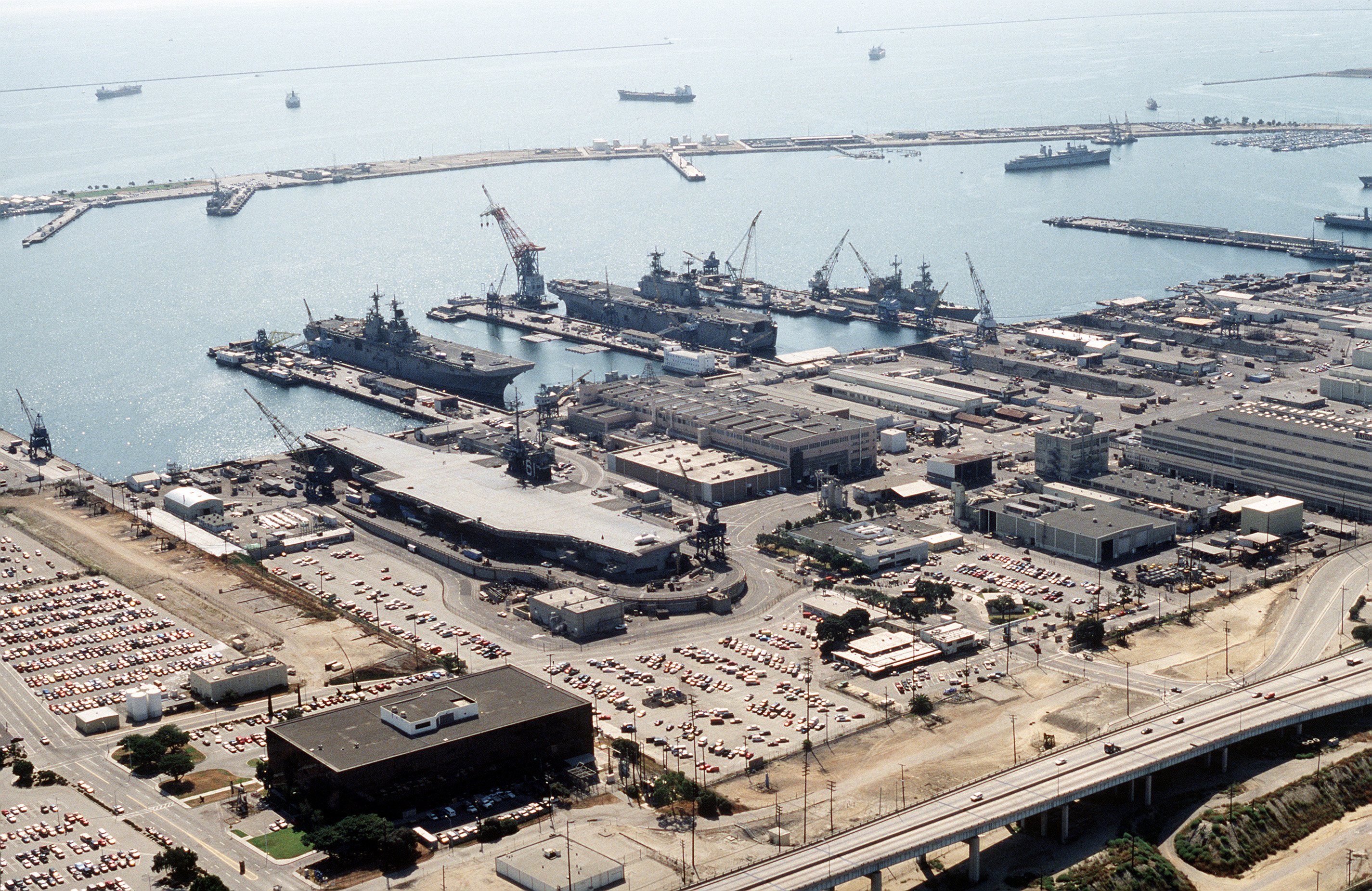
Long Beach Naval Shipyard
The crane was a war prize. After World War II, the US Navy acquired 'Herman the German' — a massive floating crane built for the German Navy — and brought it to Terminal Island, where it became the workhorse of the Long Beach Naval Shipyard. For fifty years, Herman lifted things that nothing else could lift: dry-docked battleships, destroyer hulls, turbines the size of houses. In 1982, Herman lifted the Spruce Goose — Howard Hughes's enormous wooden flying boat — off its barge and onto a display platform at the Queen Mary attraction nearby. When the shipyard closed in 1997, Herman went to the Panama Canal, where he continues to lift things. The shipyard that housed him is gone.
Roosevelt Base and the War
The Long Beach Naval Shipyard began as US Naval Dry Docks Roosevelt Base, formally established on February 9, 1943, at a facility that had been in operation since 1938. Terminal Island, already home to the California Shipbuilding Corporation's wartime Liberty ship operation, became one of the most intensely industrial pieces of real estate on the American coastline. The naval shipyard's mission was repair and overhaul: the Pacific Fleet's damaged ships limped into Los Angeles Harbor and came out of the shipyard's dry docks ready to fight again. Destroyers, cruisers, aircraft carriers — the yard processed them in the round-the-clock rhythm of a nation at war.
The Iowa-Class Battleships
The Cold War gave the Long Beach Naval Shipyard its defining mission. The four Iowa-class battleships — USS Iowa, USS New Jersey, USS Missouri, USS Wisconsin — were the largest and most powerful surface combatants in the US Navy's inventory, and the Long Beach yard became the primary facility for their overhaul and modernization. The work was enormous: the Iowa class displaced 57,000 tons at full load, their main turrets weighed more than a destroyer, and keeping them operational required the kind of heavy industrial capacity that only a major naval shipyard could provide. Long Beach refurbished the New Jersey for the Vietnam era and again for the Reagan-era recommissioning. The Missouri and the Wisconsin passed through as well.
The Crane and the Flying Boat
Herman the German arrived at Terminal Island after World War II as part of the US Navy's acquisition of German naval assets. The 250-ton floating crane had been built for the Kriegsmarine and was genuinely irreplaceable — no American crane at the time could do what Herman could do. For fifty years it was the shipyard's heavy-lift solution for objects too large for anything else. The most famous lift came in 1982, when Howard Hughes's Spruce Goose — the H-4 Hercules flying boat, the largest airplane ever built, which had flown exactly once in November 1947 from Terminal Island's waters — was moved from its storage dome to a display facility next to the Queen Mary. Herman picked it up. Only Herman could have.
Base Realignment and Closure
The Cold War's end triggered the Base Realignment and Closure process, a politically painful mechanism for reducing the Pentagon's real estate footprint as the strategic rationale for many installations evaporated. Long Beach Naval Shipyard was on the 1991 BRAC list. The closure process was contested — tens of thousands of jobs depended on the facility, directly and indirectly — but the decision held. The shipyard closed on September 30, 1997. The Navy's heavy warship fleet was contracting in any case; the Iowa-class battleships had been decommissioned in the early 1990s, and with them went much of the work that justified a major West Coast overhaul facility.
What Remained
Herman the German was sold to the Panama Canal Authority, which needed precisely the heavy-lift capability the crane offered for its own infrastructure maintenance. The crane that had lifted battleships and flying boats sailed to Panama, where it remains in service. The shipyard's site on Terminal Island was gradually absorbed into port operations. The dry docks were converted for commercial use. The infrastructure of fifty years of naval activity was repurposed or demolished. What the shipyard left behind was the shaped harbor, the dredged channels, the concrete that still anchors the port complex — and the institutional memory of a place that kept the Pacific Fleet operational through the most consequential years of the twentieth century.
From the Air
Located at approximately 33.76°N, 118.23°W on Terminal Island in Los Angeles Harbor. The former shipyard site is now part of the Port of Long Beach and Port of Los Angeles complex. Long Beach Airport (KLGB) is approximately 4 miles northeast. The Queen Mary, moored nearby at Pier J in Long Beach, and the large container cranes of the port complex are clearly visible from altitude and provide orientation. Approach from the south over the harbor entrance for best view.