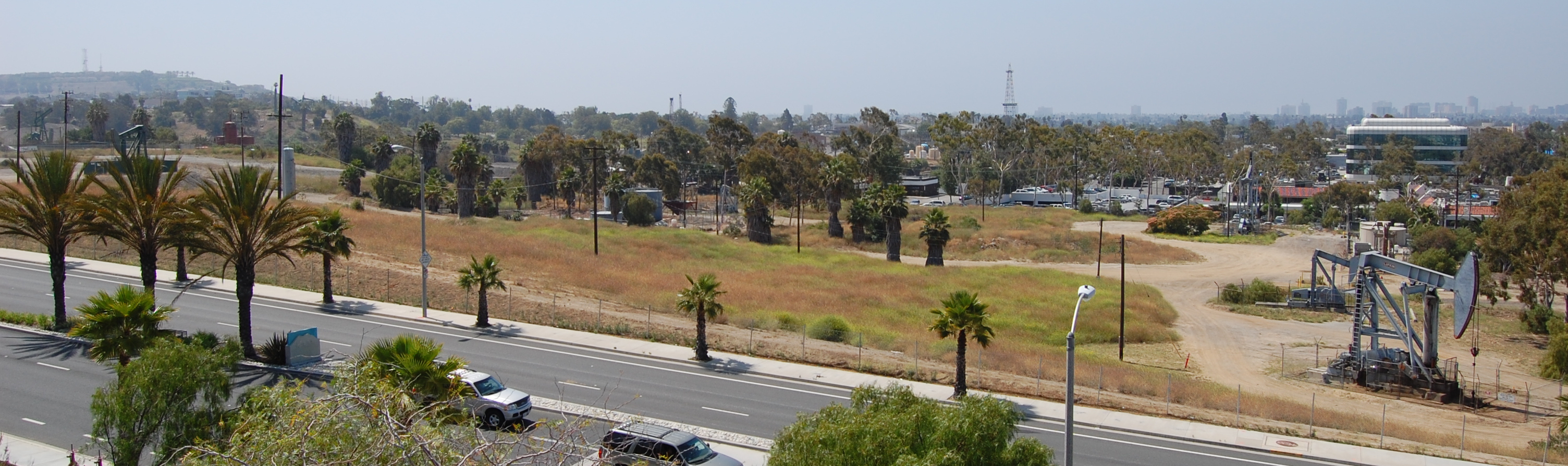
Long Beach Oil Field
They called it Porcupine Hill. The derricks rose so thick on Signal Hill's slopes after 1921 that from a distance the hilltop looked like the back of a porcupine, bristling in every direction. In the peak years of the 1920s, more than a hundred derricks stood on a hill that had previously grown citrus trees and offered views of the Pacific. The Long Beach Oil Field beneath them would prove to be one of the largest oil accumulations in California history — 3.6 billion barrels in total, nearly a billion of which had been extracted by the time the twenty-first century arrived. It began with a single well.
Alamitos Number One
The Alamitos No. 1 well was drilled by Shell Oil Company on the crest of Signal Hill, on a lease from the Alamitos Land Company. Drilling began in March 1921. On June 23, 1921, at a depth of 3,114 feet, the well blew out: oil erupted 114 feet above the derrick floor, showering the crew and the surrounding hillside in the crude that had been accumulating underground for millions of years. Word spread immediately. Within days, oilmen were arriving from across California to lease whatever land remained available near Signal Hill.
The Rush to the Hill
What followed was one of the more dramatic land rushes in California history, and California had seen several. Property owners on and around Signal Hill found themselves holding potential fortunes. Some leased their land by the day to drilling companies; some sold outright; some retained royalty interests that would pay dividends for generations. The competition for drilling sites was so intense that leases were negotiated in terms of square feet rather than acres. Derricks rose on lots barely large enough to accommodate them. When a landowner's property couldn't support a derrick due to lot size, directional drilling allowed access to the same formation from adjacent properties. The hill was thoroughly perforated.
One-Fifth of the World's Oil
The production figures from the Long Beach Oil Field in the early 1920s strain belief. In 1923, the Los Angeles Basin as a whole — of which the Long Beach field was the dominant producer — accounted for approximately 20 percent of the entire world's oil output. The field alone produced 68 million barrels in 1923, its peak year. For a single geological formation beneath a medium-sized California city to supply a fifth of the world's oil is a fact that requires a moment to absorb. California was, briefly, the Saudi Arabia of its era. Long Beach was the Riyadh. Signal Hill's porcupine silhouette was the most recognizable industrial skyline in California.
The Subsidence Problem
Extracting oil from underground at the scale practiced in Long Beach had consequences that took decades to fully understand. As the oil was removed, the geological formations that had supported the surface above began to compact. The land subsided — sank, measurably and catastrophically in places. The harbor area near the oil field sank by as much as 29 feet in some locations by the 1950s. Buildings cracked. Infrastructure failed. The Navy's facilities on Terminal Island required constant rebuilding to stay above water level. The solution, eventually, was water injection: pumping seawater back into the depleted formations to maintain underground pressure. The subsidence slowed and eventually largely stopped, but the land never fully recovered its original elevation.
The Field That Continues
The Long Beach Oil Field never fully depleted. Production declined sharply from its 1920s peak, but oil has been extracted continuously for over a century. The field holds an estimated 3.6 billion barrels in total, of which roughly 963 million had been produced by the early 2000s. Offshore production platforms, disguised to resemble artificial islands complete with waterfalls and palm trees, continue to extract oil from the harbor-area portions of the field. The derricks that made Signal Hill look like a porcupine are gone — the last of them came down decades ago — but the field beneath them still yields. Beneath the streets and houses and shopping centers, the oil continues to move.
From the Air
The Long Beach Oil Field underlies approximately 33.81°N, 118.18°W, centered on Signal Hill. Signal Hill is a distinct elevated enclave surrounded by Long Beach, clearly visible from altitude as a hilltop now covered with homes and light commercial development rather than derricks. Long Beach Airport (KLGB) is approximately 2 miles north. The offshore oil islands in Long Beach Harbor — disguised with tropical landscaping — are visible from altitude just offshore.