Long Branch Plantation
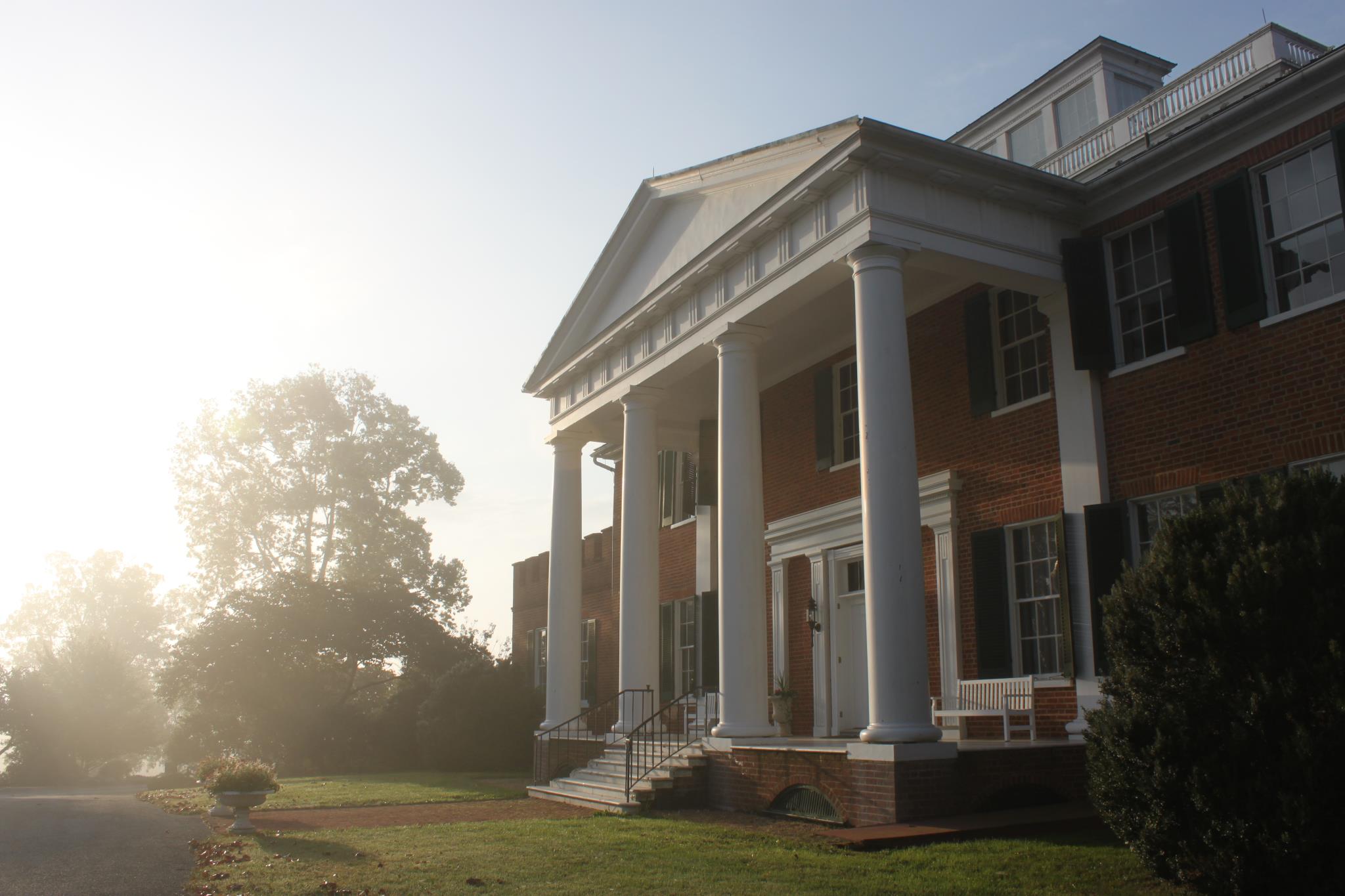
The architect never visited. Benjamin Henry Latrobe, the man who helped design the U.S. Capitol, reviewed the floor plans by mail and offered one devastating critique: there was no servant staircase. Without it, enslaved workers would have to cross the central hall every time they went upstairs. That correction, a narrow back staircase tucked to the left of the main stair, still stands inside Long Branch, a Federal-style brick mansion near Millwood, Virginia. It is a small detail that captures the entire contradiction of the place -- architectural elegance built on forced labor, a beautiful home whose story is inseparable from the people who had no choice but to maintain it.
From King Carter's Grant to Rattlesnake Spring
Long Branch's land traces back to 1650, when Charles II of England granted the Northern Neck of Virginia to seven loyalists. By the 1730s, Robert "King" Carter, one of the wealthiest men in colonial Virginia, was parceling out 50,212 acres to his sons and grandsons. His grandson Robert "Robin" Burwell received 5,619 acres. After decades of inheritance disputes, Robert Carter Burwell finally secured about 1,000 acres between Long Branch Creek and Rattlesnake Spring in 1798. He started farming wheat around 1790 while living at his sister's nearby Rattlesnake Plantation, now known as Rosney. By 1811, he began building his own home -- a two-story Flemish bond brick mansion with an east service wing. But Burwell never grew old in the house he built. He left to fight in the War of 1812 and died of disease while stationed in Norfolk in 1813, leaving the estate to his sister Sarah Nelson and her husband Philip.
Adelaide's Fight
In 1842, Philip Nelson sold Long Branch to his nephew Hugh Mortimer Nelson, who arrived from Baltimore with his wife Adelaide and their three-year-old daughter. The Nelsons threw themselves into Virginia planter society -- Hugh commanded the Clarke Cavalry and served as a justice of the peace. They renovated the house lavishly, adding a belvedere, Ionic and Tuscan porticos, a hanging spiral staircase, and what has been called some of the most beautiful Greek Revival woodwork in the nation. But behind the grandeur, Hugh was drowning in debt, taking loans against the property as early as 1850. When he organized the Clarke Cavalry for the Confederate Army in 1861 and died of typhoid after the Seven Days Battles in 1862, Adelaide discovered the financial ruin he had hidden. Long Branch's assessed value plummeted from $103,600 in 1860 to $45,000 by 1870. Courts ordered everything auctioned. Adelaide was the only bidder for the lot containing the house. She held on until pneumonia took her in 1875. Her son Hugh Jr. spent nearly a decade buying back the other half, and a court decree in 1884 finally restored the entire farm to the family.
Wheat Fields and Hoofbeats
The Shenandoah Valley was Virginia's breadbasket, and Long Branch rode the wheat boom for decades. Grain from the plantation was likely ground at the nearby Burwell-Morgan Mill in Millwood, then hauled to Alexandria's markets and shipped to Europe. Corn served as a backup when wheat failed. At the peak of operations, 20 to 30 enslaved people planted and harvested the crops, tended the gardens, and maintained the mansion. At least one formerly enslaved family stayed on as free laborers after the Civil War. The estate also had orchards of cherries, plums, and peaches, kitchen gardens, a greenhouse that burned in 1861, and flower beds of roses, chrysanthemums, and violets. Horses became the plantation's second identity. Hugh Nelson Jr. bred thoroughbreds and Clydesdales, and every subsequent owner continued the tradition. Today, Long Branch operates a boarding program for retired sport horses.
A Dying Man's Gift
After the Nelson era ended with Sallie Page Nelson's death in 1951, Long Branch passed through a string of owners and fell into disrepair. Doctors from California owned it briefly; a Texas horse breeder defaulted on the mortgage. In 1986, the property was auctioned again on the Clarke County Courthouse steps. Harry Z. Isaacs, a Baltimore textile executive and horse breeder, bought the house and 400 acres for $1.35 million and launched an extensive restoration. He added a west wing to balance the facade, rebuilt the crumbling south wall of the east wing, and replaced deteriorated chimneys, columns, and mantels. Shortly after work began, Isaacs learned he had terminal cancer. He left Long Branch to a nonprofit foundation. On April 3, 1993, the house opened to the public. In 2013, the museum added new history exhibits and period rooms. Today it hosts weddings, special events, and the Sheila Macqueen Gardens, a formal English garden established in 1997 and maintained by a dedicated group of volunteer flower arrangers.
From the Air
Long Branch Plantation sits at 39.043N, 78.056W in Clarke County, Virginia, in the northern Shenandoah Valley. The property's 400 acres of rolling farmland, horse barns, and the brick mansion are visible from moderate altitude. Look for Millwood, a tiny crossroads village along US-340/US-17 between Winchester and Berryville. The nearest airport is Winchester Regional Airport (KOKV), approximately 12nm to the northwest. Shenandoah Valley Regional Airport (KSHD) is about 45nm southwest. Clear weather provides excellent views of the Blue Ridge Mountains framing the valley to the east.