Long Corridor
Walk the Long Corridor and you walk through Chinese civilization itself. Stretching 728 meters along the northern shore of Kunming Lake at the Summer Palace, this covered walkway carries more than 14,000 individual paintings on its beams and ceiling -- scenes from classical literature, folk tales, landscapes, and historical episodes painted in vivid polychrome. The Qianlong Emperor ordered it built in 1750 so his mother could stroll through the gardens without suffering sun or rain. What he created was the world's longest illustrated gallery, a corridor where every few steps bring a new story.
A Son's Gift, an Empire's Showcase
The corridor's origin story is domestic. The Qianlong Emperor, one of the longest-reigning and most culturally ambitious rulers in Chinese history, built it for his mother. She wanted to enjoy the imperial gardens; he wanted to ensure she could do so in comfort, protected from the elements by a covered walkway. But the Qianlong Emperor never did anything simply. The walkway became an architectural statement: 728 meters long, divided by crossbeams into 273 sections, punctuated by four octagonal double-eaved pavilions named for the four seasons. Liu Jia for spring, Ji Lan for summer, Qiu Shui for autumn, Qing Yao for winter. The corridor curves along the transitional zone between Kunming Lake and the foot of Longevity Hill, a position that offers views of the water on one side and the forested hillside on the other.
Fourteen Thousand Stories
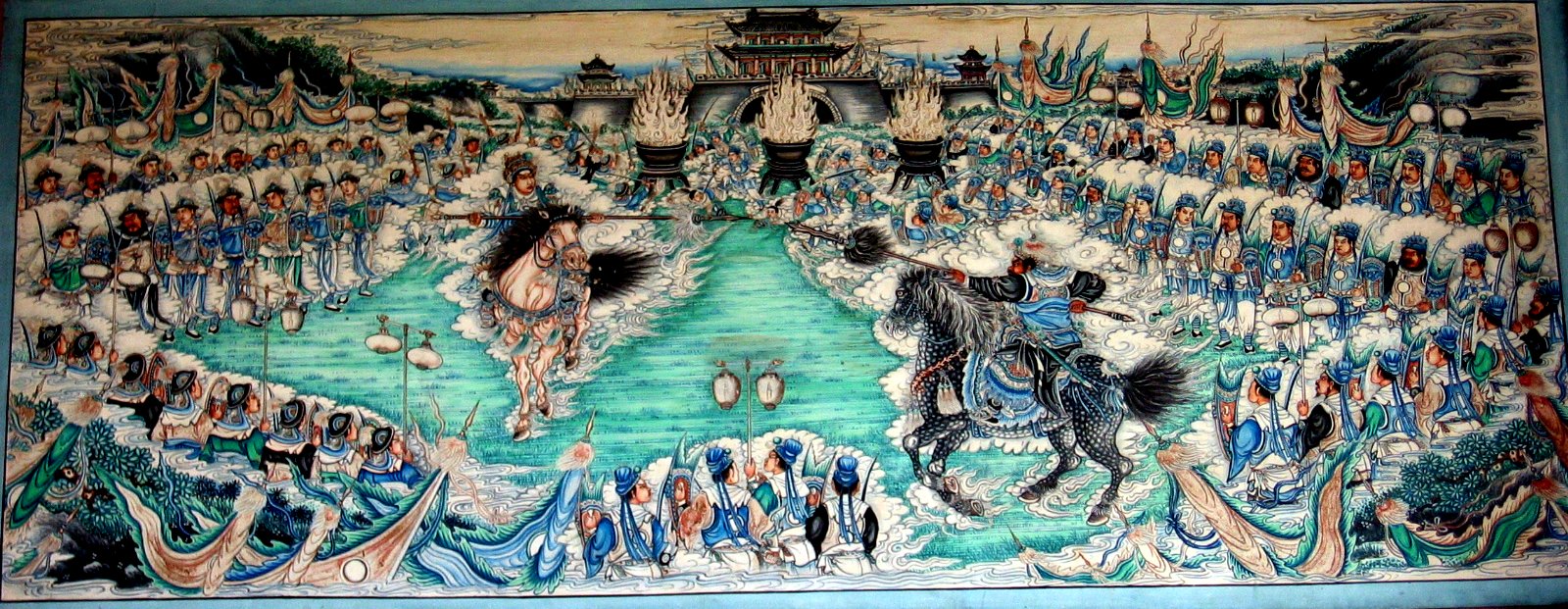
Every beam, every ceiling panel, every surface beneath the corridor's roof is painted. The subjects range across the entire breadth of Chinese culture: episodes from the Four Great Classical Novels, folk legends, famous buildings, natural landscapes, flowers, birds, fish, and insects. In the Liu Jia Pavilion, a painting depicts the Tale of the Peach-Blossom Land, a story from the Eastern Jin dynasty about a fisherman who discovers a hidden valley of peace, populated by descendants of refugees who escaped the wars of the Qin dynasty. He returns home to tell the tale, but the valley can never be found again. Nearby, Sun Wukong, the Monkey King from Journey to the West, battles the boy god Nezha, both transformed into six-armed deities. The paintings are not merely decorative; they are a curriculum.
Warriors and Sages
The pavilion paintings draw heavily from the Romance of the Three Kingdoms and the military epics of the Song dynasty. Zhang Fei duels Ma Chao at Jiameng Pass. Zhao Yun, dressed in white and clutching Liu Bei's infant son, fights his way through Cao Cao's army at the Battle of Changban. Yue Fei, the Song dynasty general and national hero, defeats the Prince of Liang with a spear thrust to the heart. In the Qiu Shui Pavilion, a quieter scene: the Seven Sages of the Bamboo Grove, seven 3rd-century intellectuals who rejected political ambition and retreated to a bamboo forest for poetry, music, and chess. The corridor's paintings honor both the warriors and the sages, the fighters and the philosophers.
Destruction and Renewal
Like most of the Summer Palace, the Long Corridor was severely damaged in 1860 when Anglo-French forces set fire to the palace complex during the Second Opium War. It was rebuilt in 1886, and in December 1998 it was inscribed on the UNESCO World Heritage List as part of the Summer Palace. The paintings have been restored multiple times, but the subjects and compositions remain faithful to the originals. At the corridor's midpoint, the Cloud-Dispelling Gate marks the center of both the walkway and the palace's architectural axis. Nearby, the Cloud-Dispelling Hall stands where Empress Dowager Cixi celebrated her birthdays. At the western end, the Marble Boat extends into Kunming Lake. The corridor connects them all, a thread of painted stories binding the palace together.
From the Air
Located at 40.00N, 116.27E along the northern shore of Kunming Lake at the Summer Palace. From the air, the corridor appears as a long, covered structure tracing the lakeshore at the base of Longevity Hill. Kunming Lake is the dominant body of water in the Summer Palace grounds. Beijing Capital International Airport (ZBAA) is approximately 30 km northeast. The corridor runs east to west and may be visible from moderate altitudes as a continuous roofline.