Longleat
In 1949, the 6th Marquess of Bath did something no English aristocrat had done before: he sold tickets to his own front door. Longleat, the magnificent Elizabethan mansion his family had occupied for four centuries, was drowning in death duties. Rather than sell the house, Henry Thynne invited the public inside. It was an act of pragmatic defiance that would transform how Britain related to its grand country estates, and Longleat has been reinventing itself ever since.
From Priory to Prodigy House
The name Longleat comes from a medieval leat, an artificial watercourse that once fed a mill on the grounds of an Augustinian priory. Sir John Thynne purchased the site in 1541 for just 53 pounds. When fire destroyed the original house in April 1567, Thynne saw opportunity rather than disaster. Working with architect Robert Smythson, he spent twelve years creating what is widely regarded as one of the finest examples of Elizabethan architecture in Britain. The symmetrical facades, enormous windows, and classical proportions were revolutionary for their time, earning Longleat its status as one of England's great prodigy houses. The Thynne family has maintained unbroken ownership since the sixteenth century, a dynasty spanning eight marquesses and counting.
Layers of Grandeur
Every generation left its mark. Christopher Wren added galleries and a chapel. Capability Brown swept away the formal gardens in the eighteenth century, replacing canals and parterres with the sweeping naturalistic parkland that still rolls across a thousand acres today. Jeffry Wyatville modernized the interiors for the 2nd Marquess, installing a grand staircase where Wren's had stood. The 4th Marquess filled the rooms with Italian Renaissance art, hiring John Crace, who had decorated the Palace of Westminster, to create opulent interiors. Inside, 40,000 books line the libraries. A Meissen porcelain centrepiece graces the State Dining Room. The house holds the first plumbed-in flush lavatory on the estate, and visitor books bear the signatures of Elizabeth II and George VI.
Lions, Labyrinths, and Reinvention
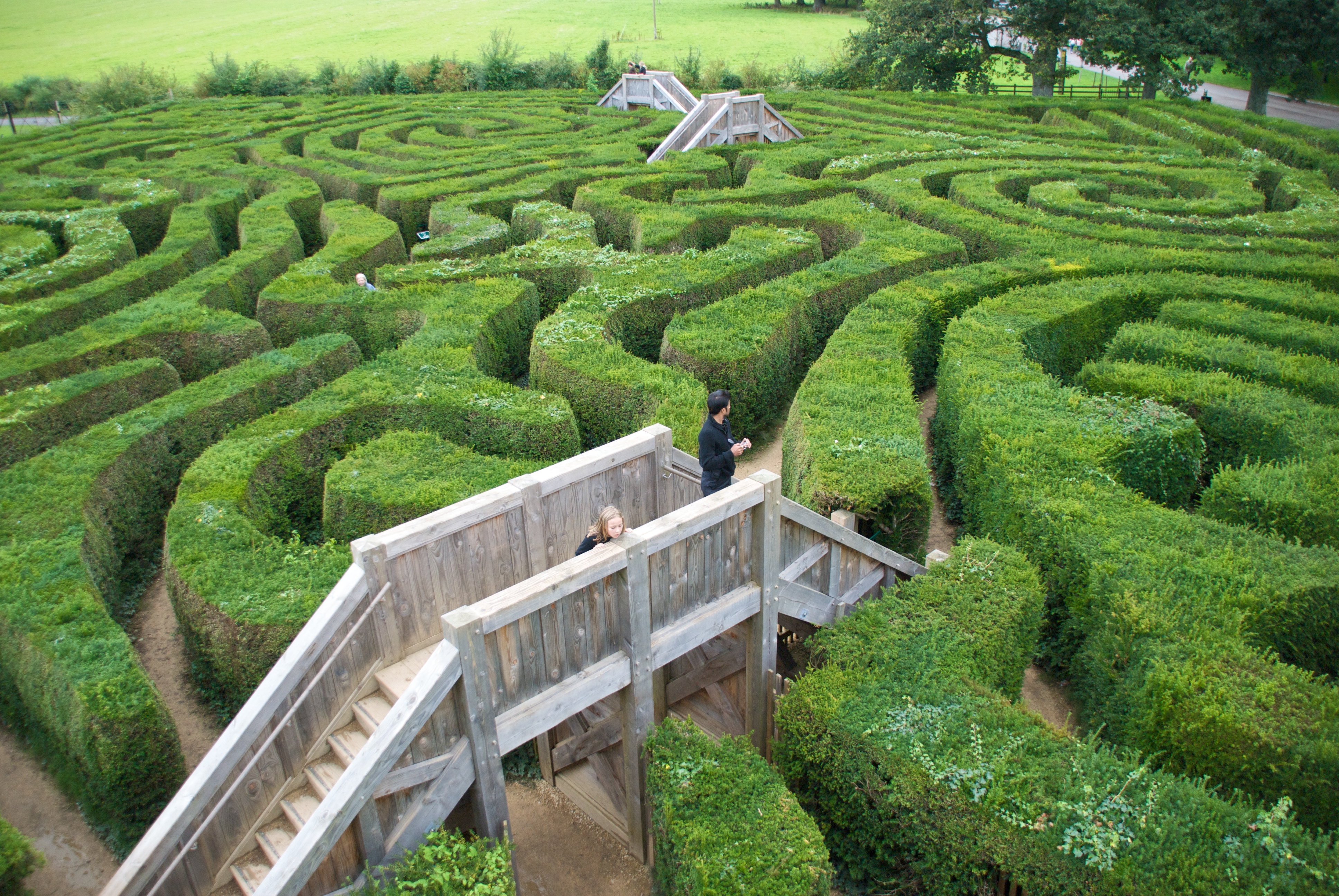
Opening the house was just the beginning. In 1966, Longleat became home to the first drive-through safari park outside Africa, an audacious experiment that placed lions, giraffes, and rhesus monkeys in the Wiltshire countryside. Over 500 animals now inhabit the 900-acre park, from Rothschild's giraffes and Amur tigers to cheetahs and grey wolves. The 7th Marquess, Alexander Thynn, brought his own brand of eccentricity. An artist and muralist, he filled walls with his paintings and developed an obsession with mazes. The hedge maze he created, designed by Greg Bright, stretches 1.69 miles through walls of 16,000 English yews, making it the world's longest. He added a love labyrinth, a sun maze, a lunar labyrinth, and King Arthur's maze for good measure.
Stolen Art and a Fallen Madonna
Longleat's story includes moments of high drama beyond the safari enclosures. In January 1995, a Titian painting worth over five million pounds, Rest on the Flight into Egypt, was stolen from the drawing room. Seven years later, it was recovered in London inside a plastic shopping bag. The house's sense of humor shows in smaller details too. A copy of The Fallen Madonna, the fictional painting that served as a running joke throughout the BBC sitcom 'Allo 'Allo!, was specially made for the 6th Marquess and hangs in the house. During both world wars, the house served the nation directly: as a military hospital in World War I, and as the evacuated Royal School for Daughters of Officers of the Army during World War II.
The View from Above
From the air, Longleat is unmistakable. Brown's landscaped parkland stretches across nearly ten thousand acres of Wiltshire countryside, the lake reflecting the honey-colored stone of the house. The safari park enclosures are visible to the south, and the geometric patterns of the hedge maze stand out clearly against the surrounding green. The surrounding Longleat Woods, a 250-hectare Site of Special Scientific Interest, adds a ring of ancient woodland. What began as one man's gamble to save his inheritance has become one of Britain's most visited attractions, proof that even the grandest houses survive not by standing still but by constantly surprising.
From the Air
Located at 51.186N, 2.274W, approximately 7 km west of Warminster in Wiltshire. The estate's parkland, lake, and safari park enclosures are clearly visible from altitude. Nearest airports: EGHG (Yeovilton, 25 nm south), EGBJ (Gloucestershire, 40 nm north). Recommended viewing altitude 2,000-4,000 ft for estate layout. The hedge maze and safari enclosures are best distinguished at lower altitudes.