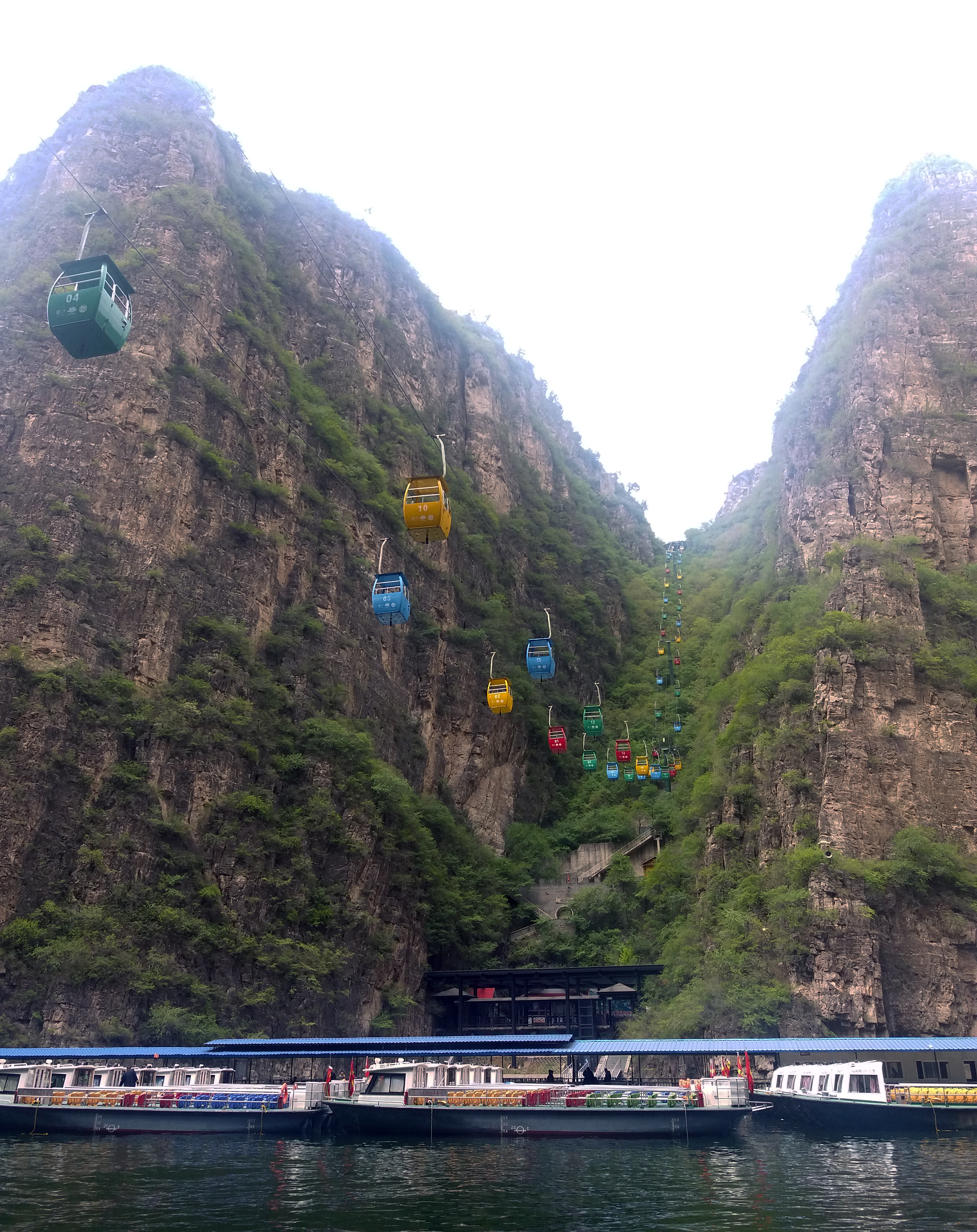
Longqing Gorge
The boat ride through Longqing Gorge lasts fifteen minutes, but the canyon it passes through took geological ages to carve. Sheer rock walls rise on either side as an open-top vessel glides through water the color of jade, carrying visitors through one of Beijing's most dramatic natural landscapes. This is the kind of day trip that makes residents of the Chinese capital forget they live in a megacity of twenty million people. Longqing Gorge sits in the village of Gucheng in Yanqing District, close enough to Beijing for a morning departure and far enough that the air tastes different when you step off the bus.
A Canyon Close to the Capital
Yanqing District, Beijing's northwestern frontier, contains terrain that seems to belong to a different province. While central Beijing is flat, dense, and relentlessly urban, Yanqing rises into mountains that form the southern edge of the Mongolian Plateau. Longqing Gorge cuts through this landscape as a steep-walled canyon floored with clear water, its rock faces sculpted by the same geological forces that shaped the mountains along which the Great Wall runs just to the south. The gorge is not large by the standards of China's grand canyons -- it lacks the scale of the Yangtze's Three Gorges or the depth of Tiger Leaping Gorge -- but its proximity to Beijing gives it an outsized role in the lives of the capital's residents, who come here to escape concrete and breathe mountain air.
Summer on the Water
The fifteen-minute boat cruise is the gorge's signature experience. Open-top vessels carry passengers along the bottom of the canyon, the rock walls close enough to study their strata, the water calm enough to reflect the sky in long, undistorted mirrors. Beyond the boats, the gorge offers bungee jumping from the top of one of its mountains -- a test of nerve that turns the same scenery into something more visceral. Cable cars carry visitors above the canyon rim for a perspective that reveals how the gorge sits within the broader mountain landscape, a green slash through gray-brown terrain that extends north toward the Great Wall and the passes beyond.
Ice and Olympic Ambitions
Each winter, Longqing Gorge transforms into an ice sculpture park that draws inevitable comparisons to the famous Harbin International Ice and Snow Sculpture Festival, 1,200 kilometers to the northeast. The comparison flatters Longqing -- Harbin's festival is one of the world's largest -- but the gorge's winter incarnation has its own appeal, offering illuminated ice sculptures in a natural canyon setting rather than an urban fairground. Beginning in 2016, the ice festival adopted an Olympics theme to promote the 2022 Winter Olympics in Beijing, which included a cluster of events hosted in Yanqing District itself. The connection was more than promotional: Yanqing's alpine terrain and winter climate were the reasons it was chosen as an Olympic venue, and Longqing Gorge embodies both qualities.
Where the City Meets the Mountains
Longqing Gorge belongs to a category of places that exist because of their relationship to a nearby city rather than their absolute scale or uniqueness. It is not China's most spectacular gorge, its most challenging bungee jump, or its most elaborate ice festival. What it offers is proximity to twenty million people who need, periodically, to stand beside still water and look up at rock instead of glass. The gorge asks nothing of its visitors except that they slow down long enough to take a fifteen-minute boat ride through scenery that predates the capital by geological eons. On a clear day, with the canyon walls catching late afternoon light and the water darkening to emerald, Longqing provides something that all the parks and gardens within Beijing's ring roads cannot: the sense that the natural world continues, patient and indifferent, just beyond the last subway stop.
From the Air
Located at 40.55N, 116.00E in Yanqing District, approximately 85 km northwest of central Beijing. The gorge appears as a narrow water-filled canyon cutting through mountainous terrain. Nearby landmarks include the Badaling section of the Great Wall to the south. Nearest airport is Beijing Capital International (ZBAA/PEK), approximately 95 km southeast.