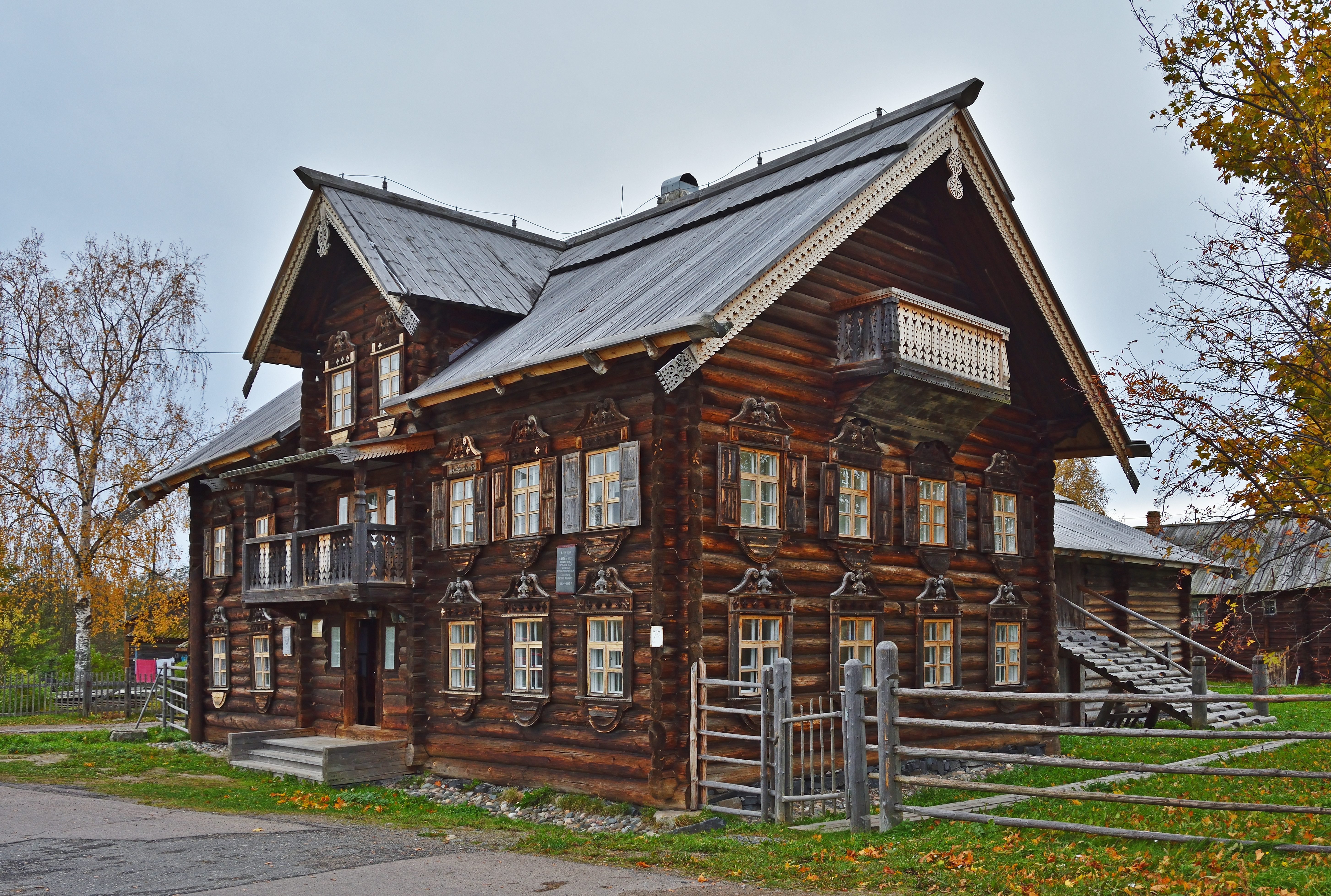
Lonin Museum of Veps Ethnography
Rjurik Lonin's wife started nagging about the artifacts. The attic was full. The wood shed was full. Even the living quarters were full of all kinds of things -- spinning wheels, woven textiles, carved utensils, tools from villages that were slowly emptying across the Republic of Karelia and Leningrad Oblast. Lonin, a sovkhoz worker born in 1930, had been collecting the material culture of the Veps people since 1964, and he had no intention of stopping. He just needed somewhere to put it all.
A People Between Languages
The Veps are a Finno-Ugric people whose language is related to Finnish, Estonian, and Karelian. Historically they lived in scattered villages across what is now the Republic of Karelia, Leningrad Oblast, and Vologda Oblast in northwestern Russia. By the twentieth century, their numbers were declining, their villages depopulating, and their language slipping out of daily use. When Lonin traveled through Veps settlements in 1964, encouraged by Nikolai Bogdanov, a researcher of the Veps language at the Karelian branch of the Soviet Academy of Sciences, he recognized that the physical objects of Veps life -- the tools, the textiles, the household implements that carried knowledge of how a culture worked -- were disappearing along with the people who made them. He began collecting with the urgency of someone who understood that what he did not save, no one else would.
Two Rooms Before the Revolution's Anniversary
For years, Lonin petitioned the Shyoltozero village soviet for museum space, and for years he was refused. The breakthrough came in 1967, just before the festivities marking the fiftieth anniversary of the October Revolution. The village council gave him two rooms in the library building, near the old House of Culture -- itself a repurposed church -- in the Dokuc' neighborhood. Yefrem Rybak, vice director of the Karelian Local Heritage Museum, traveled to Shyoltozero to inspect the project. He arrived skeptical. After meeting Lonin and seeing his collections, he decided to help. The museum opened on October 28, 1967, one week before the Revolution's anniversary. One room displayed Veps culture from before the Revolution; the other focused on contemporary village life. A separate stand honored the Veps people who fought in the Great Patriotic War.
The Stonemason's House
As the collection grew past three thousand artifacts, the museum was given a building in the Hamamattaz neighborhood. In 1980, the Karelian Ministry of Culture made it an official branch of the Karelian Local Heritage Museum, and Lonin became a full-time employee at last. The building itself carried its own history: it was built by Ivan Mel'kin, a stonemason renowned for his work with porphyry stone. According to Lonin, Mel'kin built the Red Bridge -- also known as the Theater Bridge -- that crosses the Griboyedov Canal in St. Petersburg, a bridge that was once known as Mel'kin Bridge. During World War II, one of the house's notable residents was Sylvi Paaso, a Finnish-born Soviet partisan and radio operator who relayed intelligence about Finnish troop movements along Lake Onega.
What Remains at Shyoltozero
Lonin died in 2009, and the museum was renamed in his honor the following year: the Rjurik Lonin Museum of Veps Ethnography in Shyoltozero. Today its collection numbers approximately six thousand artifacts, of which two thousand are on display. About four thousand visitors come each year to this village 84 kilometers south of Petrozavodsk -- a modest number, but remarkable for a museum in a settlement this small, dedicated to a people this few outsiders have heard of. The current director, Natal'ya Ankhimova, comes from the nearby village of Ogerisht. The museum stands as proof that cultural preservation does not require grand institutions or capital-city budgets. Sometimes it requires one determined person with an attic full of artifacts and a wife willing to tolerate the inconvenience.
From the Air
Located at 61.37N, 35.36E in the village of Shyoltozero on the western shore of Lake Onega in the Republic of Karelia. The village sits 84 km south of Petrozavodsk. Lake Onega, Europe's second-largest lake, dominates the landscape to the east. Nearest airport is Petrozavodsk (Besovets, ULPB), approximately 84 km north. At 3,000-5,000 feet, the lake's western shoreline and the small village are visible against the forested Karelian landscape.