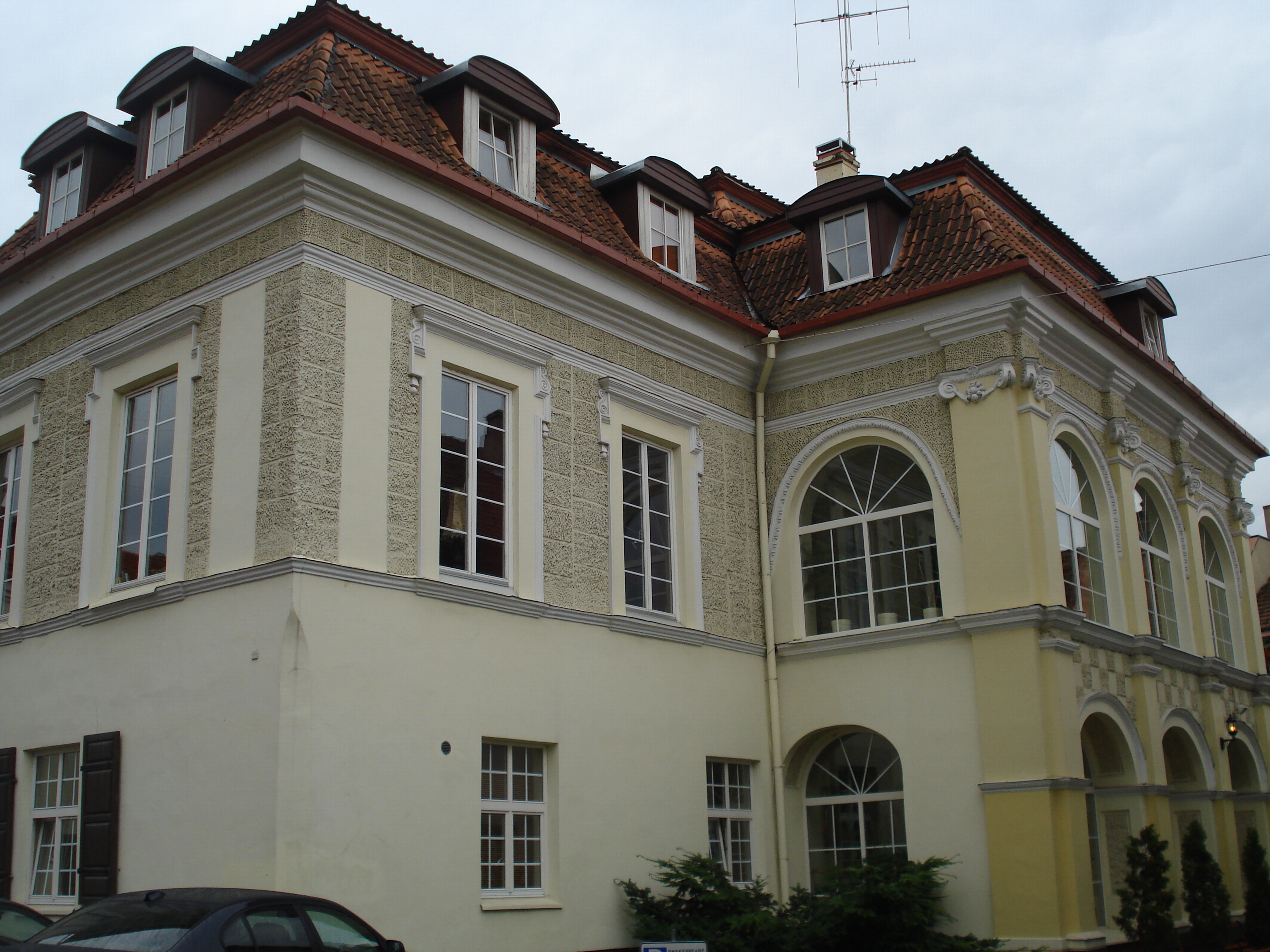
Lopacinskiai Palace (Bernardinų st.)
Walk Bernardinų Street in the Vilnius Old Town and you will pass a building whose facade follows the gentle curve of the road as if it had grown out of it. The high stepped roof, the way the wall bends to match the lane, the trapezoidal courtyard hidden behind the arch: all of it is the result of three hundred years of owners reshaping the same plot to suit their changing ambitions. There were Gothic walls here in the sixteenth century. There is a hotel here now, called Šekspyras, which is a literally translated tribute to Shakespeare. In between are Lithuanian treasurers, Polish counts, a bishop of Vilnius, a Masonic lodge, and a clandestine printing house, all leaving their fingerprints on the same brick.
The Quarrel That Made the Palace
In 1663, the Treasurer of the Grand Duchy of Lithuania, Gabrielius Kimbaras, went to court against a noblewoman named Sakavičienė, the wife of the Voivode of Smolensk, over the right to own this property near Bernardinų Street. The case dragged for years. By 1671, the original parties had died and their children were continuing the suit: Kimbaras's three daughters on one side, Sakavičienė's son Stanislovas Laudanskis, the Podstoli of Wenden, on the other. The records do not tell us who won. What the records do tell us is that by the start of the eighteenth century the palace was in the hands of a third family entirely, the Zenavičius. This is the texture of property in old Vilnius. Lawsuits inherited like jewelry, deeds passing through marriages and bankruptcies, the same walls outliving every owner who claimed them.
Glaubitz Rebuilds It
A fire in 1748 gutted what was there. In 1762, Mikołaj Tadeusz Łopaciński, the Elder of Mstsislaw Voivodeship and a Polish-Lithuanian nobleman whose name eventually got fixed to the building in two languages as Łopaciński and Lopacinskis, bought the ruins and hired the architect Johann Christoph Glaubitz to rebuild. Glaubitz was the right hire. He was the dominant late-Baroque architect of Vilnius, the man whose work transformed the spires and altars of the city, and what he produced for Łopaciński was a complex two-storey palace built around a trapezoidal plan and a semi-enclosed courtyard. The building has a deceptive shape because Glaubitz worked with what the medieval lot lines gave him rather than against them. By 1801, the palace had passed to the Kossakowski family. It had twenty-seven rooms. In 1808, when Bishop Jonas Nepomukas Kosakovskis of Vilnius took over, the building was reshaped once more, the facade pulled into the curve of the street and topped with a high stepped roof.
Counts, Masons, and a Hidden Press
Between 1819 and 1828, the palace belonged to the Count Olizaras family, and during these years the building is believed to have served as a meeting place for a Masonic lodge. Freemasonry in the Russian Empire was already approaching the ban that Tsar Alexander I would impose in 1822, which makes the Vilnius lodges of this period part of the late, semi-clandestine history of Lithuanian Masonry. The Olizars sold to the Zavadskis family, who brought a different kind of secret to the building. In 1857, books and printing equipment were stored in a separate garden building behind the palace, indicating that a printing house was operating on the premises. The Zavadskis were one of the great Vilnius publishing dynasties, and the implication is that part of their operation ran out of this courtyard.
From Soviet Publisher to Hotel
Between 1967 and 1975, the architect Aldona Svabauskienė oversaw a partial reconstruction that adapted the main building for use as a Soviet-era publishing house, an industry that operated inside the palace until 1985. Today the building is the Šekspyras hotel, a name almost too neat for a structure that has served, in three centuries, as a noble residence, a bishop's palace, a Masonic meeting hall, a printing works, and a state publisher. The trapezoidal courtyard is still there. The curving facade still follows Bernardinų Street. Most guests check in without realizing what they are sleeping inside.
From the Air
Lopacinskiai Palace stands at 54.68°N, 25.29°E in the Vilnius Old Town, on Bernardinų Street between St. Anne's Church and the Church of the Bernardines. The palace's curving stepped roof is visible from low overhead approaches; look for the trapezoidal courtyard hidden behind the street facade. The Vilnius Old Town is a UNESCO World Heritage Site, easily spotted from cruise altitude as a dense red-roofed cluster east of the Neris River. Nearest airport: Vilnius (EYVI) about 6 km south.