Lope National Park
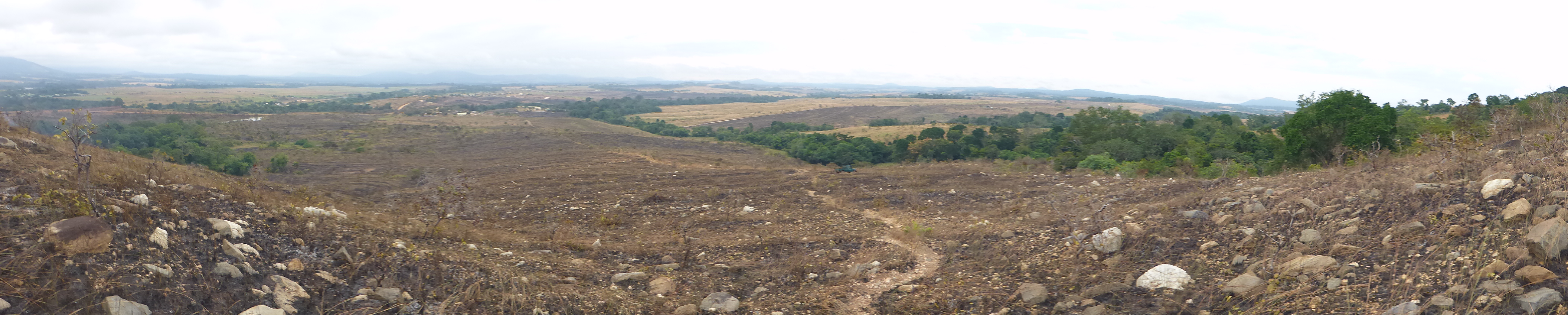
Fifteen thousand years ago, during the last ice age, grass savannas stretched across what is now central Gabon. The rainforest retreated. When the climate warmed and the trees returned, they did not reclaim everything. In the northern reaches of Lope National Park, those ancient savannas persist, hemmed in by dense tropical forest that has been slowly advancing for millennia. The result is a landscape unlike anything else in Central Africa: a mosaic of grassland and jungle where forest elephants gather at densities among the highest on Earth, where Bantu peoples left stone axes and pottery on hilltops three thousand years ago, and where the boundary between two ecosystems is still visibly, actively shifting.
Where the Ice Age Still Shows
Lope National Park covers 4,912 square kilometers in central Gabon, bordered by the Ogooue River to the north and the Chaillu Massif to the south. Its defining feature is the ecological tension between its two landscapes. The northern savannas are relics of the last glacial period, the last remnants of grass ecosystems that once dominated Central Africa. Since the ice age ended, the surrounding monsoon forest has been expanding into these open spaces, gradually swallowing them. The transition zone, or ecotone, between forest and savanna is one of the most dynamic ecological boundaries on the continent. Climate change is accelerating the forest's advance, threatening to eliminate the savanna entirely. Park managers now conduct annual controlled burns to slow the encroachment, preserving habitat diversity and maintaining the grasslands that forest buffalo depend on for their diet.
Four Hundred Millennia of Footprints
Evidence of human presence at Lope stretches back nearly 400,000 years, making it one of the longest records of continuous habitation in equatorial Africa. The most substantial archaeological traces come from the Neolithic period, between 3,500 and 2,000 years ago, when Bantu peoples may have passed through the Ogooue valley during the great Bantu expansion that reshaped sub-Saharan Africa. They left behind polished stone axes and pottery on hilltops, along with large rubbish pits that archaeologists have used to reconstruct the outlines of small villages. Ancient rock engravings dot the landscape along the river. This layering of human and natural history earned Lope its UNESCO World Heritage designation as the Ecosystem and Relict Cultural Landscape of Lope-Okanda, recognized for both its ecological and archaeological significance.
A Kingdom of Primates and Pangolins
The park's complex mosaic of habitats supports extraordinary biodiversity. Over 1,550 plant species have been recorded, with large portions of the park still unexplored. Lope contains one of the world's largest concentrations of wild primates, with more than 1,000 individuals, and is the only protected area with a significant population of the sun-tailed monkey, a species found nowhere else on Earth in comparable numbers. Forest elephants in the northern sector reach seasonal densities of 1.5 per square kilometer, among the highest recorded anywhere. Leopards hunt red river hogs, African forest buffalo, and cane rats through the understory. Endangered giant pangolins and tree pangolins share underground burrows with microbats in an arrangement that researchers documented with some astonishment. Even the land snails are diverse: a single survey turned up 74 species from 12 families.
Mikongo and the Edge of the Forest
Tourism infrastructure at Lope is modest but deliberate. The Mikongo research station, operated by the Zoological Society of London, sits in the village of the same name and offers several chalets and an open-air dining room where the rainforest begins just five meters away. The park also hosts the CEDAMM Training Centre, run by the Wildlife Conservation Society as an international conservation education center. BirdLife International has designated Lope an Important Bird Area for its significant populations of forest-dependent species. Reaching the park requires commitment: the Trans-Gabon Railway passes near its northern edge, and rough roads connect it to Libreville, but this is not a place designed for casual visitors. Those who make the journey find themselves at the boundary of two worlds, where savanna light gives way to forest shadow and the deep past surfaces in stone tools scattered across the hilltops.
From the Air
Located at approximately 0.53S, 11.54E in central Gabon. The park covers 4,912 square kilometers bordered by the Ogooue River to the north and the Chaillu Massif to the south. From altitude, the distinctive savanna-forest mosaic is clearly visible, with open grasslands in the north transitioning to dense tropical canopy. The Ogooue River is a prominent navigation landmark. Nearest airport is Libreville's Leon Mba International (FOOL), approximately 250 km to the northwest. The Trans-Gabon Railway passes near the park's northern boundary. Expect tropical weather with frequent cloud cover.