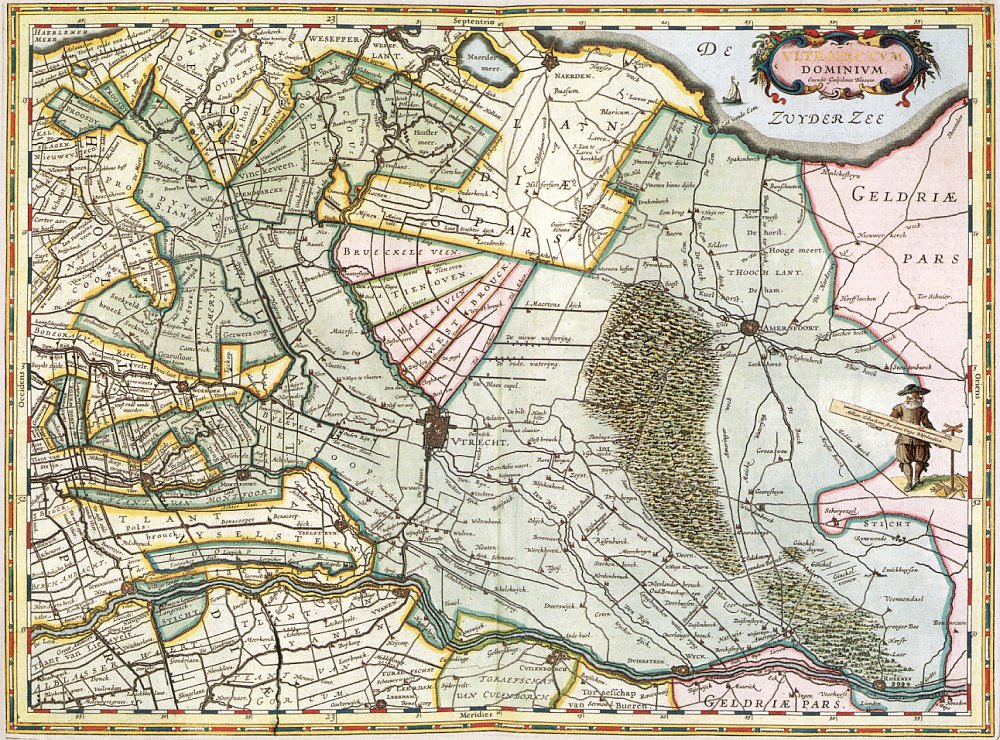
Lordship of Utrecht
On October 20, 1528, Bishop Henry of the Palatinate handed his sword, his ring, and seven hundred years of accumulated worldly authority to a foreign emperor. The bishops of Utrecht had ruled this corner of the Low Countries as temporal princes since the Saxon and Franconian emperors began granting them immunities in the early medieval period. They had collected taxes, raised armies, judged criminals, and minted coin. And then, in the space of an afternoon, they were just bishops again - and not even that for long, because the territory they had governed was about to become something the Holy Roman Empire had never quite seen before.
The Bishop Who Asked for Rescue
Henry of the Palatinate had a problem common to medieval prince-bishops: he was a churchman with a country to defend, and the Duchy of Guelders had been chewing on his borders since 1521. By the late 1520s, Guelders forces effectively occupied much of the bishopric. Henry, who also held sees in Freising and Worms, did what desperate rulers had always done in the Empire - he called on a more powerful neighbor. Charles V of Habsburg, Holy Roman Emperor and master of Spain, the Netherlands, and most of central Europe, sent in his commander Georg Schenck van Toutenburg. Habsburg troops liberated Utrecht from the Duke of Guelders. The price for that rescue was the bishopric itself.
From Crozier to Crown
What replaced the prince-bishopric was the Lordship of Utrecht, a secular polity ruled by a Habsburg stadtholder rather than a mitred prince. The old territory was carved in two: Utrecht went west, Overijssel went east. For more than half a century, the same man served as stadtholder of both Utrecht and the County of Holland, knitting the new lordship into the Burgundian network that the Habsburgs had inherited through marriage and inheritance. The Pragmatic Sanction of 1549 formally bundled Utrecht into the Burgundian Circle of the Empire, making it one of the Seventeen Provinces - the patchwork of duchies, counties, and lordships that we now call the Low Countries. On paper, it looked like consolidation. In practice, it planted a fuse.
The Revolt That Followed
Charles V's son Philip II inherited the Netherlands in 1555 and tried to govern them as Spanish provinces - heavy taxation, religious orthodoxy, foreign troops. Utrecht's reaction was immediate and historic. When the northern provinces began their revolt against Spanish rule, Utrecht was at the very center. In 1579, representatives from the rebellious provinces gathered in the chapter house attached to St. Martin's Cathedral and signed the Union of Utrecht, the military and political pact that became the founding document of the Dutch Republic. A bishopric that had been swapped for a lordship just fifty years earlier was now the cradle of an independent Protestant state. The Habsburgs had bought Utrecht in 1528; by 1581 they had effectively lost it.
Funeral for an Archdiocese
The religious turn was sharper than the political one. In 1559, in a last burst of Catholic reorganization, Pope Paul IV had elevated Utrecht to an archdiocese with six suffragan sees - Haarlem, Bois-le-Duc, Middleburg, Deventer, Leeuwarden, Groningen. Twenty-one years later, on August 25, 1580, the first archbishop, Frederik Schenck van Toutenburg, was dead, his funeral held inside the Dom Cathedral the Calvinists had already seized. Catholic mourners chanting De Profundis were heckled by a Protestant crowd who broke up the Requiem. It was, by long tradition, the last public Catholic worship in the city for roughly three hundred years. The two bishops Spain tried to appoint after Schenck never set foot in the diocese. The States-General would not allow it.
An Underground Church
Catholicism did not vanish - much of the Dutch population remained Catholic - but it went underground, administered by apostolic vicars who were usually exiled to Cologne or Brussels and worked through clandestine churches called schuilkerken. One of those vicars, Petrus Codde, was suspended in 1702 by Pope Clement XI for leaning toward Jansenism. The Utrecht chapter refused to accept Rome's verdict and in 1723 elected its own archbishop, Cornelius Steenhoven, who was promptly excommunicated. That excommunication accidentally founded a denomination: the Old Catholic Church, which still has its seat in Utrecht today. Roman Catholic hierarchy was only restored to the Netherlands in 1853 by the bull Ex qua die arcano. The lordship that began with a bishop surrendering his crozier ended up producing two separate Catholic churches, both still standing.
From the Air
Centered over Utrecht at 52.09 N, 5.12 E, the historic core of the former Lordship. Cruise altitude offers a clear view of the city's medieval street grid radiating from the Dom Tower. Nearest major airport is Amsterdam Schiphol (EHAM), about 35 km west. Rotterdam The Hague (EHRD) lies southwest. The flat Dutch landscape makes the Dom Tower a useful visual landmark in clear weather.