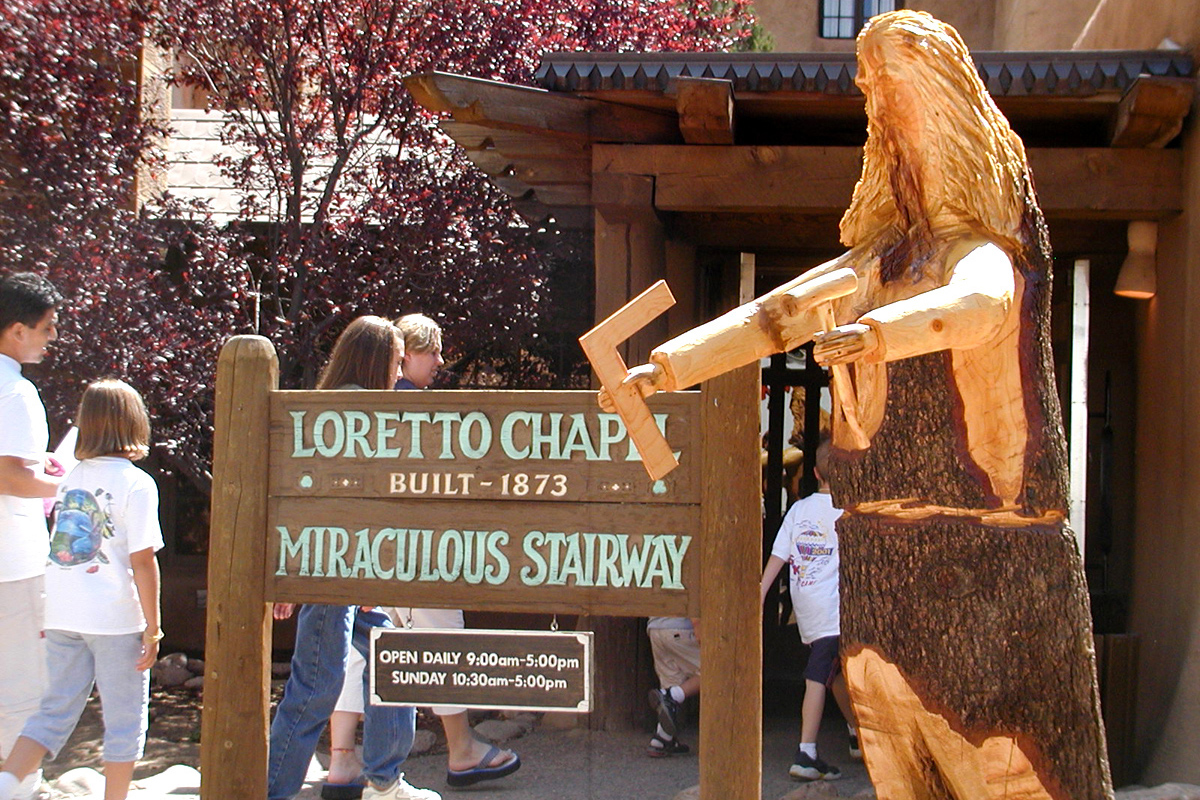
Loretto Chapel
The nuns prayed for nine days. According to the Sisters of Loretto, they had a problem no carpenter could solve: their new chapel needed a staircase to the choir loft, but the space was so cramped that conventional designs would not fit. On the last day of their novena to Saint Joseph, patron saint of carpenters, a stranger appeared at the door with a donkey and a toolbox. He worked alone for months, built something no one had seen before, and vanished without collecting his pay. The staircase he left behind has been drawing visitors to this small chapel on Old Santa Fe Trail for nearly 150 years.
A Little Sainte-Chapelle in the Desert
The Loretto Chapel began as a practical necessity. In 1873, the Sisters of Loretto needed a proper chapel for their girls' academy in Santa Fe. Archbishop Jean-Baptiste Lamy, who had brought French architects Antoine and Projectus Mouly to New Mexico for the Cathedral project, suggested the younger Mouly could design it. Projectus based his plans on the Sainte-Chapelle in Paris, scaling down its Gothic Revival elements -- pointed arches, buttresses, spires -- to fit the American Southwest. Stained glass windows were imported from France and hauled overland along the Santa Fe Trail. The chapel was built from locally quarried sandstone and consecrated in 1878 after five years of construction. It was a jewel of European Gothic set incongruously among adobe walls.
The Helix That Defies Expectation
The staircase makes two complete 360-degree turns as it rises to the choir loft, all without a central pole or newel post. It contains 33 stairs -- a number some have noted matches the traditional age of Christ at the crucifixion. The structure is assembled entirely from wood, held together with wooden pegs rather than nails, glue, or metal hardware. The inner stringer consists of seven joined segments; the outer has nine. The wood has been identified as a species of spruce not native to New Mexico. Handrails were added in 1887, and an iron bracket was later attached for additional support, but the original construction remains a feat that impresses professional carpenters to this day. As one master carpenter told the Washington Post: 'To create a staircase like this using modern tools would be a feat.'
The Mystery Builder
The Sisters attributed the staircase to divine intervention, believing Saint Joseph himself had answered their prayers. The mystery of the builder's identity endured for over a century and became one of Santa Fe's most popular legends. In the late 1990s, researcher Mary Jean Cook proposed that the builder was Francois-Jean Rochas, a French woodworker known in Santa Fe as an expert craftsman. Cook found an entry in the Sisters' logbook recording a payment of $150 to 'Mr. Rochas' for 'wood' in 1881. At the time of his death, Rochas owned an extensive collection of specialized carpentry tools, including trammel points for drawing large circles -- exactly the kind of instrument needed to lay out a helical stringer. The identification remains debated, but it shifted the story from miracle to remarkable human craftsmanship.
From Convent to Curiosity
Loretto Academy operated from 1853 until 1968, and the chapel served its students and nuns daily for nearly a century. When the school closed, the rest of the academy campus was demolished, but the chapel survived as a privately owned museum and wedding venue. The staircase's fame grew through television and literature: Unsolved Mysteries featured it in 1990, a television film starring Barbara Hershey followed in 1998, and it has appeared in shows from The UnXplained to Dark Winds. Today the chapel sits quietly on a side street just blocks from the Santa Fe Plaza, a Gothic anomaly amid the city's mandated adobe aesthetic. Visitors pay a small admission fee to stand beneath the spiraling wood and decide for themselves whether they are looking at a miracle or simply one of the finest pieces of carpentry ever assembled by human hands.
From the Air
Loretto Chapel is located at 35.686N, 105.938W in downtown Santa Fe, just south of the Plaza. The small Gothic structure is not individually visible from cruise altitude but sits within the easily identifiable downtown historic district. Santa Fe Regional Airport (KSAF) is approximately 10 miles southwest. Best viewed by approaching the city from the south along the I-25 corridor at lower altitudes where Santa Fe's compact historic core becomes distinguishable.