Los Alamos: The Secret City That Changed the World
Every address was the same: P.O. Box 1663, Santa Fe, New Mexico. During World War II, the town of Los Alamos did not officially exist. Carved from a boys' ranch school on a remote mesa in the Jemez Mountains, it was the secret heart of the Manhattan Project, where J. Robert Oppenheimer assembled the greatest concentration of scientific talent the world had ever seen. Nobel laureates, refugee physicists, and young mathematicians lived behind fences and security checkpoints, racing to split the atom before Nazi Germany could. They succeeded. The bombs they built ended the war and began the atomic age. Eight decades later, Los Alamos still sits on its mesa, still home to the national laboratory, still defined by the extraordinary thing that happened here.
The Hill
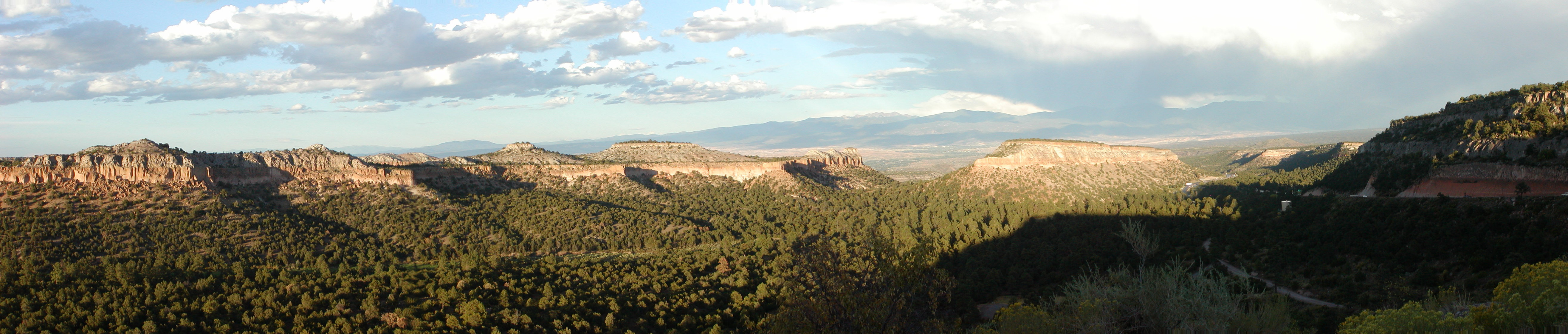
General Leslie Groves chose the site in 1942 for its isolation. The Los Alamos Ranch School, a boarding school for boys on the Pajarito Plateau at 7,300 feet, offered existing buildings, mountain water, and remoteness from prying eyes. The school's last class graduated in early 1943; within weeks, physicists were moving in. Oppenheimer, who knew the area from horseback rides through the Sangre de Cristo Mountains, had suggested it. The mesa provided natural security: deep canyons on three sides and a single access road. Scientists arrived through a nondescript office at 109 East Palace Avenue in Santa Fe, where Dorothy McKibbin handed them directions to a place that appeared on no map.
Nobel Prizes and Nuclear Secrets
The roster of Manhattan Project scientists at Los Alamos reads like a who's who of twentieth-century physics. Oppenheimer directed. Enrico Fermi consulted. Edward Teller pushed for the hydrogen bomb. Stanislaw Ulam solved the mathematics. Edwin McMillan won the 1951 Nobel Prize in Chemistry. Emilio Segre took the 1959 Nobel in Physics. Frederick Reines earned the 1995 Nobel for detecting the neutrino. Klaus Fuchs spied for the Soviet Union. Louis Slotin died of radiation poisoning in 1946 during a criticality experiment. John von Neumann visited regularly. The concentration of genius was staggering, and many of these scientists stayed, making Los Alamos their permanent home.
Life on the Mesa Today
Los Alamos remains a company town. Los Alamos National Laboratory is the dominant employer, and the community reflects it: the median household income is 8,458, and per capita income is 4,067, both dramatically higher than the New Mexico average. Only 6.6% of residents live below the poverty line, one-third the state rate. The population skews heavily toward scientists and engineers. The town's 93.3% high school graduation rate towers over New Mexico's 76.9%. A future president of Croatia, Kolinda Grabar-Kitarovic, graduated from Los Alamos High School in 1986. The former CEO of Starbucks, Kevin Johnson, graduated in 1978. Author Judy Blume lived here from 1975 to 1978 and set her novel Tiger Eyes in the town.
Canyons, Mesas, and Pajarito Mountain
The geography that made Los Alamos ideal for secrecy also makes it remarkable for recreation. The town sits on narrow mesas separated by deep canyons, with trails threading through ponderosa pine forests into the Jemez Mountains. The community-owned Pajarito Mountain Ski Area operates on 10,440-foot Pajarito Mountain. Los Alamos Canyon holds New Mexico's only refrigerated outdoor ice skating rink, an NHL-regulation surface shaded by canyon walls, in operation since the Ranch School days. The Valles Caldera National Preserve, a vast volcanic caldera, lies to the west. Bandelier National Monument, with its ancient Ancestral Pueblo cliff dwellings, borders the town to the south.
Sister City: Sarov
In a twist that captures the strange symmetry of the nuclear age, Los Alamos maintains sister city status with Sarov, Russia. Sarov was the Soviet Union's equivalent of Los Alamos, the closed city where Soviet scientists developed their own nuclear weapons. The two secret cities, once pointed at each other's destruction, now exchange cultural delegations. Los Alamos also hosts one of ten dishes of the Very Long Baseline Array radio telescope, a continent-spanning instrument that peers into deep space. The town that built humanity's most destructive weapon now helps map the universe. In 2015, the Manhattan Project National Historical Park was established here, alongside units in Hanford, Washington and Oak Ridge, Tennessee, preserving the places where the atomic age began.
From the Air
Located at 35.89N, 106.26W on the Pajarito Plateau in the Jemez Mountains of northern New Mexico at approximately 7,300 feet elevation. The town's distinctive mesa-and-canyon geography is clearly visible from altitude, with narrow finger mesas separated by deep forested canyons. Los Alamos County Airport (KLAM) is on the eastern edge, serving small private aircraft. Santa Fe Regional Airport (KSAF) is a 43-mile drive south. Albuquerque International Sunport (KABQ) is 100 miles south. The Valles Caldera, a massive volcanic caldera, is visible to the west. Bandelier National Monument lies to the south.