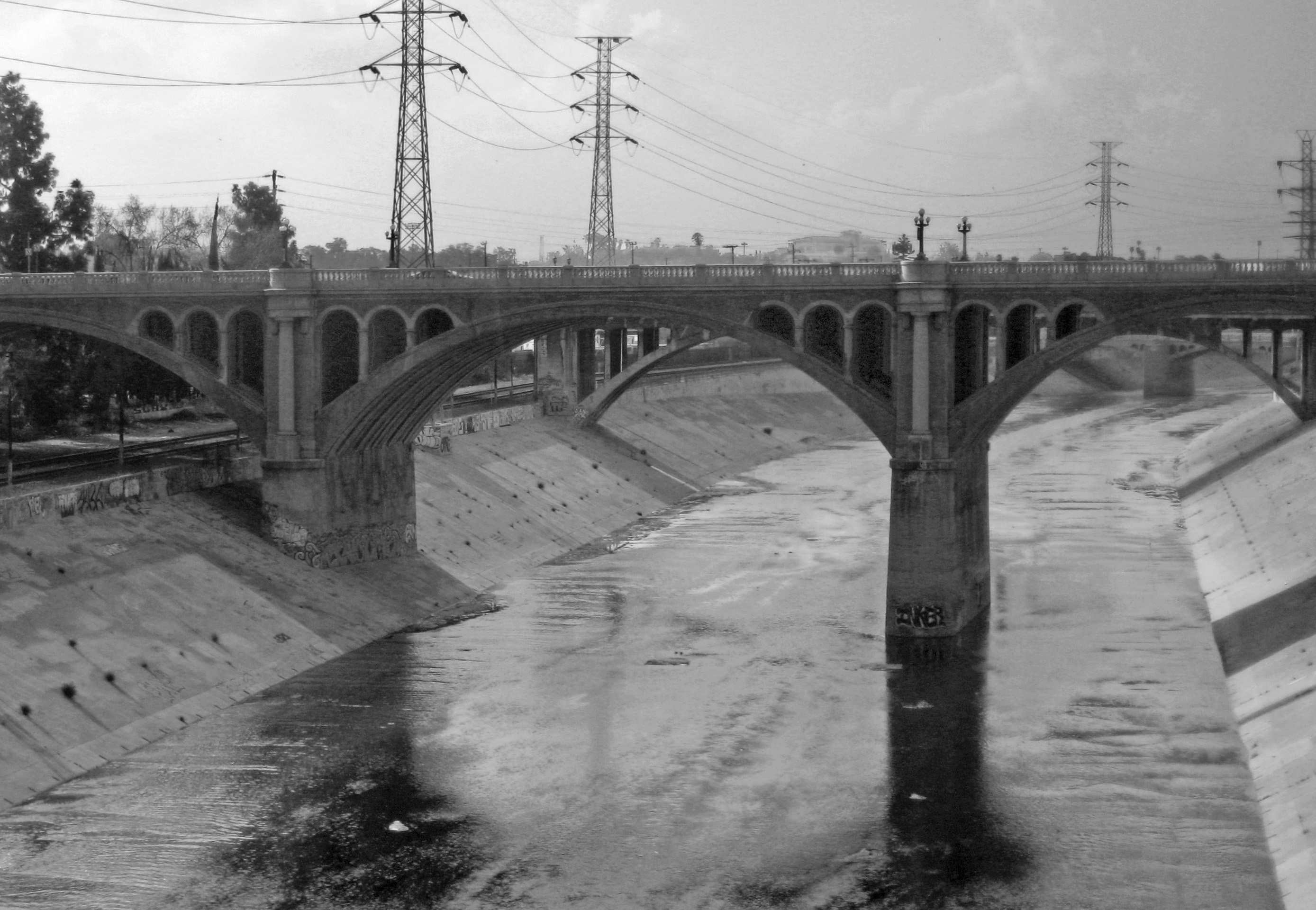
Los Angeles River
There is a scene in the 1991 film Terminator 2 that almost everyone who has seen it remembers: a motorcycle racing through a wide concrete channel, water trickling down the center, the walls rising sheer on either side. The setting is the Los Angeles River. Most viewers who grew up outside Southern California assumed it was a fictional setting — a movie construction, too strange to be real. It is entirely real, and it runs for 51 miles through the heart of the second-largest city in the United States.
Before the Concrete
The Tongva people, who lived in the Los Angeles basin for thousands of years before European arrival, called the river Paayme Paxaayt. Spanish missionaries encountered it on August 15, 1769, when Fray Juan Crespi's expedition camped along its banks and named it Nuestra Señora la Reina de los Ãngeles de la Porciúncula — a name that passed, shortened, to the city that grew there.
Before the twentieth century, the Los Angeles River behaved like a river. It flooded seasonally, shifting its channel across the alluvial plain, its banks lined with willow and cottonwood, its waters supporting steelhead trout and the Pasadena Freshwater Shrimp, species adapted to its rhythms over geological time. The river was the reason the pueblo was founded where it was: water in an arid landscape. It was also, periodically, a catastrophe.
The Floods and the Concrete Solution
Catastrophic floods struck Los Angeles repeatedly in the late nineteenth and early twentieth centuries. The storms of 1938 were the worst in living memory — damage was severe enough to finally compel action. The Army Corps of Engineers undertook the channelization of the Los Angeles River, encasing most of its 51-mile length in concrete and transforming it from a natural watercourse into what engineers called a flood-control channel.
The project was completed by 1960 and accomplished its stated purpose: the river has not produced catastrophic flooding since. It also accomplished something that was not in the project description: it killed the river as a living system. By 1940, before the project was even complete, the last native steelhead trout had disappeared from the channel. The Pasadena Freshwater Shrimp, found nowhere else on earth, went extinct. The riparian habitat that had supported both wildlife and the human communities along its banks was replaced by a drainage ditch.
The River in Film
The concrete channel created something the engineers had not intended: a visual environment unlike anything else in the American landscape. Filmmakers discovered it. The Los Angeles River has appeared in Them! (1954), Grease (1978), Chinatown (1974), Terminator 2 (1991), Drive (2011), and dozens of other productions. Its industrial bleakness, its unexpected scale, its quality of being an impossible thing in a city — a river without water, a channel without current — made it irresistible to cinematographers looking for locations that communicated alienation or speed or the uncanny.
Chinatown used it as the climactic location for its investigation of water rights corruption — the river as a symbol of the lies embedded in Los Angeles's relationship with water, which is perhaps the most accurate metaphor the film could have chosen.
The Restoration Effort
Around the turn of the twenty-first century, a movement to restore the Los Angeles River began gathering momentum. The argument was ecological, cultural, and urban: the channel could be transformed into a linear park, an accessible greenway threading through the city, a habitat for native species, a public space for a city that lacked them.
The Los Angeles River Revitalization Master Plan, adopted in 2007 and updated in 2020, laid out a framework for this transformation. The Army Corps of Engineers approved restoration planning for an 11-mile soft-bottom stretch through the Glendale Narrows. Segments of the river have been replanted with native vegetation. Birds have returned to portions of the channel. The scale of the ambition — restoring ecological function to a concrete channel running through one of the world's densest urban environments — has no real precedent in American history. Whether it succeeds will define what kind of city Los Angeles chooses to become.
From the Air
The Los Angeles River runs 51 miles from its headwaters in the Simi Hills northwest of the San Fernando Valley to its mouth at Long Beach Harbor on San Pedro Bay. The concrete channel is visible from the air as a gray ribbon threading through the urban grid, often catching light in a way that makes it distinctive from surrounding streets. Los Angeles International Airport (KLAX) lies near the river's southern reach. The Glendale Narrows, where the river bottom remains unpaved and the most visible restoration work has occurred, sits approximately 8 miles northeast of downtown.