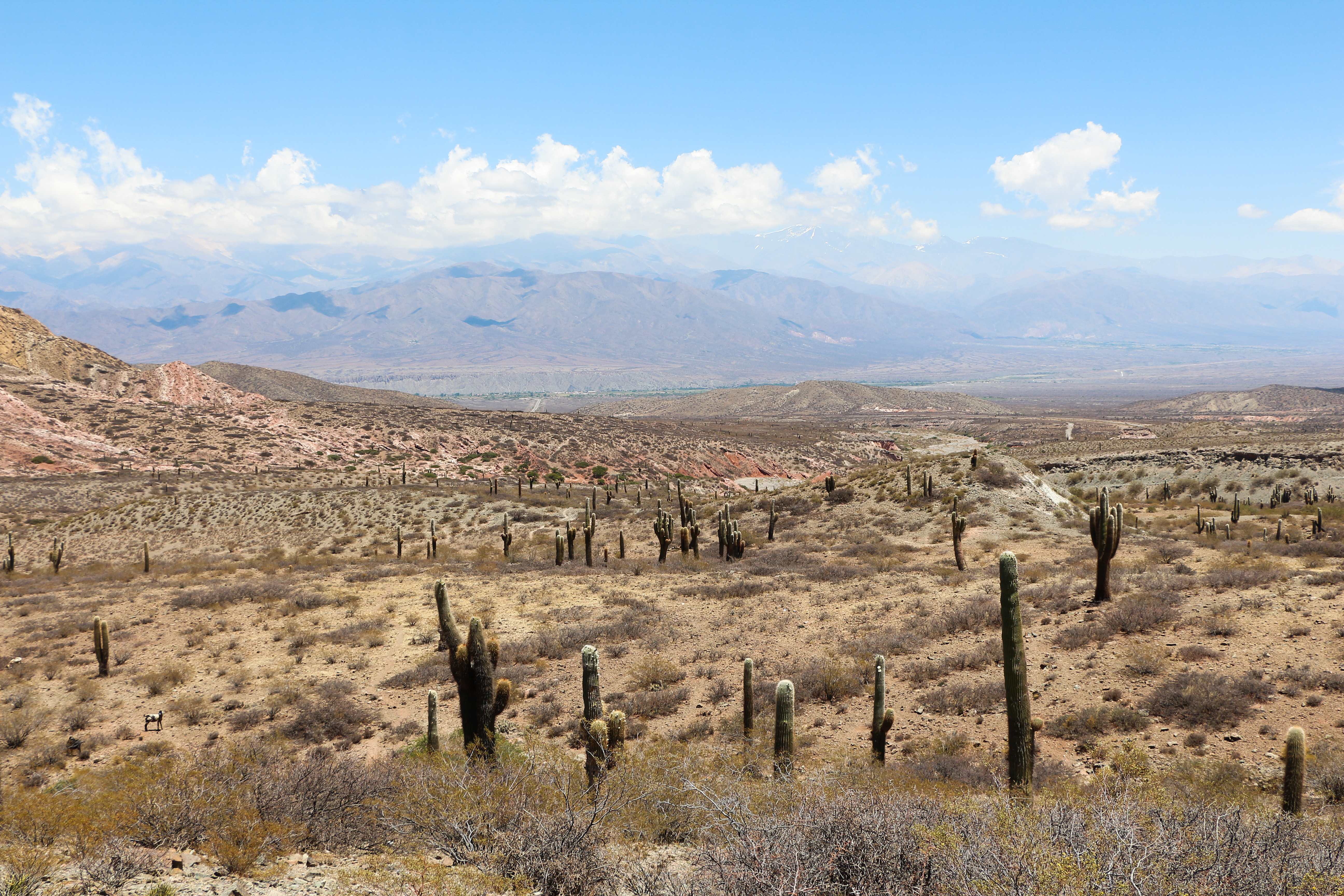
Los Cardones National Park
They stand like sentinels across the high desert, arms raised toward a sky so blue it looks artificial. The cardon grande -- Argentina's answer to the saguaro -- grows slowly, sometimes taking two centuries to reach full height, and the 65,000 hectares of Los Cardones National Park protect tens of thousands of them. But these cacti are not the oldest residents. Embedded in the dry, fractured rock beneath their roots lie dinosaur fossils, preserved by the same arid climate that makes this landscape feel suspended outside of time. Created in 1996 when the Argentine government purchased the land from private owners, the park guards a stretch of the Andean northwest where altitude, aridity, and deep geological history converge.
A Landscape Between Earth and Sky
The park rises from 2,700 meters through a terrain of valleys, ravines, and sierras until it reaches the peak of Cerro Malcante at 5,070 meters. At these elevations, the air is thin and the light is sharp, cutting clean edges on every ridge and canyon wall. Some areas reflect classic Andean highland terrain -- sparse, windswept, and mineral-toned -- while lower zones harbor small streams and scrubby vegetation clinging to seasonal moisture. The massive granite formation known as Piedra del Molino stands at 3,600 meters, offering panoramic views that stretch across the park's full expanse. From the top, the cardon cacti below look like pins stuck in a relief map, their spacing so even it seems deliberate.
Life in a Dry Kingdom
More than 100 bird species inhabit the park, including the Andean condor, whose wingspan can exceed three meters. Watch the thermals above the ridgelines long enough and you will see one riding the updrafts, banking with an economy of motion that makes powered flight look wasteful. On the ground, the park belongs to the guanaco. Herds of these wild camelids -- relatives of the domesticated llama and alpaca, along with the rarer vicuna -- roam the valleys and hillsides, their tawny coats blending into the desert palette. Gray foxes slip through the scrub. Chinchillas and armadillos keep to the shadows. Snakes and lizards warm themselves on exposed rock, motionless until you are close enough to startle them.
Bones in the Stone
What makes Los Cardones unusual among Argentina's national parks is what lies beneath the surface. The park's dry climate has preserved prehistoric fossils with remarkable clarity, and paleontologists have found dinosaur remains embedded in rock formations that date back tens of millions of years. The same aridity that makes the landscape feel harsh and empty is precisely what kept these remnants intact -- no humidity to accelerate decay, no heavy vegetation to disrupt sediment layers. For visitors, the fossils are a reminder that this seemingly unchanging desert has in fact seen radical transformation, from lush prehistoric environments to the high, dry plateau it is today.
Walking the Enchanted Valley
The park offers only a handful of marked trails, and most exploration requires hiring a local guide from nearby towns. The so-called Secret Trail is almost comically short, but the Enchanted Valley Trail rewards the effort of its 8-kilometer length and 173 meters of elevation gain. This route passes through the park's more verdant zones, where wildflowers appear in season and a wider variety of wildlife gathers near the water. The contrast is striking -- in the span of a morning's hike, the landscape shifts from bare, cactus-studded desert to pockets of green that feel borrowed from another climate entirely. The park gates open daily from 9:30 to 18:00, and the nearest city of any size is Salta, about 125 kilometers to the north via RN-68 and RP-33.
From the Air
Located at 25.13S, 66.18W in the Andean northwest of Argentina, at elevations between 2,700 and 5,070 meters. The park's vast cactus forests are visible from altitude as a textured beige-green carpet across the mountainous terrain. Cerro Malcante (5,070 m) is the most prominent peak. The nearest major airport is Salta (SASA / Martin Miguel de Guemes International), approximately 125 km to the north. The park lies along Provincial Route 33 between Cachi and the Quebrada de Escoipe. Clear, dry conditions are typical, though altitude-related turbulence can occur near the higher peaks.