Los Tres Ojos National Park
The earth opened, and water filled the wound. Sometime in the geological past, tectonic fractures collapsed a limestone cave system on the eastern edge of what is now Santo Domingo, carving a bowl-shaped depression that gradually flooded with water fed by an underground river. The result is Los Tres Ojos - the Three Eyes - a series of lagoons hidden below ground level inside an open-air cave, each pool a different color depending on its depth and mineral composition. The Taino people, Hispaniola's first inhabitants, used this subterranean world for religious rituals and fertility rites long before any European ship appeared on the horizon. Today, 346 steps connect the four lagoons, and the descent from the park entrance into the cave feels less like entering a tourist attraction and more like dropping into a secret the island has been keeping for centuries.
The Colors Below
Each lagoon has its own character. Lago de Azufre, the first one visitors encounter, was discovered in 1916 and named for what early explorers assumed was sulfurous water - the intense blue hue seemed to demand a chemical explanation. Testing later revealed the color comes from calcium minerals, not sulfur, but the name stuck. La Nevera, the second lagoon, runs cooler than its neighbors. El Lago de las Damas, the shallowest at roughly 8 feet, reflects light differently depending on the hour, shifting between green and yellow as the sun moves overhead. The varying depths across the system create a palette that changes throughout the day: blue in one pool, green in the next, gold in the third. Stalactites hang from the cave ceiling above, and stalagmites rise from the edges, formations built over millennia by water that is still at work shaping this place.
The Fourth Eye
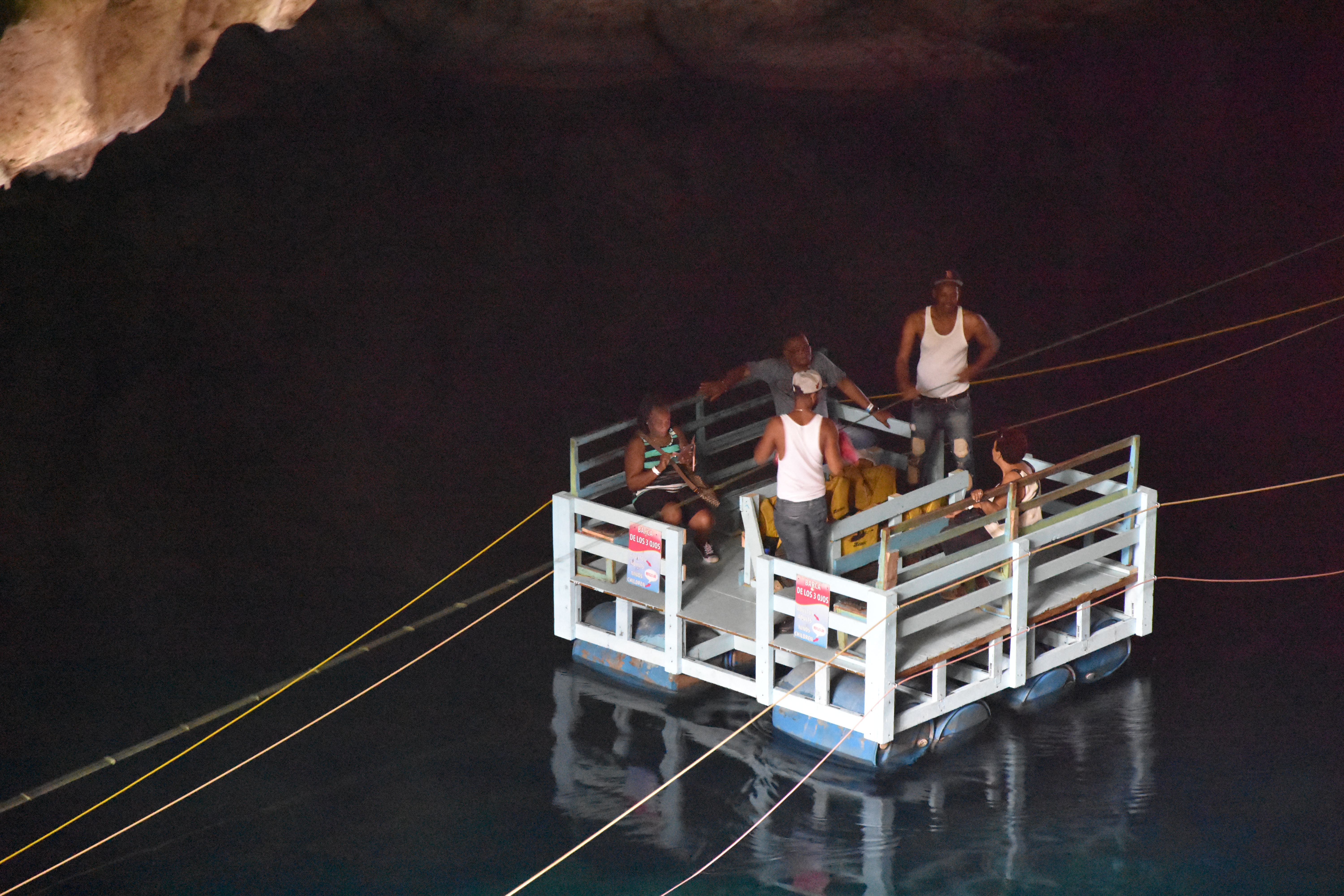
Strictly speaking, Los Tres Ojos has four lagoons, not three. The deepest, Los Zaramagullones, reaches 25 feet and sits beyond La Nevera, accessible only by a small ferry raft pulled across the water on a rope. Because it has an opening to the outside - sunlight pouring in where the cave roof gave way - it is not counted among the three true "eyes." That technicality has not dimmed its reputation. Los Zaramagullones is widely considered the most tranquil and beautiful of the four, a freshwater pool stocked with fish since the 1940s where turtles glide through water so clear the bottom is visible. Film crews have used this lagoon as a backdrop for movies including Jurassic Park III and Tarzan, drawn by the combination of tropical vegetation, dramatic rock walls, and the kind of light that looks cinematic without any help from a lighting rig.
A Sacred Descent
For the Taino, this was not a curiosity but a cathedral. The collapsed cave, with its hidden pools and echoing chambers, served as a site for religious ceremonies. Fertility rites took place here, rituals tied to the water and the earth and whatever spiritual forces the Taino believed inhabited the space between them. The cave's acoustics amplify small sounds - dripping water, the rustle of bats - and muffle the world above. Standing at the bottom of the staircase carved into the rock, surrounded by limestone walls that rise dozens of feet on every side, it is easy to understand why this place felt sacred. The Taino were the first people of Hispaniola, and their relationship with the island's landscape was intimate in ways that later arrivals rarely matched. Los Tres Ojos was a temple built by geology and claimed by faith.
Between the City and the Underworld
What makes Los Tres Ojos remarkable beyond its beauty is its location. This is not a remote cave system deep in the countryside. It sits inside Mirador del Este park, within the municipality of Santo Domingo Este, surrounded by the sprawl of the Dominican Republic's capital. Visitors descend from a modern park into a world that feels prehistoric - bats circling overhead, fish breaking the surface of underground pools, tropical vegetation crowding every horizontal surface. The temperature of the lagoons ranges from 20 to 29 degrees Celsius depending on the pool, and the cave stays cool even when the Caribbean sun punishes the city above. The park is open from 9 a.m. to 5 p.m., and at night, colored lights illuminate the formations. It is one of the country's most popular tourist attractions, drawing visitors who arrive expecting a cave and discover something closer to a hidden ecosystem, a place where the surface world drops away and the island reveals what it looks like from the inside.
From the Air
Located at 18.481°N, 69.844°W in Santo Domingo Este, Dominican Republic. The park is within the larger Mirador del Este park on the eastern bank of the Ozama River. From altitude, the cave system is not visible - it is concealed beneath the tree canopy of the park grounds - but the green expanse of Mirador del Este is distinguishable from the surrounding urban development. Best viewed at 2,000-4,000 feet AGL. Nearest major airport is Las Americas International Airport (MDSD/SDQ), approximately 15 km east. Santo Domingo's La Isabela International Airport (MDJB/JBQ) is roughly 20 km northwest. Tropical maritime climate with warm, humid conditions year-round.