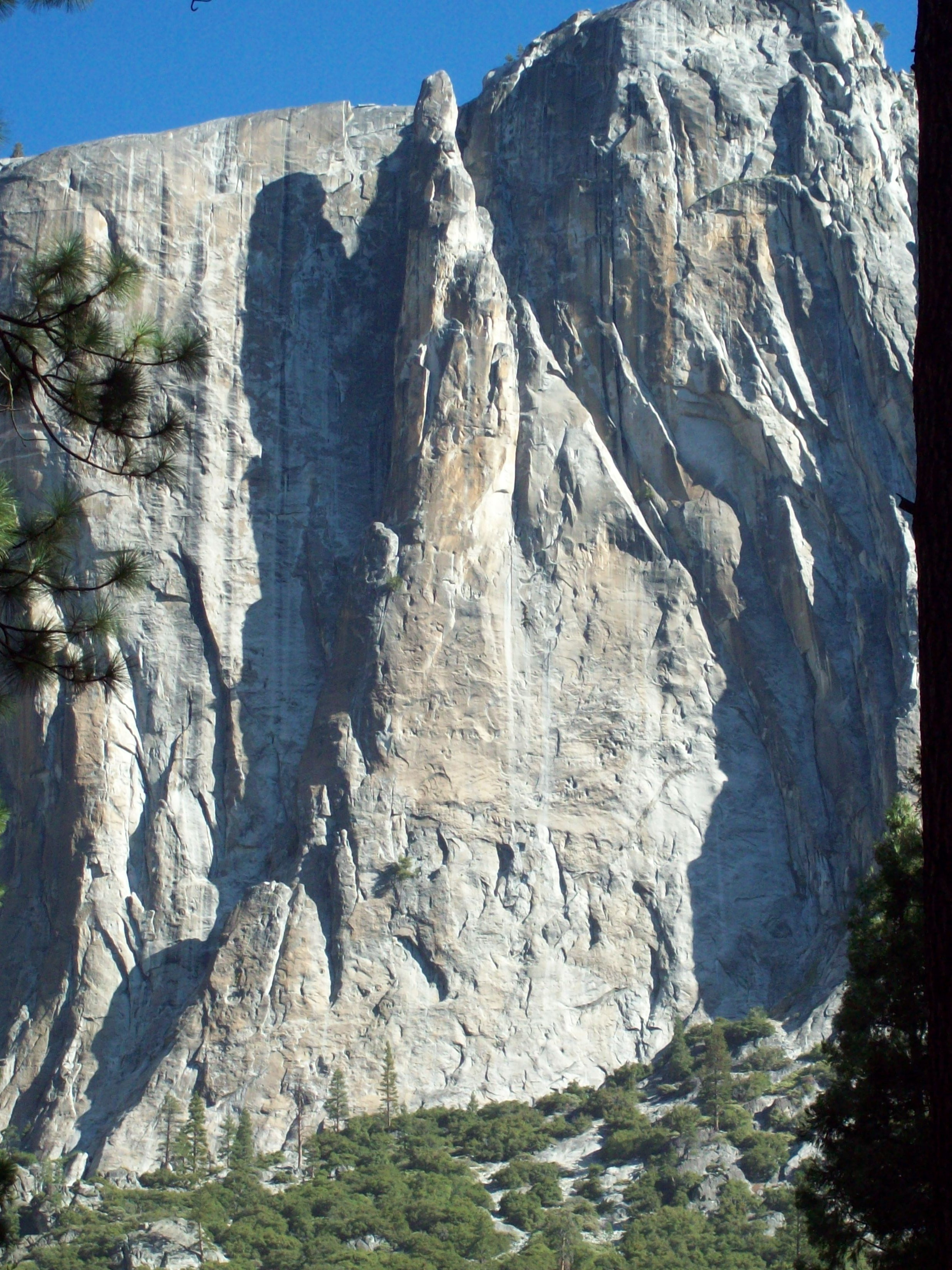
The Spire They Lassoed
In 1946, a twenty-nine-year-old climber named Ax Nelson stood on the rim of Yosemite Valley, 125 feet from a granite pillar that no one had ever stood on top of, and threw a lasso. The rope caught the tip. Nelson clipped himself to the line and prusiked across the void - hauling himself hand over hand along a rope suspended over nothing - to become the first person to summit Lost Arrow Spire. It was, as climbing historian Steve Roper later wrote, "one of the greatest rope stunts ever pulled off in climbing history." Nelson himself was more honest about it. "Spectacular and effective though it was," he admitted, "this maneuver required very little real climbing." The distinction mattered. The spire stands directly beside Upper Yosemite Falls, a detached finger of granite separated from the valley rim by a gap that is narrow enough to seem crossable and deep enough to kill you. Getting there was the trick. Getting there by actually climbing the rock - that would take someone else entirely.
The Blacksmith Who Changed Everything
That same year, a forty-eight-year-old Swiss immigrant named John Salathe was also attempting the spire. Salathe had a problem the mountain had created and only he could solve. Standard pitons - the metal spikes climbers hammer into cracks for protection - buckled and bent against Yosemite's compact granite. The rock was simply harder than the steel. Salathe, who had worked as a blacksmith, began experimenting with the carbon-chrome-vanadium alloy used in Ford Model A axles. The resulting pitons were harder, thinner, and could be driven into hairline cracks without deforming. He called them Lost Arrows, after the spire that had demanded their invention. The following year, in 1947, Salathe and Nelson joined forces and used these new pitons to complete the first true climbing ascent of the spire via the Lost Arrow Chimney — a five-and-a-half-day effort that Roper called "a true Valley milestone: the first big-wall climb ever done in the United States - and without a doubt the beginning of the Golden Age of Yosemite climbing." A single pillar of rock had forced the invention of hardware that would unlock every major wall in the valley.
Thirty Million Watching
By the 1980s, Lost Arrow Spire had become a proving ground for the next generation. The route known as the Lost Arrow Spire Chimney earned a place in the canonical text Fifty Classic Climbs of North America, cementing its reputation as a rite of passage. Its final two pitches - the Lost Arrow Spire Tip, rated 5.12b or 5.7 with aid - complete the detached portion and deposit climbers on the summit, surrounded by air on all sides. In 1984, Dave Shultz led the first free ascent of the Tip. The following year, the spire went prime-time. In June 1985, British climber Jerry Moffatt and Yosemite local Ron Kauk performed the first free ascent of the entire Chimney route as a live television event for ABC's Wide World of Sports. Over thirty million viewers watched two men climb a rock most of them had never heard of. Decades later, in 2020, a six-year-old named Sam Baker climbed the spire alongside his father, a reminder that what was once the cutting edge of human capability becomes, eventually, a family outing.
Walking the Void
The gap between the spire's summit and the valley rim is typically crossed by Tyrolean traverse - a horizontal transfer along a fixed rope over the abyss. Climbers clip in, pull themselves across, and try not to look down. But the gap also presented an irresistible challenge to a different tribe of athletes. The line is seventeen meters long. The valley floor is 880 meters below. On July 13, 1985 - just weeks after the televised climb - Scott Balcom became the first person to slackline across the gap, walking a flat nylon webbing stretched between the spire and the rim. He used a safety leash. Ten years later, Darrin Carter became the first to do it without one, a discipline known as free-solo slacklining, though he only walked the downhill direction - toward the spire, where a stumble would at least deposit him on rock rather than air. In 2003, Dean Potter completed both directions unleashed, walking away from the spire and back, each step a decision not to die. Libby Sauter became the first woman to complete the slackline in 2007, using a safety leash.
A Pillar Beside the Falls
Lost Arrow Spire is not a mountain. It is a remnant - a column of granite left standing when the rock around it fell away, separated from the valley rim by weathering and gravity over millennia. It rises directly beside Upper Yosemite Falls, close enough to feel the mist when the water runs high in spring. The spire's proximity to the falls gives it a dramatic visual context that few climbing objectives can match: the vertical white line of water next to the vertical gray line of rock, both dropping into the same enormous valley. From the rim, the spire appears deceptively close. From below, it is a needle against the sky. The route up the chimney between spire and wall follows a crack system that widens and narrows unpredictably, demanding constant adjustment. Climbers who reach the top find a summit barely large enough to sit on, surrounded by a 360-degree panorama of Yosemite Valley. Half Dome anchors the eastern horizon. El Capitan dominates the west. And 880 meters straight down, the meadows look like someone else's problem.
From the Air
Located at 37.7563°N, 119.5941°W, immediately adjacent to Upper Yosemite Falls on the north rim of Yosemite Valley. The spire is a detached granite pillar visible as a thin column separated from the main cliff face. Nearest airports: Fresno Yosemite International (KFAT), approximately 65 miles south; Mariposa-Yosemite Airport (MPI), about 30 miles west. Best viewed at 4,000-6,000 ft AGL from the south side of the valley. Yosemite Falls is the prominent waterfall immediately west of the spire.