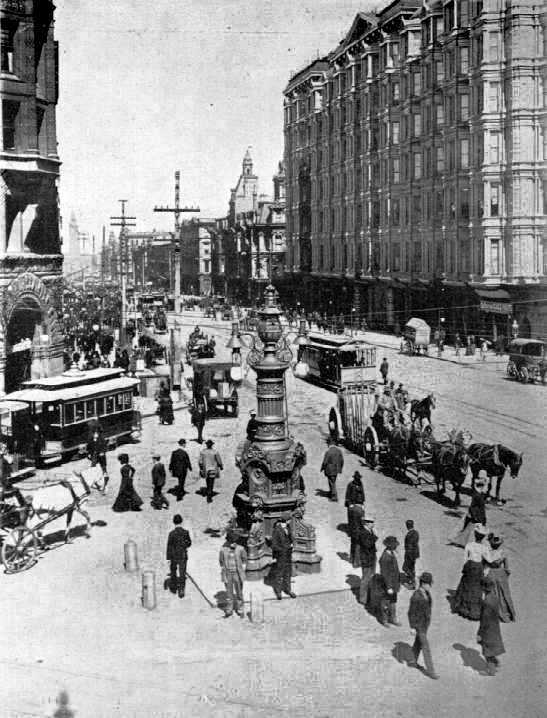
Lotta's Fountain
Every April 18 at 5:12 in the morning, people gather at the intersection of Market, Geary, and Kearny Streets. They come to remember the 1906 earthquake, and they meet at a cast-iron fountain that was already thirty-one years old when the ground shook. The tradition started in 1919, when a fraternal drinking organization called the South of Market Boys hung a wreath on the fountain. For decades after, actual survivors of the earthquake showed up at dawn. After 2015, the last two survivors died. The gatherings continue, now in period costume, now about preparedness as much as memory. The fountain stands.
A Child Star's Gift
Lotta Crabtree was not from San Francisco, but the city made her. Born in New York in 1847, she was brought to California during the Gold Rush and became a child performer in mining camps, singing and dancing for miners who threw gold nuggets at her feet. By the time she was an adult, she was one of the highest-paid actresses in America. In 1875, she commissioned a cast-iron fountain as a gift to San Francisco and had it installed at the busy intersection where Market Street meets Geary and Kearny. It was dedicated on September 9, 1875. The fountain was practical, ornamental, and oddly personal, a famous woman's thank-you to the city that launched her career.
The Meeting Point
When the 1906 earthquake and fire destroyed most of downtown San Francisco, the fountain survived. In the chaos that followed, it became a natural gathering point, a recognizable landmark in a landscape suddenly rendered unrecognizable. Families separated by the disaster searched for each other there. A plaque on the fountain commemorates this role. Another plaque remembers opera soprano Luisa Tetrazzini, who gave a free outdoor performance for San Franciscans at the fountain on Christmas Eve 1910. Legal difficulties had prevented her from appearing on stage, so she sang in the street instead, to a crowd estimated at 250,000 people. The fountain kept collecting stories.
Moved, Shortened, Repainted
In 1916, a bronze column was added to the fountain to match the height of new lights being installed along Market Street's Path of Gold lamp posts. In 1974, during a renovation of Market Street, the fountain was relocated slightly from its original position and brought into alignment with those same lamps. In 1999, it was refurbished, shortened back to its 1875 appearance, and repainted a metallic gold-brown. Its lion's-head spigots flow during daytime hours. The fountain has been designated both a San Francisco Landmark and a listing on the National Register of Historic Places. For a piece of cast iron standing on a traffic island, it has had a remarkably eventful life.
Dawn Rituals
The annual earthquake commemoration at 5:12 a.m. on April 18 is San Francisco's most persistent civic ritual. In 2016, more than 200 participants gathered, many in period costuming, to honor the dead and discuss earthquake preparedness. The gathering carries a particular poignancy now that no living person remembers the earthquake firsthand. What began as survivors' solidarity has become something else entirely, a city collectively choosing to remember a catastrophe that happened before anyone alive was born, at a fountain that a Gold Rush actress paid for, on a street that a 26-year-old surveyor laid out in 1847 while property owners plotted to lynch him for making it too wide. San Francisco layers its history in exactly this way: casually, densely, and in plain sight.
From the Air
Located at 37.79°N, 122.40°W at the intersection of Market, Geary, and Kearny Streets in downtown San Francisco's Financial District. The fountain is a small structure not individually visible from altitude but sits at a major intersection along Market Street's prominent diagonal corridor. Nearest airports: SFO (KSFO, 11 nm south), Oakland (KOAK, 9 nm east).