Lotus Pond, Kaohsiung
You enter through the dragon's mouth and exit through the tiger's. That is the rule at the Dragon and Tiger Pagodas, the twin seven-story towers standing in Lotus Pond on slender stilts, connected to shore by a zigzag bridge designed to confuse evil spirits, who can only travel in straight lines. The superstition is specific, the architecture extravagant, and the experience unforgettable. Lotus Pond is an artificial lake in Kaohsiung's Zuoying District, opened in 1951, but it feels like a place that has been accumulating gods and legends for centuries. More than a dozen temples crowd its shoreline, each competing in color, scale, and spiritual ambition. The water blooms with lotus in summer, and the reflections of pagodas, pavilions, and towering deity statues shimmer across its surface like a fever dream of devotion.
A Skyline of Gods
The temples ringing Lotus Pond form one of the densest concentrations of religious architecture in Taiwan. The Spring and Autumn Pavilions, built in 1953, stand as a pair of four-story octagonal towers with green-tiled roofs and yellow walls, connected by the Nine-Bend Bridge. At their entrance, a statue of Guanyin riding a dragon rises from the water. According to local legend, the Goddess of Mercy appeared in the clouds astride a dragon and instructed her followers to build her likeness between the two pavilions. Nearby, the Pei Chi Pavilion honors the Taoist deity Xuan Wu with a statue claimed to be 72 meters tall, its Seven-Star sword alone stretching 38.5 meters. The Chi Ming Palace, rebuilt in 1973 as a three-story palace-style complex, is considered the most spectacular temple on the lake. It was founded by Taiwanese elders determined to preserve traditional Confucian and martial virtues against the cultural pressures of the Japanese colonial period.
Walls Within Walls of History
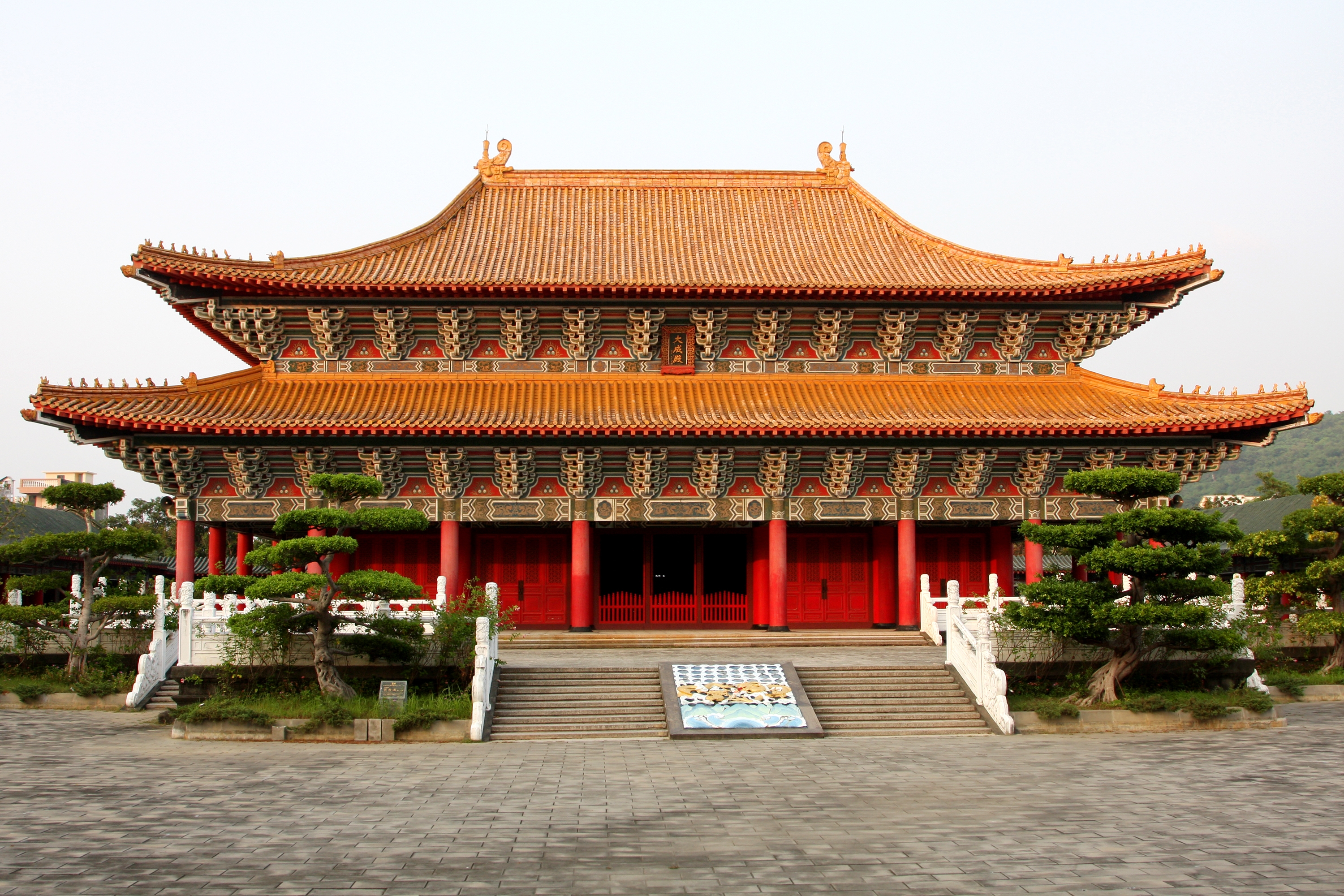
The temples are not merely decorative. They are documents of southern Taiwan's layered past. The Kaohsiung Confucius Temple traces its origins to 1684, though the current structure was rebuilt in 1977 on the pond's north shore. Its design follows the Song Dynasty Confucian temple model and the layout of Shandong's Qufu Confucius Temple, with yellow-tiled roofs, black foundations, red pillars, and white stone railings. It is the largest Confucius temple in Taiwan, and its ceremonies still feature the Ba Yi Dance, eight dancers arranged in eight rows. The Cheng Huang Temple, originally built in 1704, carries the scars of every upheaval to shake southern Taiwan: the Lin Shuangwen rebellion of 1787, the Japanese occupation, the retreat of the Nationalist government. Each board and joss stick, as locals say, speaks quietly about the footsteps of ancestors.
Where Faith Meets Water
What makes Lotus Pond remarkable is not any single temple but the cumulative effect: an entire lakefront devoted to the sacred, where Taoist, Buddhist, and Confucian traditions exist side by side without apparent tension. The Cih Ji Palace, originally built in 1719, worships Baosheng Dadi, the divine physician. During the Chungyuan Festival, households hang radishes on their doors as offerings. It was Baosheng Dadi who, through spirit mediums in 1974, ordered the construction of the Dragon and Tiger Pagodas that have since become one of Kaohsiung's most recognizable landmarks. Tianfu Palace, established in 1660, is the oldest temple in the Zuoying area. The Cide Palace, dedicated to the sea goddess Mazu, was suppressed during the Japanese occupation and rebuilt after Taiwan's restoration. On the birthday of each deity, Taiwanese opera troupes perform on a stage erected before the temple.
Living Water
Lotus Pond is not frozen in devotion. In 2009, it hosted water sporting events for the World Games, including canoe polo, water skiing, and dragon boat races. The juxtaposition is perfectly Taiwanese: sacred architecture and international athletic competition coexisting on the same body of water. Summer visitors come to see the lotus blooms that give the pond its name, their pink and white flowers opening at dawn across the lake's surface. At sunset, the pavilions and pagodas cast golden reflections across the water, and at night the temples light up in neon and incandescent color, transforming the lakeshore into something between a carnival and a cathedral. The nearby Kaohsiung Produce Pavilion markets the region's agricultural bounty, grounding all this spiritual spectacle in the practical reality of a city that grows things, builds things, and believes things with equal fervor.
From the Air
Lotus Pond is located at 22.685N, 120.297E in Kaohsiung's Zuoying District. From the air, the lake is a distinctive rectangular water feature on the eastern side of the district, surrounded by dense urban development. The colorful temple complexes along its shoreline are visible at lower altitudes. Nearest major airport is Kaohsiung International Airport (RCKH), approximately 10 km to the south. Zuoying High Speed Rail station is nearby. Best viewed at 2,000-3,000 feet for temple detail.