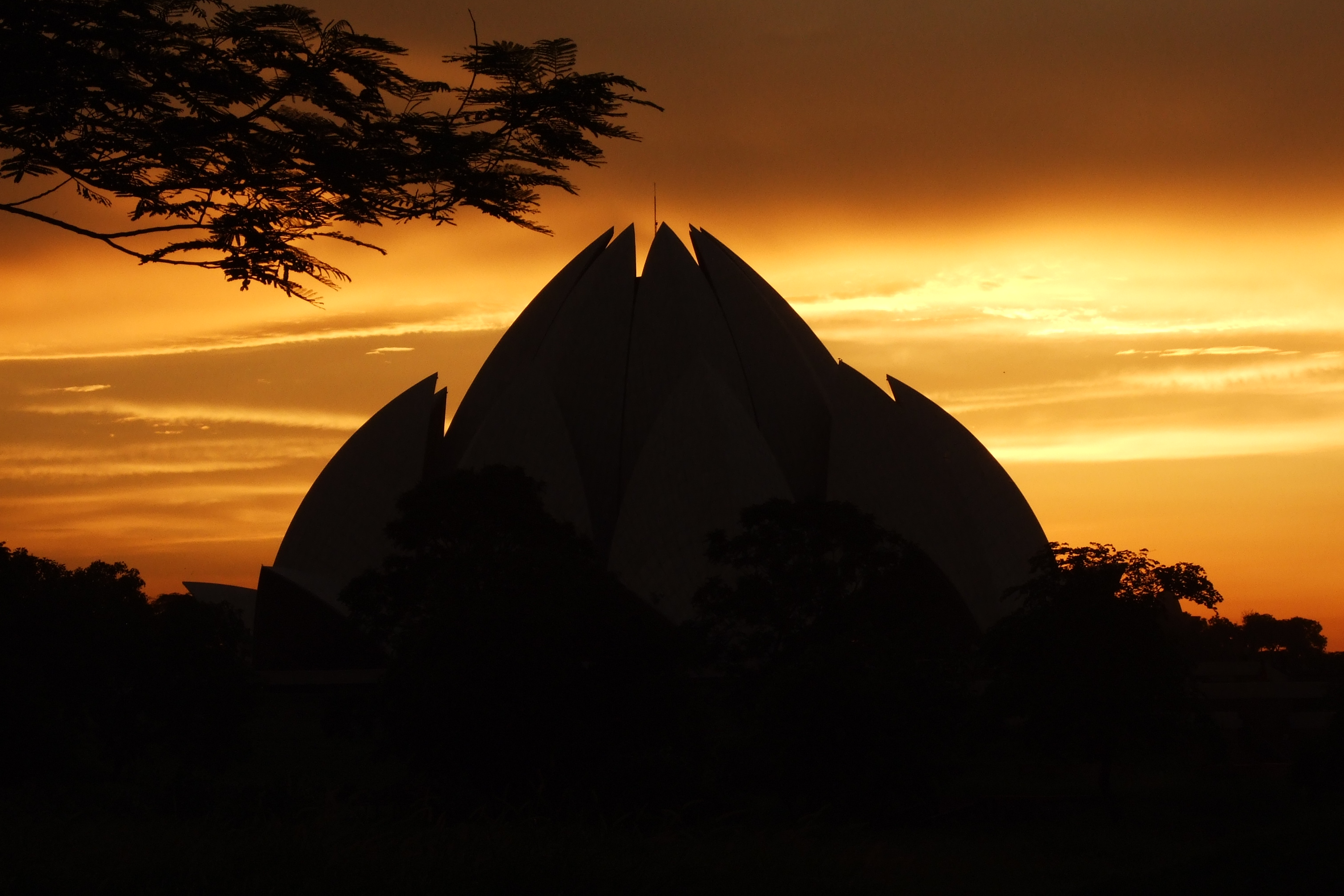
Lotus Temple
Twenty-seven marble petals, and not a single sermon. The Lotus Temple in New Delhi is a Baha'i House of Worship that has drawn over 100 million visitors since opening in 1987 -- more, by some counts, than the Taj Mahal over the same period. Yet most visitors know almost nothing about the Baha'i Faith when they arrive. They come because the building looks like nothing else on Earth: a half-opened lotus blossom rendered in white Pentelic marble, the same stone the Greeks used to build the Parthenon. Inside, the rules are simple. Anyone may enter. Sacred texts from any religion may be read aloud. No instruments may be played, no sermons delivered, no money collected. It is a building designed, quite literally, to hold silence.
The Architect and the Flower
When the Baha'i community approached Iranian-born architect Fariborz Sahba in 1976, they gave him an unusual brief: design a house of worship that belongs to no single tradition but welcomes all of them. Sahba chose the lotus, a flower sacred across Hinduism, Buddhism, and Islam, as his organizing form. The structural challenge was immense. The British firm Flint and Neill spent 18 months on the engineering alone, solving how to make 27 free-standing concrete shells -- arranged in clusters of three to form nine sides -- support themselves while appearing to float. ECC Construction Group of Larsen & Toubro built the result for $10.56 million. Much of the funding came from a single donor: Ardishir Rustampur of Hyderabad, Sindh, who left his entire life savings for the project. The foundation stone was laid in 1977, and the temple was dedicated on December 24, 1986, before a gathering of 8,000 Baha'is from 107 countries.
Nine Sides, No Altar
Baha'i scripture requires that every House of Worship be nine-sided and circular, but says nothing about domes, minarets, or steeples. The Lotus Temple fulfills the mandate with nine doors that open onto a central hall 34.3 meters tall, capable of seating 1,300 and holding up to 2,500. There are no pictures, statues, or images inside -- the architecture itself is the statement. The nine surrounding ponds, fed by water that cools the building naturally, extend the footprint to 26 acres. Sahba saved a portion of the construction budget to build a greenhouse for studying which indigenous plants would thrive on the grounds. The result is a landscape that feels less like a religious campus than a botanical garden with a masterpiece at its center.
Greek Stone Under Delhi Skies
The temple's surface is clad in white marble quarried from Mount Pentelikon in Greece, connecting a modern Indian temple to a lineage of stone that includes the Parthenon and the Temple of Zeus. The choice was both aesthetic and symbolic: Pentelic marble ages to a warm honey tone, and its crystalline structure catches light in ways that change throughout the day. But Delhi's air is not Athens's. Like the Taj Mahal, the Lotus Temple is slowly discoloring under the pressure of vehicle exhaust and industrial pollution. The white petals are acquiring patches of grey and yellow, a 21st-century problem settling onto a material that has survived since antiquity. The temple was the first in Delhi to install solar panels, generating 120 kilowatts of its 500-kilowatt electricity needs -- a practical gesture toward the environment that is simultaneously attacking its facade.
A Hundred Million and Counting
When the Lotus Temple opened to the public on January 1, 1987, more than 10,000 people visited on the first day. The pace has not slowed. By 2001, CNN reported 70 million cumulative visitors. By 2014, India's permanent delegation to UNESCO put the number at over 100 million. On peak holidays, the temple receives up to 100,000 visitors in a single day. The Illuminating Engineering Society of North America called it the "Taj Mahal of the Twentieth Century." The Architectural Society of China named it one of 100 canonical works of 20th-century architecture. The Encyclopaedia Britannica recognized it as an outstanding achievement. And the Interfaith Forum on Religion, Art and Architecture -- an affiliate of the American Institute of Architects -- praised it as "an extraordinary feat of design, construction, and appropriateness of expression." For a building where no one is allowed to give a speech, it has generated a remarkable amount of conversation.
From the Air
Located at 28.553N, 77.259E in south New Delhi, near Nehru Place and Kalkaji. The white lotus-shaped structure is distinctive from the air, surrounded by nine ponds and 26 acres of gardens. Nearest major airport is Indira Gandhi International Airport (VIDP), approximately 18 km southwest. The temple sits on the western bank of the Yamuna River. Best viewed at lower altitudes in clear weather; the white marble petals contrast sharply with the surrounding urban landscape.