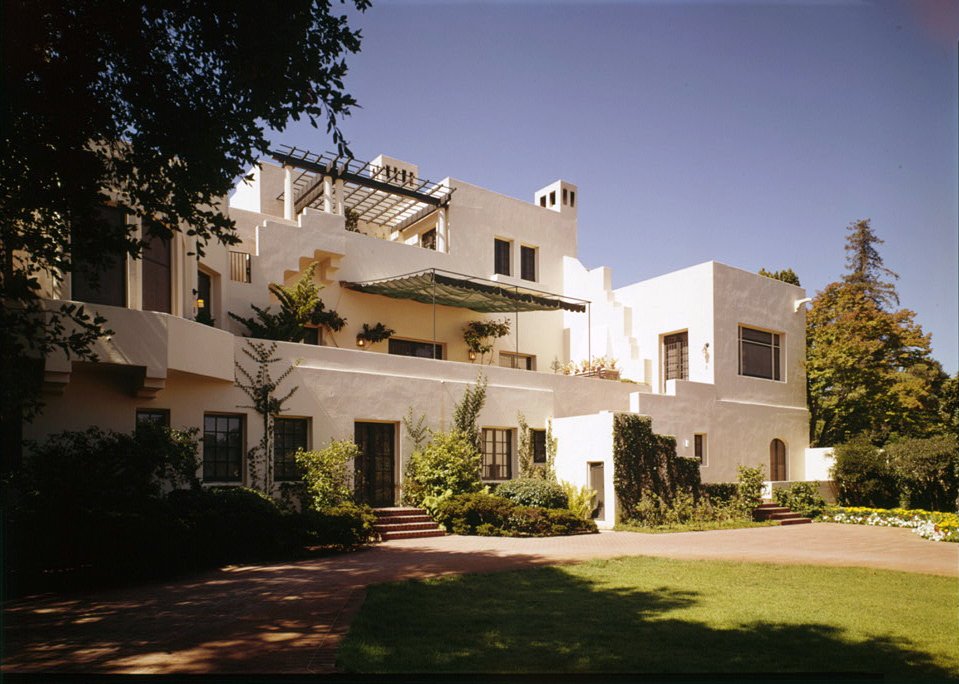
Lou Henry Hoover House
Lou Henry Hoover designed the house herself. Completed in 1920 on a hillside of the Stanford University campus, it was the first and only permanent residence she and her husband Herbert ever owned. The design defied easy classification -- critics have identified International Style elements, Pueblo Revival influences, and a modernist sensibility unusual for its era. Herbert's contribution to the design process was a single, pragmatic demand: the house must be fireproof. The walls were built from hollow tiles. That insistence on practicality from a mining engineer, married to the visionary aesthetics of a geologist and linguist who had lived around the world, produced one of the more architecturally distinctive houses in California. It was designated a National Historic Landmark in 1985.
A Home Between Elections
The Hoovers barely had time to settle in. Herbert was appointed Secretary of Commerce by President Warren G. Harding in 1921, continuing under Calvin Coolidge, and the couple spent most of the following decade in Washington. It was in this Stanford house, however, that Hoover awaited the presidential election returns twice: in 1928, when he defeated Alfred E. Smith, and in 1932, when Franklin D. Roosevelt defeated him. The symmetry is poignant -- the same rooms where he celebrated victory four years earlier witnessed his rejection by the American electorate. During his presidency from 1929 to 1933, the family made only brief visits to their California home.
Lou Henry's Vision
Lou Henry Hoover was no ordinary political spouse. She was the first woman to earn a geology degree from Stanford, class of 1898, and was fluent in Mandarin Chinese. She and Herbert had lived in China, Australia, Burma, and London during his mining career, and those global experiences informed her architectural sensibility. The house she designed incorporated flat roofs, asymmetric massing, and clean geometric forms that anticipated the International Style -- years before European architects like Le Corbusier and Mies van der Rohe popularized those principles in America. Other observers have seen Pueblo influence in the adobe-like walls and the way the house steps up the hillside, blending with the terrain rather than dominating it.
The President's Residence
After Lou's death in 1944, Herbert deeded the house to Stanford University. It now serves as the official residence of the university president and is not open to the public. The house sits on a wooded hillside with views across the campus toward the foothills of the Santa Cruz Mountains. Solar panels were installed in 2008, a concession to modernity that Lou Henry Hoover -- a scientist who lived her life at the intersection of practicality and vision -- might have appreciated. The building endures as a monument to a remarkable woman whose design talent has been overshadowed by her husband's political career, and as a reminder that the Stanford campus holds architectural surprises beyond its famous sandstone arcades.
From the Air
The Lou Henry Hoover House is at 37.42°N, 122.17°W on the Stanford University campus, on a hillside south of the Main Quad. Not individually visible from altitude but located within the broader Stanford campus. Nearby airports: Palo Alto (KPAO), San Jose (KSJC). Best viewed at 2,000-3,000 ft AGL.