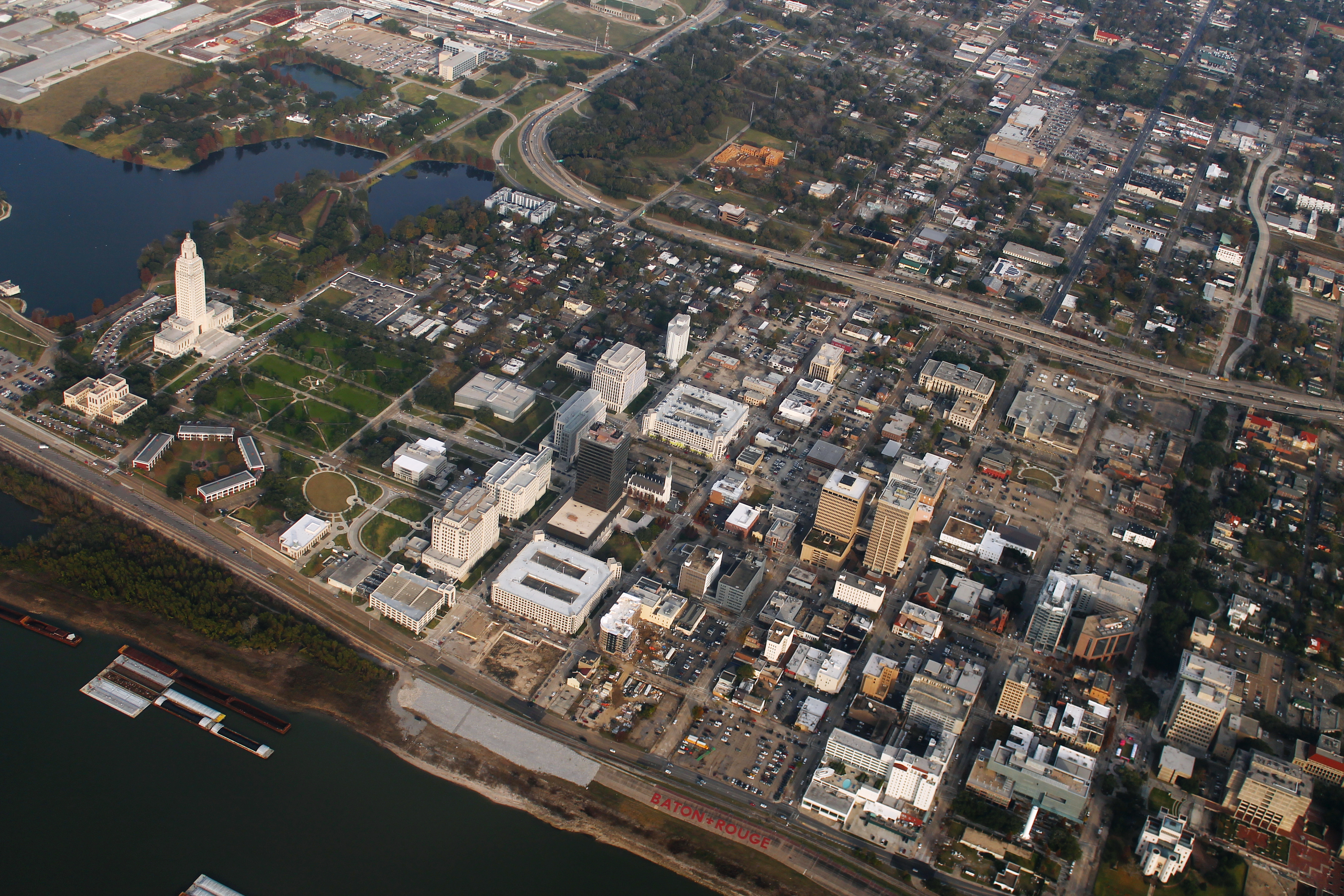
Louisiana State Capitol
"Only one building compares with it in architecture," Huey Long declared upon its completion. "That's St. Peter's Cathedral in Rome, Italy." The boast was pure Long—extravagant, audacious, and delivered without a trace of irony. But the Louisiana State Capitol, rising 34 stories above downtown Baton Rouge, really is unlike any other statehouse in America. While nearly every other state modeled its capitol on the domed rotunda in Washington, Long demanded a skyscraper. Completed in just 14 months at a cost of $5 million, the Art Deco tower was meant as a monument to his populist revolution—a symbol that the old planter aristocracy no longer controlled Louisiana. It became his tomb instead. Long was shot in the building's first-floor corridor on September 8, 1935, and his body now lies beneath a bronze statue on the grounds out front.
A Capitol That Could Not Sit Still
Louisiana's seat of government has wandered more than any other in the nation. New Orleans served as the colonial capital from 1722 through statehood, until the legislature grew restless and voted to relocate to Donaldsonville in 1829. After convening there in January 1830, legislators became "dissatisfied with the quarters" and returned to New Orleans within a year. The state constitution of 1845 finally mandated a permanent move, and Baton Rouge won the prize: a plot on a bluff overlooking the Mississippi River, where architect James H. Dakin built a castellated Gothic Revival capitol dedicated in 1849. Mark Twain later called it an "architectural falsehood," blaming Sir Walter Scott's romantic influence. During the Civil War, the government fled to Opelousas and then Shreveport while Union troops used the old capitol as a prison and garrison before an accidental fire gutted it in 1862. The rebuilt structure, with its famous spiral staircase and stained glass dome, served until the 1920s, when it proved too small for a growing state.
Huey's Tower
Elected governor in 1928 as a fiery populist, Huey Long saw a new capitol as a way to announce the end of Louisiana's old-guard political dominance. He hired Leon C. Weiss and the firm Weiss, Dreyfous and Seiferth, and cleverly secured funds from the Board of Liquidation to begin design work before the legislature could stop him. Inspired by the Nebraska State Capitol—the first American statehouse built as a modern skyscraper—Long insisted on a tower, despite inefficiencies in early elevator-shaft floor plans. Construction began on December 16, 1930, with a dedicated railroad spur built to deliver 2,500 carloads of materials. Long, who had been elected to the U.S. Senate but delayed taking the oath to prevent a rival from becoming governor, drove the project relentlessly. The building was finished in little over a year and dedicated on May 16, 1932.
Limestone, Granite, and 49 Steps
The capitol's Alabama limestone facade is an encyclopedia in stone. A frieze by sculptor Ulric Ellerhusen wraps the tower's base at the fifth floor, depicting Louisianans from colonization through World War I. Twenty-two square portraits of historic figures—from Hernando de Soto to John James Audubon—are carved between pilasters on the exterior of the House and Senate chambers. The front entrance is reached by a monumental stairway of 49 Minnesota granite steps, each engraved with the name of a U.S. state in order of admission; Alaska and Hawaii share the last step with the phrase "E pluribus unum." Limestone sculptures by Lorado Taft titled Pioneers and Patriots flank the stairs, while reliefs by Adolph Alexander Weinman and an Egyptian-style architrave by Lee Lawrie frame the great bronze doors. Above the 21st floor, the square tower transitions to an octagonal shape, crowned by a cupola with four stone eagles serving as flying buttresses beneath the beacon lantern.
Bullet Holes and a Burial
On the evening of September 8, 1935, Dr. Carl Weiss confronted Huey Long in the first-floor corridor. Weiss shot Long, and Long's bodyguards—Louisiana State Police—immediately gunned Weiss down. The alleged motive: Long was about to gerrymander Weiss's father-in-law, Judge Benjamin Pavy, out of office. Long survived two days at Our Lady of the Lake Hospital before dying on September 10. Approximately 100,000 mourners—some from Arkansas, Mississippi, and Texas—filed past his body as it lay in state inside the capitol. He was buried on the grounds, and in 1940 a marble pedestal topped with a bronze statue by Charles Keck replaced his original tombstone. The bullet holes from the shooting remain visible in the corridor columns, just outside the governor's office. In 1970, a bomb of twenty or more sticks of dynamite detonated in the Senate Chamber in retaliation for police shootings of African Americans. The building survived, as it has survived everything Louisiana's turbulent history has thrown at it.
From the Air
The Louisiana State Capitol is located at 30.457°N, 91.187°W in downtown Baton Rouge, directly overlooking the Mississippi River to the west. At 34 stories, it is the tallest building in Baton Rouge and unmistakable from the air—a slender Art Deco tower with an octagonal upper section and beacon lantern. The Capitol Gardens spread south and east, with Huey Long's burial monument visible as a focal point in the south park. Nearest airports: Baton Rouge Metropolitan (KBTR, 6 nm north) and Ryan Field (L38, 14 nm south). Best viewed at 2,000–3,000 ft AGL on a Mississippi River approach from the south, where the tower rises above the tree canopy.