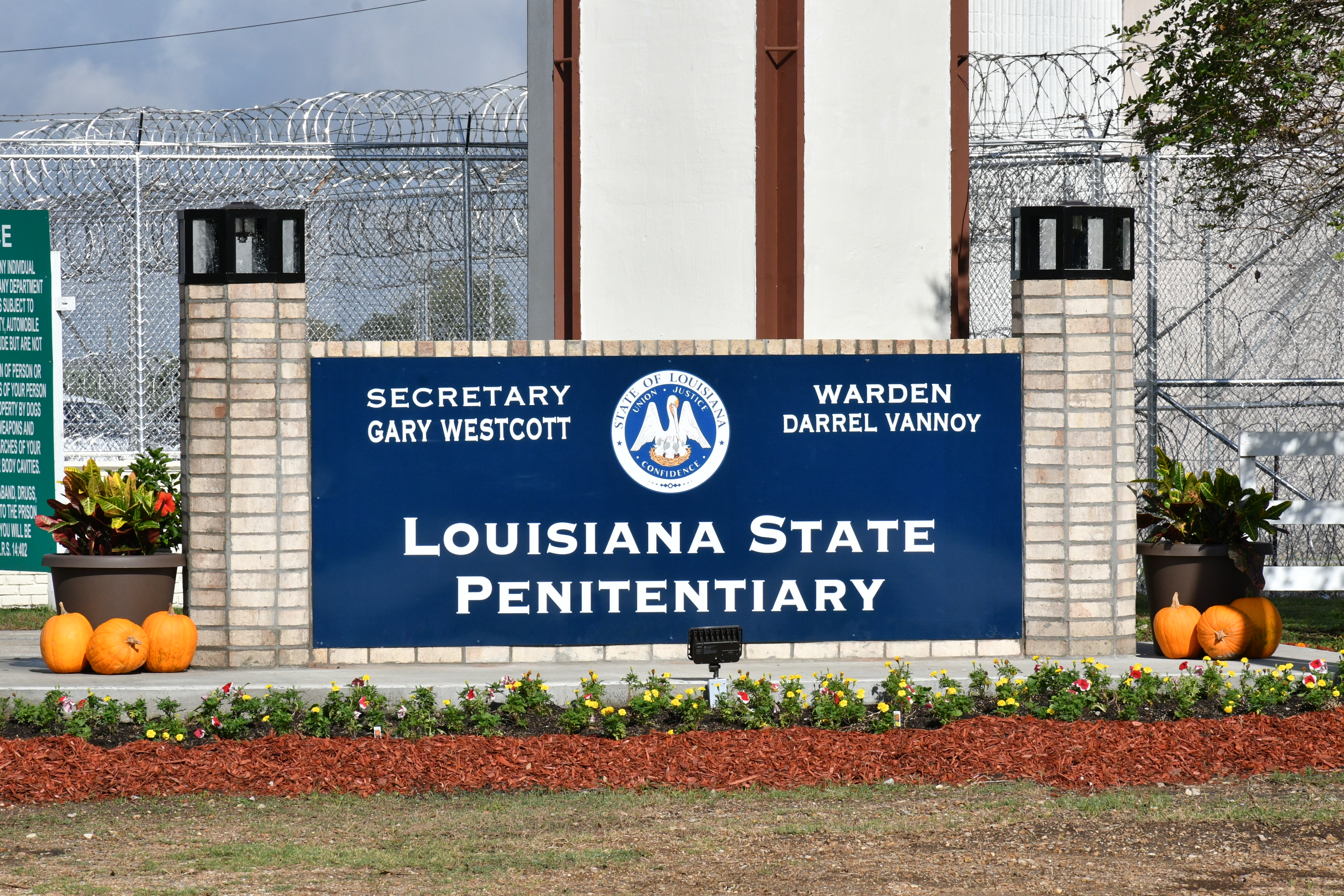
Louisiana State Penitentiary
In February 1951, thirty-one inmates at the Louisiana State Penitentiary sliced through their own Achilles tendons. Unable to walk on both feet, they hopped around the yard singing a tune they called 'The Heel-String Boogie.' By May, fifty-five men had joined them. They were protesting conditions at a place Collier's Magazine would soon call 'the worst prison in America' -- a sprawling 18,000-acre complex at the end of a winding Louisiana highway, flanked on three sides by the muddy coils of the Mississippi River, where guards patrolled on horseback and one in every ten prisoners was stabbed each year. The prison is called Angola, after the African country from which many of the enslaved people who once worked this land were taken. It sits on ground that has been used to extract labor from Black bodies under one system or another -- slavery, convict leasing, incarceration -- for nearly two centuries.
From Slave Plantation to Prison Farm
In the 1830s, slave trader Isaac Franklin purchased four contiguous plantations from Francis Rout along a bend in the Mississippi River in West Feliciana Parish. Franklin, co-owner of the profitable firm Franklin and Armfield based in Alexandria, Virginia, and Natchez, Mississippi, named one of the tracts Angola after the country on Africa's west coast from which many enslaved people had originated. After Franklin died in 1846, his widow Adelicia Cheatham eventually sold all four plantations -- Panola, Belle View, Killarney, and Angola -- to Samuel Lawrence James, a former Confederate major, in 1880. Under the convict lease system, James ran his vast estate using prisoners leased from the state. The state passed laws targeting African Americans with minor fees and fines; cash-poor men in the agricultural economy were jailed and forced into labor. Convicts were underfed, abused, and frequently worked to death. The state exercised virtually no oversight. James had total authority over his human workforce until his death in 1894.
A Dungeon Crawling with Rats
The facility officially became a state prison in 1901. By the 1930s, authors Charles Wolfe and Kip Lornell wrote that Angola was 'probably as close to slavery as any person could come.' A staff of ninety people 'ran the prison like it was a private fiefdom.' Hardened criminals broke down upon learning they were being sent there. The most feared unit was the Red Hat Cell Block, named for the red-painted straw hats its occupants wore in the fields. Mother Jones reported that men who survived Red Hat 'told of a dungeon crawling with rats, where dinner was served in stinking buckets splashed onto the floors.' In 1971, the American Bar Association described conditions as 'medieval, squalid and horrifying.' A federal judge declared a state of emergency in 1975, and again in 1989. The Heel-String protest of 1951 did produce reforms -- corporal punishment was abolished -- but the cycle of crisis and intervention would repeat for decades. Between 1929 and 1940, according to folklorist Harry Oster, 10,000 floggings were carried out at Angola.
Where the Blues Were Born Again
Angola's isolation preserved something unexpected: music. In the 1930s, folklorist John Lomax and his son Alan traveled to Southern prison farms believing they would find the purest forms of African American song culture, uncontaminated by popular trends. At Angola, they met Huddie William Ledbetter -- Lead Belly -- a folk and blues musician serving time for attempted murder who would become one of the most influential artists in American music history. He was released early for good behavior. Blues musician Robert Pete Williams also served time at Angola and was pardoned in 1964. The Neville Brothers wrote 'Angola Bound.' Gil Scott-Heron recorded 'Angola, Louisiana.' Dr. John devoted an entire album side to his 'Angola Anthem.' From 1968 to 1970, Baton Rouge television station WAFB aired a weekly program called Good Morning, Angola Style, featuring bands made up of inmates. Today, Angola hosts the only inmate-operated FCC-licensed radio station in America: KLSP, 'the Incarceration Station,' broadcasting at 100 watts on 91.7 FM to roughly 6,000 listeners. The signal fades before it reaches the prison gate.
A City Behind the Wire
Angola is larger than Manhattan. Its 6,300 prisoners and 1,800 staff form a self-contained community with a canning factory, dairy, mail system, ranch, repair shops, and a sugar mill. Inmates cultivate corn, cotton, soybeans, okra, and strawberries -- four million pounds of vegetable crops per year -- and tend 2,000 head of cattle. The prison manufactures its own license plates, mattresses, and road signs. There is a 9-hole golf course where visitors must submit to background checks 48 hours in advance. Convicted felons cannot play. There is an airstrip for transporting prisoners and officials. There is a 10,000-seat rodeo stadium, opened in 2000, where inmates compete every April and October in the Angola Prison Rodeo, drawing thousands of visitors. And there is Point Lookout cemetery, with 331 grave markers and an unknown number of bodies, where inmates build proper coffins for the dead -- a policy change instituted after a body fell through the bottom of a cardboard box.
Seventy-One Percent Will Die Here
As of 2010, the racial composition of Angola's inmates was 76 percent Black and 24 percent White. Seventy-one percent were serving life sentences. Only about four prisoners gain parole each year, while roughly thirty-two die inside. Peter Applebome of The New York Times wrote in 1998 that 'it's impossible to visit the place and not feel that a prisoner could disappear off the face of the earth and no one would ever know or care.' In 2014, Glenn Ford walked free after nearly three decades of wrongful imprisonment, twenty-six of them in solitary confinement on death row. A memoir by former inmate Wilbert Rideau described systematic sexual slavery through the 1960s and 1970s, with 'perhaps a quarter of the population in bondage.' In 2021, a federal judge found the prison had violated the Americans with Disabilities Act. Laura Sullivan of National Public Radio captured the strange insularity of the place: 'In a place so remote, it's hard to know what's nepotism. There's simply no one else to hire.' The road in is Louisiana Highway 66, winding and often muddy. The road out, for most, does not exist.
From the Air
Located at 30.96°N, 91.59°W in West Feliciana Parish, Louisiana, on a dramatic bend of the Mississippi River. The prison complex is unmistakable from the air: 18,000 acres of cultivated fields and scattered housing units flanked on three sides by the river's oxbow curves. The Angola Airstrip (LA09) is on the property, used for official state aircraft only during daylight VFR conditions. Recommended viewing altitude: 3,000-5,000 ft AGL. Nearest public airports: KHZR (False River Air Park, 20 nm S), KBTR (Baton Rouge Metropolitan, 45 nm SE). The Tunica Hills rise to the east. St. Francisville lies approximately 15 nm to the southeast.