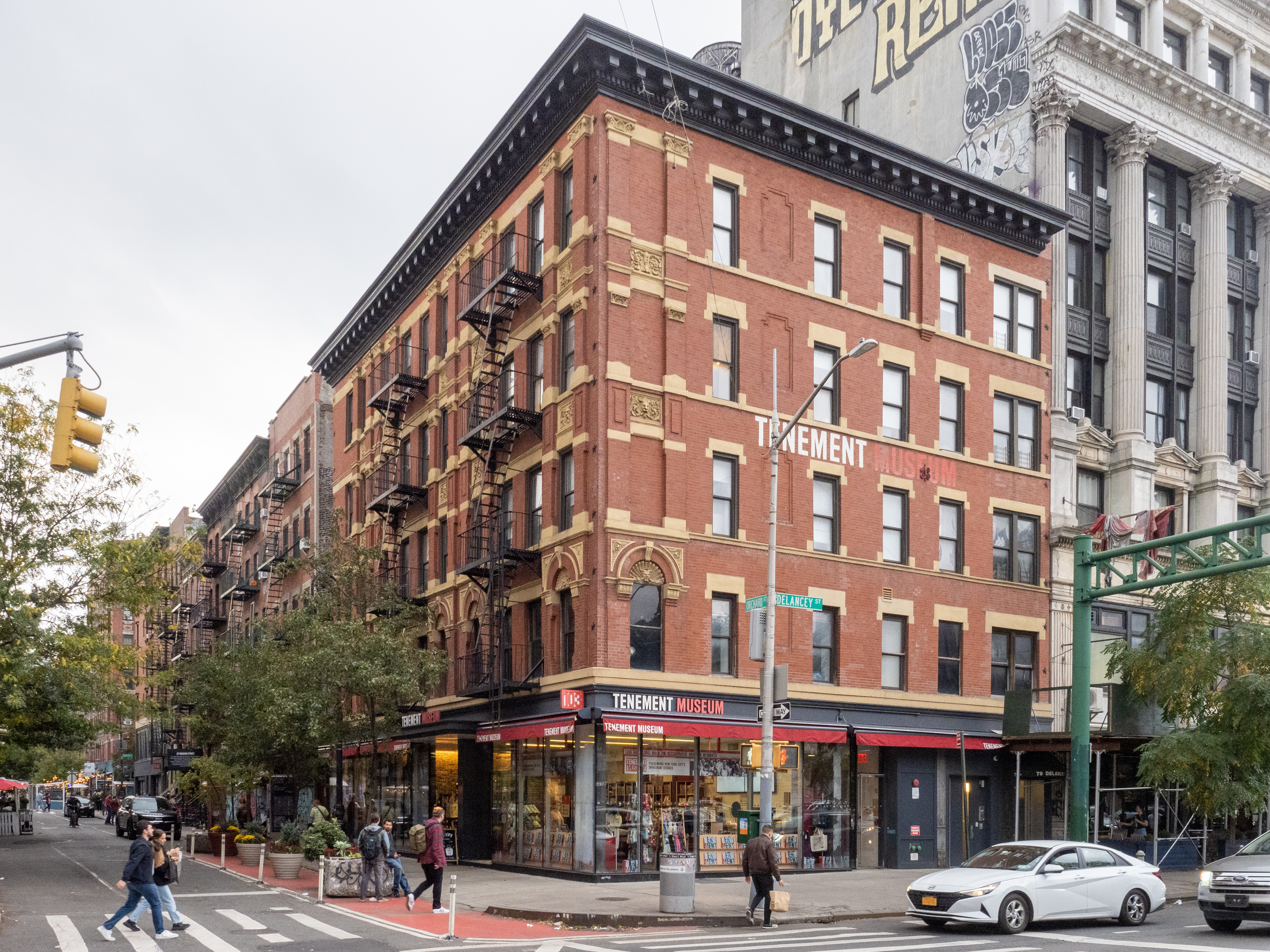
Lower East Side Tenement Museum
In 1935, a landlord on Orchard Street decided he was done making repairs. Rather than bring his aging tenement up to yet another round of housing codes, he simply evicted the remaining tenants, boarded the upper windows, and sealed the doors. The storefronts at street level stayed open for business, but the apartments above went dark. They would stay that way for fifty-three years, the peeling wallpaper and cast-iron stoves and shared hallway toilets left exactly as the last residents abandoned them. When Ruth J. Abram and Anita Jacobson pried open those doors in 1988, they found a building that had accidentally preserved something no museum could have planned: the unvarnished daily reality of immigrant life in America.
A Prussian's Investment
Lukas Glockner, a Prussian-born immigrant himself, built 97 Orchard Street in 1863. The five-story brick building contained 22 apartments and a basement saloon. Each apartment had three rooms. There was no running water, no sewage connection, no garbage disposal. The rear units had no windows to the outside at all. Families of five or six lived in 325 square feet, sleeping in shifts, cooking on coal stoves that doubled as the only heat source. Over the next seven decades, the building was retrofitted again and again to keep pace with housing legislation: cold running water arrived, then shared toilets in the hallway (two per floor), then air shafts cut through interior walls to give the windowless rooms a fighting chance at ventilation. Each modification was the bare minimum the law required. The building was never comfortable. It was only ever legal.
Twenty Nations Under One Roof
An estimated 7,000 people lived at 97 Orchard Street between 1863 and 1935. They came from Germany and Ireland, from Eastern European shtetls and southern Italian villages, from China and Puerto Rico. The museum has painstakingly researched individual families who occupied the building and recreated their apartments down to the wallpaper patterns and kitchen implements. The Gumpertz family from Prussia occupied apartment 6 in the 1870s, where Nathalie Gumpertz became the household's sole breadwinner as a dressmaker after her husband disappeared. The Levine family ran a garment workshop from their apartment in the 1890s, sewing ready-made clothing in the same room where they ate and slept. These are not generic immigrant stories. They are specific lives, documented through census records, city directories, and family descendant interviews, lived out in rooms visitors can walk through today.
Laws Written in Tenement Walls
The Tenement House Acts of 1867, 1879, and 1901 are abstract legislative history until you stand inside 97 Orchard Street and see their consequences carved into the building itself. The 1867 act required one toilet for every twenty tenants and a connection to the city sewer. The 1879 act mandated that every room have access to light and air, which produced the dumbbell-shaped tenement floor plan with narrow air shafts between buildings. The 1901 act demanded running water in each apartment, indoor toilets, and fire escapes. Each law left its physical mark on the building: the plumbing that snaked through interior walls, the air shafts punched between rooms, the iron fire escape bolted to the facade. The building is a three-dimensional record of how New York slowly, reluctantly improved the living conditions of its poorest residents, one crisis and one law at a time.
The Second Building
In 2017, the museum expanded with an exhibition called "Under One Roof" at 103 Orchard Street, the building next door. Where 97 Orchard Street tells the story of 19th and early 20th century immigration, 103 Orchard Street picks up the thread from the 1950s through the 1980s. The exhibition follows three families: a Holocaust refugee family, a Puerto Rican family who came during the Great Migration from the island, and a Chinese immigrant family. The museum designated 97 Orchard Street as a National Historic Landmark in 1994 and a National Historic Site in 1998. The 2015 National Defense Authorization Act extended that designation to include 103 Orchard Street. Together, the two buildings span more than 150 years of the American immigrant story, from the Civil War era through the late 20th century, told not through grand narratives but through the kitchens and parlors where that story was actually lived.
The Block That Tells the Story
Orchard Street remains one of the Lower East Side's most evocative blocks. The neighborhood that once held the densest population on Earth has gentrified considerably, but the physical footprint of the tenement era remains visible in the narrow storefronts, the fire escapes stacked like iron ladders up brick facades, and the tight side streets where pushcart vendors once competed for space. The museum offers neighborhood walking tours alongside its apartment tours, tracing the routes immigrants walked to synagogues and churches, to the public bathhouses that compensated for apartments without bathtubs, to the settlement houses where they learned English. In 2021, the museum added "Reclaiming Black Spaces," a tour inspired by the discovery that two men named Joseph Moore - one Irish, one Black - lived in neighboring tenements and worked the same trade, a coincidence that illuminated how race shaped the immigrant experience on the very same streets.
From the Air
Located at 40.7185N, 73.9901W on Manhattan's Lower East Side. The museum sits on Orchard Street between Delancey and Broome Streets, in the dense grid of lower Manhattan south of Houston Street. From altitude, the area is identifiable by its tight street grid and proximity to the Williamsburg Bridge crossing the East River to Brooklyn. Nearest airports: LaGuardia (KLGA) 10nm northeast, JFK (KJFK) 14nm southeast, Newark (KEWR) 10nm west. Recommended viewing altitude: 2,000-3,000 feet for neighborhood context. The Lower East Side's small blocks and dense building pattern are distinctive from the wider avenues of midtown.