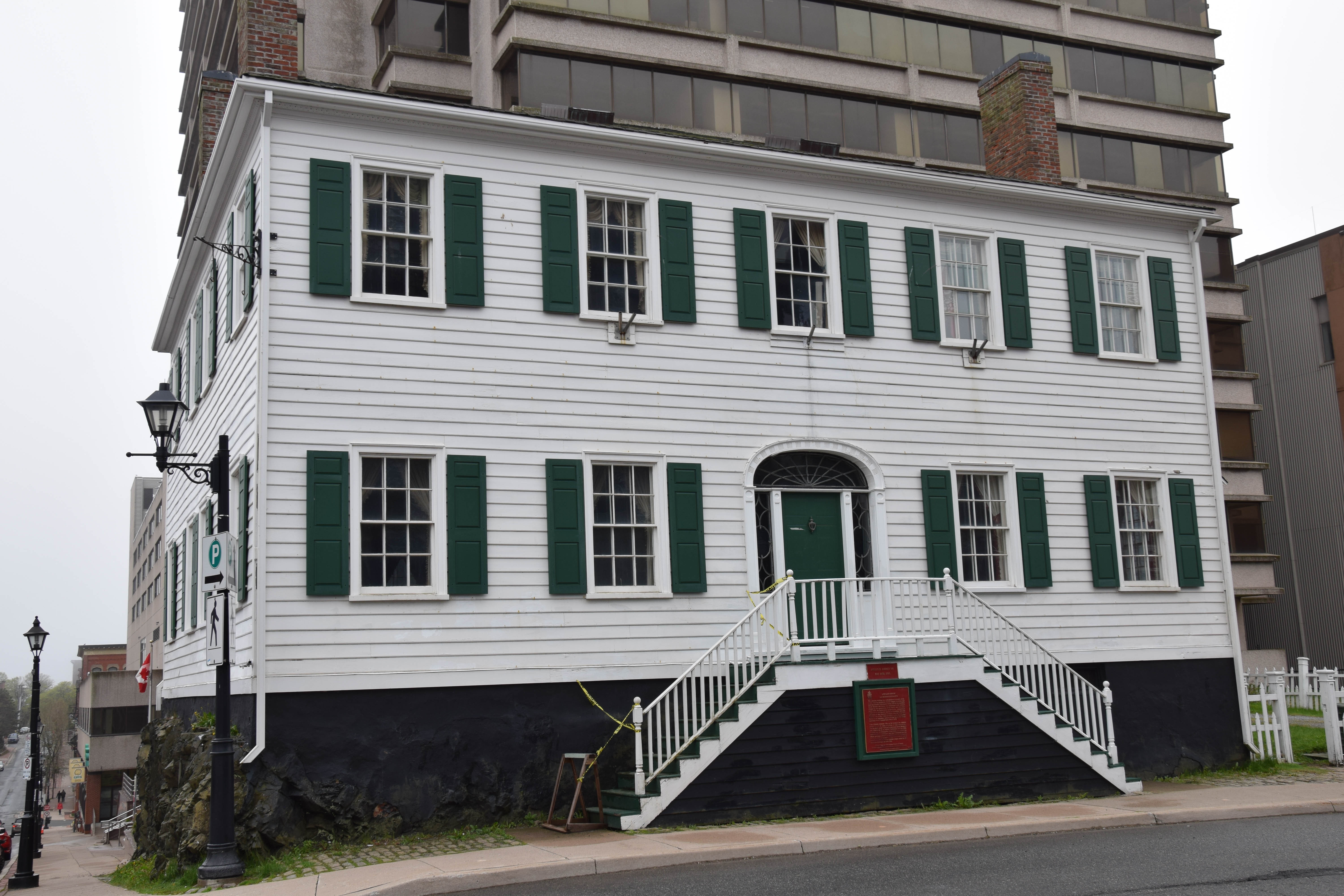
Loyalist House
Walk up to 120 Union Street in uptown Saint John and you notice something odd: the house sits several feet above the sidewalk, perched on what looks like an artificial hill. It was not always this way. When David Daniel Merritt finished building the house in 1817, it sat at street level. The city later dug down the surrounding roads to ease the grade for draft horses hauling loads up Germain Street, and the house simply stayed where it was, rising above a city that literally lowered itself around it. That stubbornness -- the refusal to be moved or altered -- is what makes Loyalist House remarkable. While the Great Fire of 1877 consumed most of Saint John, this Georgian home endured, and it remains the oldest structurally unaltered building in the city.
Refugees Who Built an Empire
The Merritt family were United Empire Loyalists, originally from Rye, New York. In May 1783, they landed at Parrtown -- what is now the south end of Saint John -- along with approximately 6,000 other loyalists who had fled the American Revolution. The patriarch, Thomas Merritt, arrived with his wife and seven children in what the records politely describe as "modest circumstances." Modest did not last. Within a generation, the family had amassed considerable wealth, and Thomas's third son, David Daniel Merritt, became a prosperous shopkeeper. He purchased the property on Union Street and began construction in 1810. The War of 1812 slowed progress, and the house was not completed until 1817. At that time, Union Street marked the city's northern border, and the surrounding land was so sparsely populated that the Merritts kept livestock on the property well into the second half of the century.
A House Built for Symmetry
Loyalist House was built in the New England Federalist style, a deliberate echo of the world the Merritts had left behind. The two main floors are nearly identical in layout and almost perfectly symmetrical: living and dining rooms, a kitchen, a study, four bedrooms, and a network of family and servant halls. Four chimneys with two fireplaces each provided heat, while thirty-one large windows flooded the rooms with light from the harbour. A centralized bell system allowed the family to summon servants, and separate staircases kept the household's two classes from crossing paths too often. The top floor housed five rooms for servants, including what may have been a small dining room with an adjoining pantry connected by an interior window -- a curious detail that suggests even the help ate with a degree of formality. Gas lighting was installed at some point but later disabled by the family, leaving little trace today. Outside, a carriage house -- once double its current length -- sheltered the Merritts' carriage, sleigh, and livestock.
Surviving What Neighbors Could Not
On June 20, 1877, the Great Fire of Saint John destroyed some 1,600 buildings and left 13,000 people homeless. Nearly every structure of Loyalist House's era vanished in a single afternoon. The house survived, reportedly because servants surrounded it with wet towels to keep the flames at bay. Its survival made it a relic overnight -- suddenly the oldest unaltered building in a city forced to rebuild from ash. The Merritt family continued to own the house until 1961 and lived in it on and off until Louis Merritt Harrison died in 1958. His housekeeper stayed on until industrialist K.C. Irving and an associate purchased the property and handed it to the New Brunswick Historical Society, which opened it as a museum. In 2017, the house underwent a $600,000 refurbishment, a modest investment to preserve two centuries of continuous history.
A Museum of Domestic Life
Today, Loyalist House operates as a museum from Loyalist Day on May 18 through early September, with extended openings for cruise ship arrivals in autumn. The two main floors are furnished with Georgian and Victorian pieces drawn from the collections of the New Brunswick Historical Society, the New Brunswick Museum, and Kings Landing Historical Settlement. Guided tours emphasize not just the Merritt family but the broader texture of wealthy 19th-century life in Saint John -- a city that was, for a time, one of the most prosperous in British North America. The house offers something increasingly rare in a world of interactive exhibits and digital reconstructions: an authentic domestic space where the rooms themselves are the primary artifact. The fireplaces, the servant bells, the symmetrical halls -- they are not reproductions. They are the real thing, standing where they have stood since 1817.
From the Air
Located at 45.27°N, 66.06°W in uptown Saint John, New Brunswick. The house is near the waterfront in the urban core. Nearest airport is Saint John Airport (CYSJ), approximately 15 km east. The Bay of Fundy coastline and Saint John Harbour are prominent visual landmarks. Best viewed at 2,000-3,000 feet AGL for urban context.