Luba Crater Scientific Reserve
It takes two days on foot to reach the floor of the Gran Caldera de Luba. The crater walls drop nearly vertically for a thousand meters, and when a Spanish expedition from the Technical University of Madrid descended by rope in 2007, their guides had to hack through the jungle below with machetes. They collected over 2,000 specimens of plants and animals, including 250 types of butterfly. Perhaps 100 of the species were new to science. This is what isolation buys on Bioko: a volcanic island off the coast of West Africa where the forests inside a shield volcano have remained, until recently, beyond the reach of anyone who might empty them.
An Island on the Continental Shelf
Bioko sits on the African continental shelf and was likely connected to the mainland until the last ice age ended roughly 10,000 years ago. It belongs to the Cameroon line, a chain of volcano-capped swells stretching nearly 1,000 kilometers from the island of Pagalu in the southwest to the Oku volcanic field on the mainland in the northeast. The island is made of two volcanic massifs, and the Caldera de Luba, at 2,261 meters, is the highest point of the southern one. The shield volcano, formerly known as San Carlos, has been active within the last 2,000 years. Its crater has walls exceeding 1,000 meters in height and a diameter of five kilometers. Waterfalls cascade down the mountain slopes toward black sand beaches on the coast below. Before Equatorial Guinea gained independence from Spain in 1968, cocoa was king here. Since then, many plantations have been reclaimed by the forest.
The Wettest Mountain
Prevailing humid winds drench the Caldera de Luba with up to 10,000 millimeters of rain per year, making it one of the wettest places on Earth. Temperatures in the lower regions range from 17 to 34 degrees Celsius. This relentless moisture feeds layered forests: closed rainforest rich in species below 700 meters, montane forest draped with creepers and epiphytes up to 2,000 meters, and palm forests in between. The lowland trees reach 50 meters tall, emerging above a canopy of roughly 30 meters, with figs dominating the upper stories. The reserve's 51,000 hectares encompass the full spectrum from black sand beach to volcanic summit, much of it pristine. On the wetter southern slopes, the forest has been largely untouched by human hands.
Africa's Primate Stronghold
The Gran Caldera de Luba holds some of the highest primate densities recorded anywhere in Africa, with 1.2 to 3.3 encounters per square kilometer. Five primate species here are of global conservation concern: Preuss's monkey, the red-eared guenon, the black colobus, the western red colobus, and the drill. The reserve may shelter the largest surviving population of drill on Earth. According to the IUCN Species Survival Commission's Primate Specialist Group, Bioko is the single most important location in Africa for conserving primate diversity. Pennant's colobus, a subspecies of red colobus found only on the island, ranks among the most endangered primates in the world. No viable captive populations exist for any of Bioko's monkey subspecies. Attempts to raise black colobus and red colobus in captivity have failed. If these populations disappear from the crater, they disappear entirely.
Bushmeat and the Price of Oil
In the early 1980s, a commercial bushmeat market took root in Malabo, the capital on Bioko's north coast. Offshore oil discovery pumped money into the economy, increasing the number of people who could afford what had become a luxury food. Improved roads provided easier access to remote areas like the Luba Crater. A theoretical ban on primate hunting has had no effect because the government does not enforce it. Shotgun hunting is increasingly common, since bushmeat prices easily cover the cost of cartridges. A single 20-kilogram drill commands over $250 in Malabo. The meat of drills, red colobus, and black colobus fetches the highest prices. About 7,200 people live in or near the reserve, and for the villagers of San Antonio de Ureca in the south, trade in monkeys and turtles was until recently a primary source of income.
Holding the Line
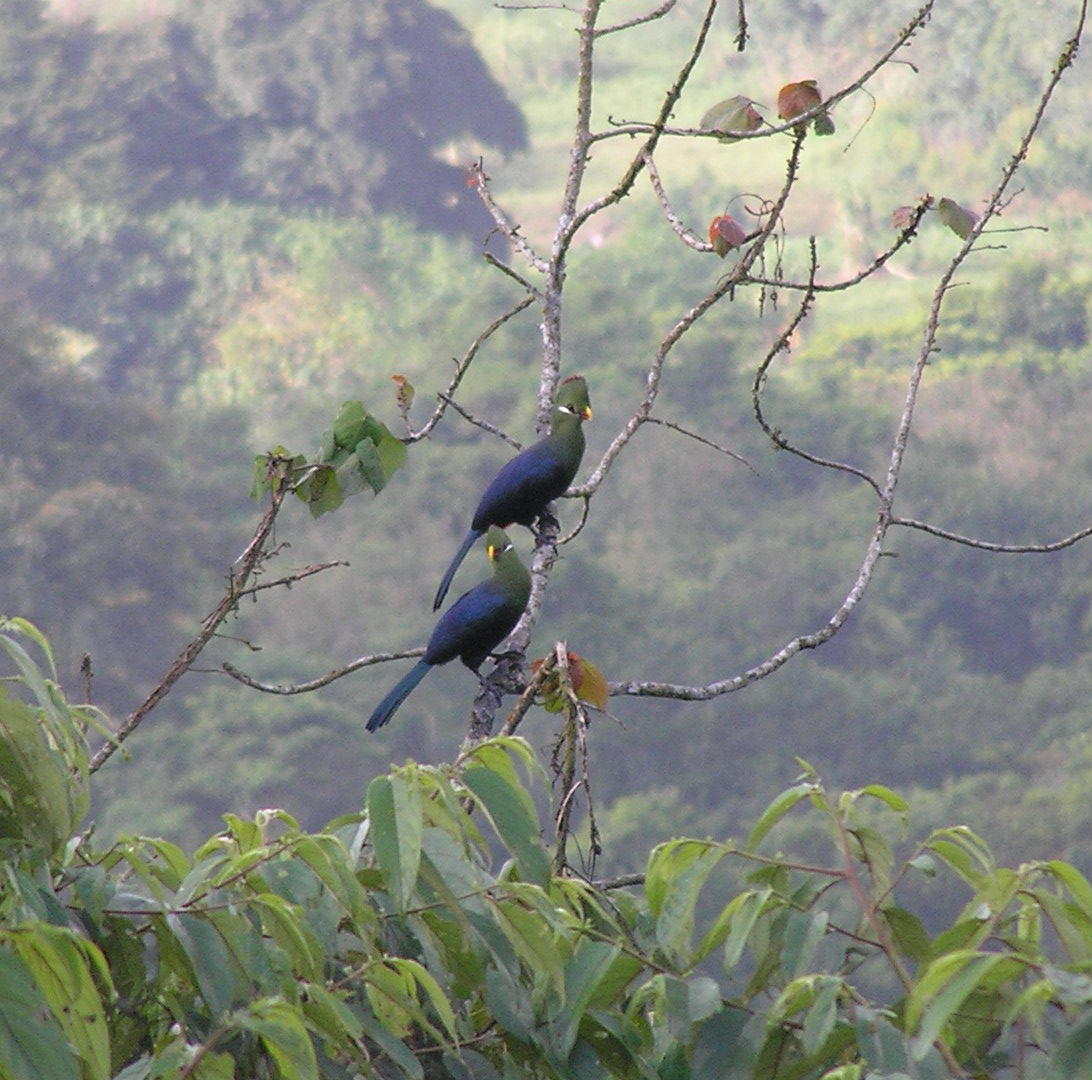
Conservation efforts began in 1995 when the Spanish organization Asociacion Amigos de Donana launched a program focused on green sea turtle protection. Since 1998, the Bioko Biodiversity Protection Program, a partnership between the National University of Equatorial Guinea and Drexel University in Philadelphia, has maintained continuous research operations. BBPP runs the Moka Wildlife Center, the country's first permanently operating research station, designated in 2019 as an official management center for the reserve. Two seasonal research stations on the southern coast monitor turtle nesting and serve as gateways to the caldera. The program employs residents of Ureca as forest guards, providing income that offsets the loss of bushmeat revenue. Endangered green, hawksbill, olive ridley, and leatherback sea turtles all nest on the reserve's beaches. BirdLife International has designated the crater an Important Bird Area, with 120 identified bird species including 36 endemic to Bioko. The Fernando Po batis exists nowhere else on Earth.
From the Air
The Gran Caldera de Luba is located at 3.35°N, 8.51°E on the southern half of Bioko Island, Equatorial Guinea. From altitude, the massive crater is visible as a circular depression in the volcanic massif, surrounded by dense forest. The island's main airport is Malabo International Airport (FGSL) on the north coast. The crater rises to 2,261 meters, so approaches from the south offer dramatic views of the caldera walls and cascading waterfalls. Expect heavy cloud cover and rain year-round due to the mountain's exceptionally wet microclimate.