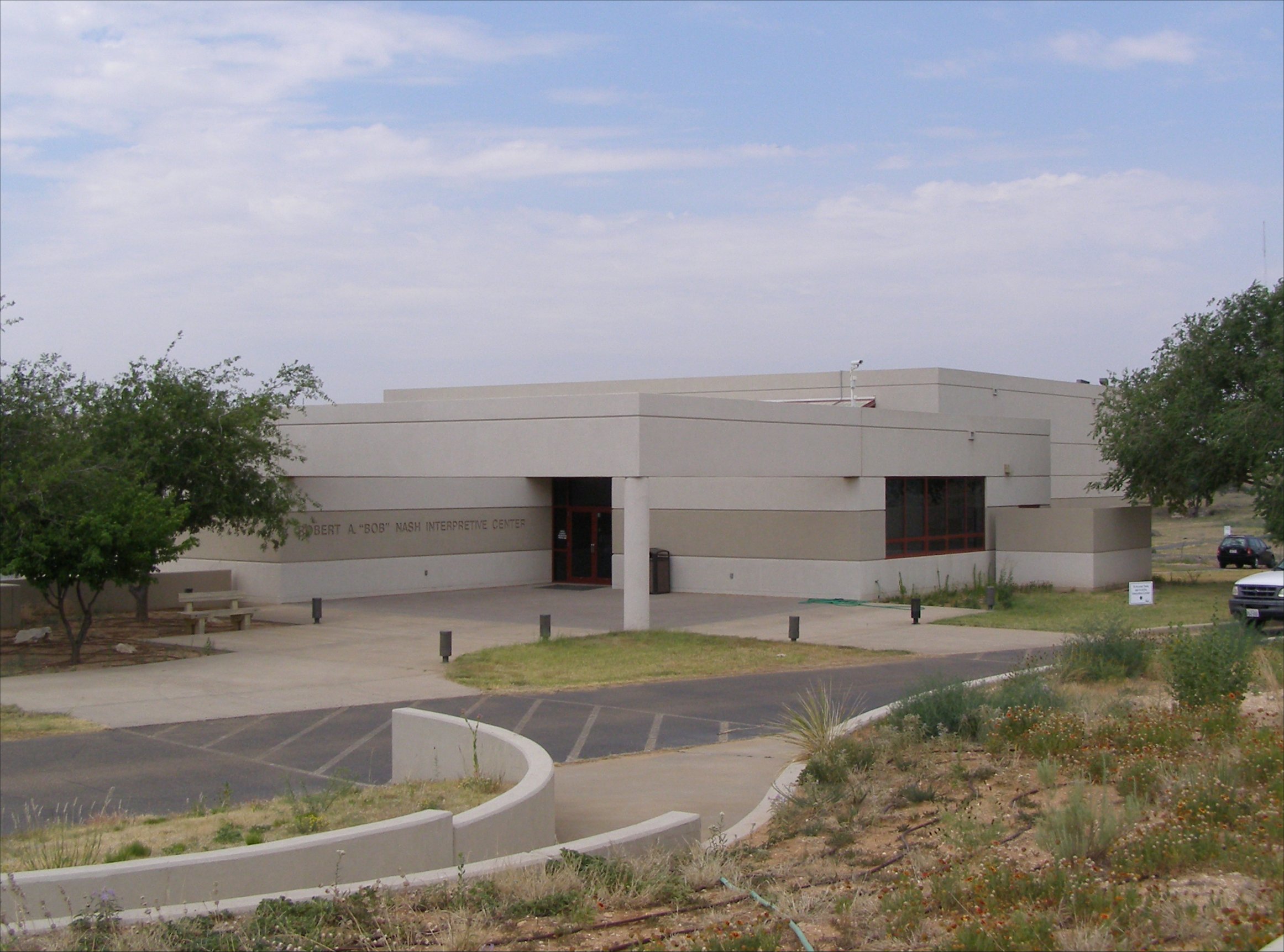
Lubbock Lake Landmark
There is no lake at Lubbock Lake. There has not been one for millennia. What remains is something far more valuable: a meander in a dry streambed that holds the complete story of human occupation on the southern High Plains. Lubbock Lake Landmark preserves nearly 12,000 years of continuous human activity in its layered sediments, from the Clovis mammoth hunters who arrived at the end of the last Ice Age to the Anglo buffalo hunters who passed through in the 1870s. When the City of Lubbock dredged this bend in Yellow House Draw in 1936, searching for water, they found history instead. Today, volunteers from around the world join archaeologists each summer to carefully brush away the centuries, revealing bones, tools, and fire pits that document virtually every cultural period known in North America.
The Geology of Memory
The bedrock beneath Lubbock Lake is part of the Blanco Formation, Pleistocene lake sediments roughly two million years old. Above it lies the Blackwater Draw Formation, wind-deposited silt that accumulated between one million and 50,000 years ago. The critical feature is Yellow House Draw, a tributary of the Brazos River that carved through these layers about 20,000 years ago, creating a bend some fifteen meters deep by 10,000 BC. Ancient springs fed the meander, attracting animals and humans alike. The geological record tells a story of gradual drying: first stream deposits, then lake sediments, and finally windblown sand from a severe drought between 6,500 and 4,500 years ago. This slow environmental shift preserved each era distinctly, separating cultural deposits with sterile layers that allow archaeologists to read the site like pages in a book.
Mammoth Hunters to Apache Warriors
Material from the Clovis Period, 11,500 to 11,000 years ago, sits on gravel bars of the ancient stream. Excavators have found mammoth, two types of horse, camel, ancient bison, giant short-faced bear, and armadillo-like Pampatheriidae. These Paleo-Indian hunters broke mammoth bones to fashion tools and established butchering sites around the ponds. In the late 1940s, charred bison bones from a Folsom Period kill produced the first-ever radiocarbon date, roughly 9,800 years old, a scientific milestone that still anchors dating methods today. Later peoples left baking ovens, hearths, broken Puebloan pottery, and finally Apache camps from the 15th through 18th centuries. The Comanches pushed the Apache out and dominated the Llano Estacado until the 1870s, when they too yielded to a new wave of arrivals.
From Trading Post to Landmark
The most recent archaeological deposits include rifle cartridges, square nails, buttons, and a ginger beer bottle. These artifacts mark George Singer's store, the first commercial business in what would become Lubbock. Built near the springs in 1881 at the crossing of two military trails, the Singer Store served early settlers and cattle ranchers until it burned in 1886. The store was the seed from which modern Lubbock grew. In 1936, the city's failed attempt to tap the meander for drinking water revealed its archaeological significance. The first explorations were conducted in 1939 by the West Texas Museum, now the Museum of Texas Tech University, which still operates the site. Listed on the National Register of Historic Places and designated a National Historic and State Archeological Landmark, Lubbock Lake now invites visitors to watch active digs and trace the full sweep of human experience on the southern plains.
Viewing the Landmark From Above
From the air, Lubbock Lake Landmark appears as a preserved green swath in the meander of Yellow House Draw, set apart from the surrounding urban development of northwest Lubbock. The site lies roughly three miles northwest of downtown, adjacent to the Lubbock Preston Smith International Airport. Look for the distinctive loop in the drainage and the museum buildings along its southern edge. The interpretive trails and excavation areas are visible as pale clearings within the preserve. The contrast between the ancient streambed environment and the flat, gridded city around it is striking, a reminder that this oasis drew humans for 12,000 years before Lubbock ever existed.
From the Air
Lubbock Lake Landmark is located at 33.622N, 101.890W, approximately 3 nm northwest of downtown Lubbock. The site sits in the meander of Yellow House Draw and appears as a green preserve area contrasting with surrounding development. Lubbock Preston Smith International Airport (KLBB) is approximately 2 nm to the northeast. The landmark is best viewed at lower altitudes in clear weather when the preserved streambed and museum complex are visible against the urban grid.