Lucca Cathedral
Look carefully at the facade of Lucca Cathedral and you will notice something odd: every column is different. According to local legend, the citizens announced a contest for the best column, then took them all without paying the artists. Whether the tale is true hardly matters -- it captures something essential about this cathedral, where the unexpected keeps appearing around every corner. A labyrinth carved into the portico references the Minotaur's Crete. A wooden crucifix inside supposedly dates to the time of Christ. And the bishop who began the current building in 1060 later became Pope. Lucca Cathedral is a building that collects improbable stories the way some buildings collect dust.
From Bishop's Chair to Pope's Throne
A church has stood on this site since the 6th century, when the bishop's seat transferred here from the church of San Reparto. But the building that stands today owes its existence to Bishop Anselm, who began construction in 1060 -- four years before Pisa Cathedral, Lucca's great rival, broke ground. Anselm would go on to become Pope Alexander II, making this one of the rare cathedrals whose founding bishop ascended to the papacy. The cathedral chapter that governed the building was formidable in its own right: four dignities and fourteen canons who enjoyed the privilege of wearing the mitre and a gold pectoral cross. They guarded their independence fiercely. When a later Bishop Anselm -- Anselm of Lucca -- tried to impose the Rule of Saint Augustine upon them in 1077, the canons largely refused. A Papal interdict followed, but the chapter held firm until Anselm was expelled from Lucca around 1080. In 1225, the chapter chose their bishop by lot, selecting a cathedral canon named Riccardus. Pope Honorius III confirmed the election despite his displeasure at the method.
The Holy Face
The most precious object in Lucca arrived, according to legend, through a series of miraculous events in 782. The Volto Santo -- the Holy Face -- is a wooden crucifix that tradition claims was carved by Nicodemus, a contemporary of Jesus, capturing Christ's actual likeness. Art historians date it more prosaically to the late 8th or early 9th century, but its significance transcended questions of provenance. The Volto Santo made Lucca a major pilgrimage destination, drawing travelers from across medieval Europe. Lucchese merchants carried its image wherever they traded, spreading the cult as far as England. Today the crucifix rests in a small octagonal chapel built by Matteo Civitali in 1484, the most famous Lucchese sculptor of the early Renaissance. Civitali's tempietto sits in the nave like a building within a building, its Renaissance elegance framing a relic that connects the cathedral to the earliest centuries of Christianity -- or at least to Lucca's fervent belief that it does.
Romanesque Bones, Gothic Flesh
The architectural history of the building is written in its stones. The great apse with its tall columnar arcades and the campanile survive from the original Romanesque construction. But the nave and transepts are 14th-century Gothic, creating a dialogue between two centuries of architectural thinking under one roof. The west front is the cathedral's crowning achievement: a vast portico of three arches, surmounted by three ranges of open galleries adorned with sculpture -- each of those mismatched columns contributing to a facade that reads like a catalog of medieval carving skills. Inside, masterworks accumulate across centuries. Domenico Ghirlandaio's Madonna and Child with Saints hangs alongside Federico Zuccari's Adoration of the Magi. Jacopo Tintoretto contributed a Last Supper near the end of the 16th century, and Fra Bartolomeo's Madonna and Child dates from 1509. The funerary monument of Ilaria del Carretto, carved by Jacopo della Quercia in 1413, is considered one of the finest tomb sculptures of the early Renaissance -- a young woman lying in repose with her small dog at her feet, eternally asleep.
The Labyrinth at the Door
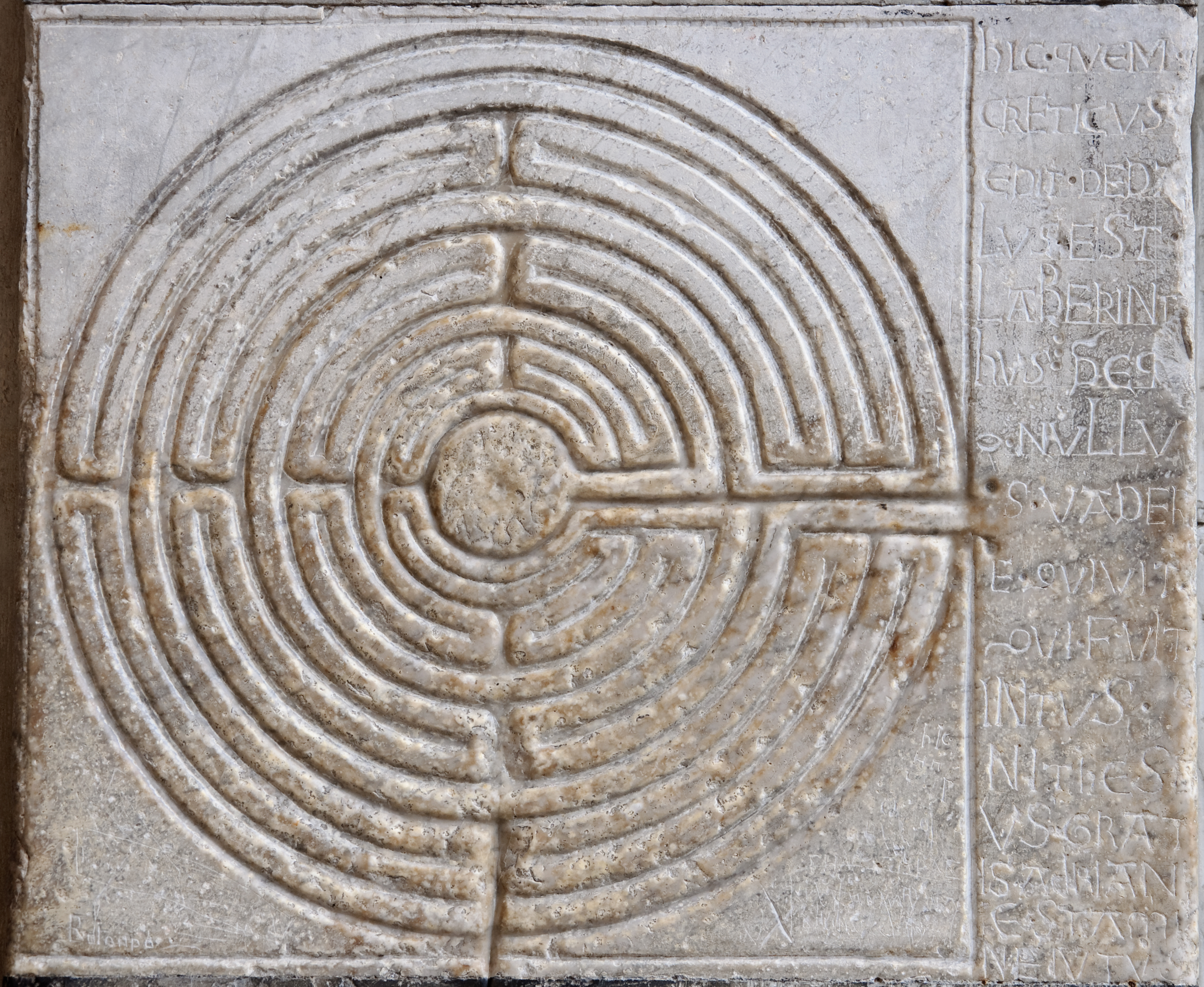
Carved into the right pier of the portico is a labyrinth believed to date from the 12th or 13th century. It follows the Chartres pattern -- the same design that would become standard for church labyrinths across Europe -- and may actually predate the famous labyrinth at Chartres Cathedral, making it potentially the template rather than the copy. A rustic Latin inscription runs alongside it, referencing not Christian theology but pagan mythology: 'This is the labyrinth built by Daedalus of Crete; all who entered therein were lost, save Theseus, thanks to Ariadne's thread.' The mixing of Greek myth with Christian architecture was not unusual in medieval Italy, where classical learning never entirely disappeared, but it remains striking to find the Minotaur's architect invoked at the entrance to a house of God. Medieval worshippers may have traced the labyrinth's path with a finger as a substitute pilgrimage, a miniature journey to Jerusalem and back performed at the church door before stepping inside.
From the Air
Located at 43.841N, 10.506E in the center of Lucca, a walled city in Tuscany approximately 20 km northeast of Pisa. The cathedral sits within Lucca's remarkably intact Renaissance walls, which form a distinctive oval visible from the air. Best viewed at 2,000-4,000 feet AGL. Nearest airports: Pisa International (LIRP/PSA, 25 km southwest) and Lucca's small Tassignano airfield (LIQL). The campanile is a useful visual reference point rising above the red-roofed cityscape.