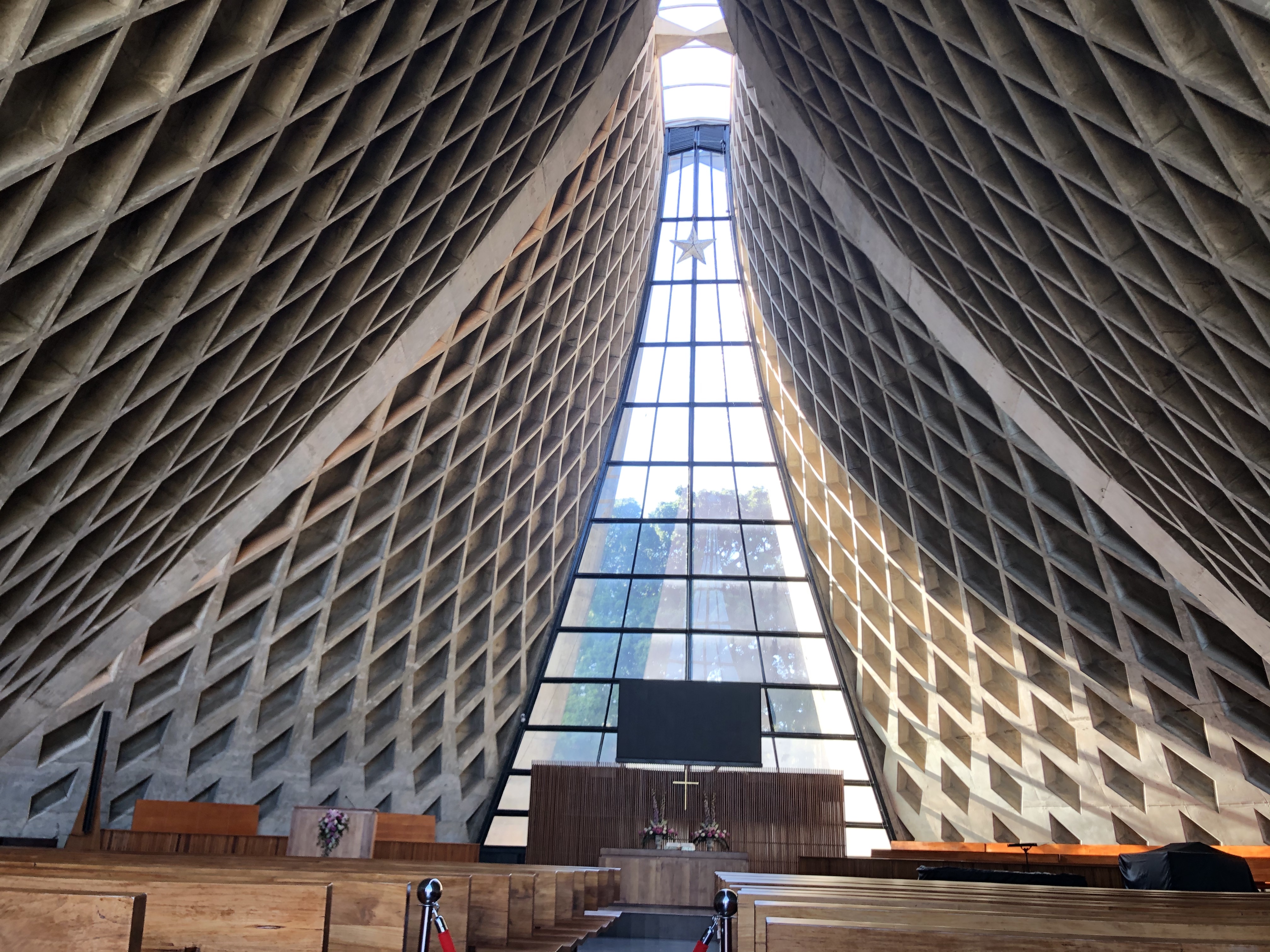
Luce Memorial Chapel
Four curved walls lean toward each other and never quite touch. The Luce Memorial Chapel at Tunghai University in Taichung, Taiwan, rises 19.2 meters from an irregular hexagonal base, its form suggesting a tent, a pair of praying hands, or something more elusive depending on the angle and the light. Designed by I. M. Pei and Chen Chi-kwan, two of the twentieth century's most distinctive architectural voices, the chapel was completed in November 1963 at a cost of just $125,000. It remains one of Taiwan's most recognizable buildings, voted among the island's top ten man-made marvels, and it started with a $50,000 donation that made The New York Times in 1954.
A Missionary's Legacy
The chapel takes its name from Henry W. Luce, an American Presbyterian missionary who spent decades in China during the late nineteenth century. His son, Henry R. Luce, became one of America's most powerful media figures as the publisher of Time, Life, and Fortune magazines. The elder Luce's commitment to Christian education in Asia lived on through the Luce Foundation, which provided the initial gift for the chapel's construction at Tunghai University, a Christian institution founded in 1955. The project was first planned in April 1954, but financial and design complications delayed construction until September 1962.
Concrete Poetry
Pei and Chen originally conceived the chapel as a multi-planar wooden structure, but Taiwan's humid climate and seismic activity forced them to abandon timber. What emerged instead was a conoid form built from reinforced concrete: four warped leaves that rise and narrow toward the sky, their surfaces composed of lattice beams that grow thicker as they descend. The design bears the influence of Le Corbusier's Philips Pavilion, built for the 1958 Brussels World's Fair, but with a crucial difference. The Luce Chapel is not a thin-shell structure. Its planes carry real structural weight, a concept possibly informed by Louis Kahn's Yale University Art Gallery, completed in 1953. The diamond-shaped yellow glazed tiles covering the exterior mirror the diamond-shaped coffer beams visible inside, creating a visual continuity between outer skin and inner skeleton.
The Hands of Local Craftsmen
For all the international pedigree of its designers, the Luce Chapel was built by Taiwanese hands. The elaborate reinforced concrete formwork required to achieve the chapel's curved surfaces was created entirely by local craftsmen. The chapel sits on a 3-acre zone at the center of the Tunghai campus, its irregular hexagonal base enclosing 477 square meters of floor area. The 245-square-meter nave seats 500. An 81-square-meter chancel and 44-square-meter robing rooms complete the interior. The building establishes itself as the campus's central landmark not through size but through the drama of its silhouette, visible from nearly every approach across the university's wooded grounds.
Sacred Geometry in the Subtropics
What makes the Luce Memorial Chapel endure is the tension between its ambitions. It is a Christian chapel drawing on modernist European forms, built on a Confucian-influenced campus in subtropical Taiwan, designed by a Chinese-American architect and a Taiwanese painter-architect. Pei, who would go on to design the Louvre Pyramid and the Bank of China Tower, was still early in his career. Chen Chi-kwan brought a painter's sensibility to the collaboration, and the result feels less like a building than a sculpture that happens to contain pews. The yellow tiles catch afternoon light and glow against Taichung's green hills. Inside, the narrowing walls draw the eye upward along the lattice beams toward a sliver of sky. It is a building that earns its silence.
From the Air
Located at 24.18N, 120.60E on the Tunghai University campus in Xitun District, western Taichung, Taiwan. The chapel's distinctive tent-shaped silhouette, rising 19.2 meters, is identifiable from low altitude amid the university's wooded campus. Nearest airport: Taichung Airport (RCLG/RMQ), approximately 15 km north. The campus is situated on the western edge of the Taichung metropolitan area, near the Taichung Intercity Bus Terminal.