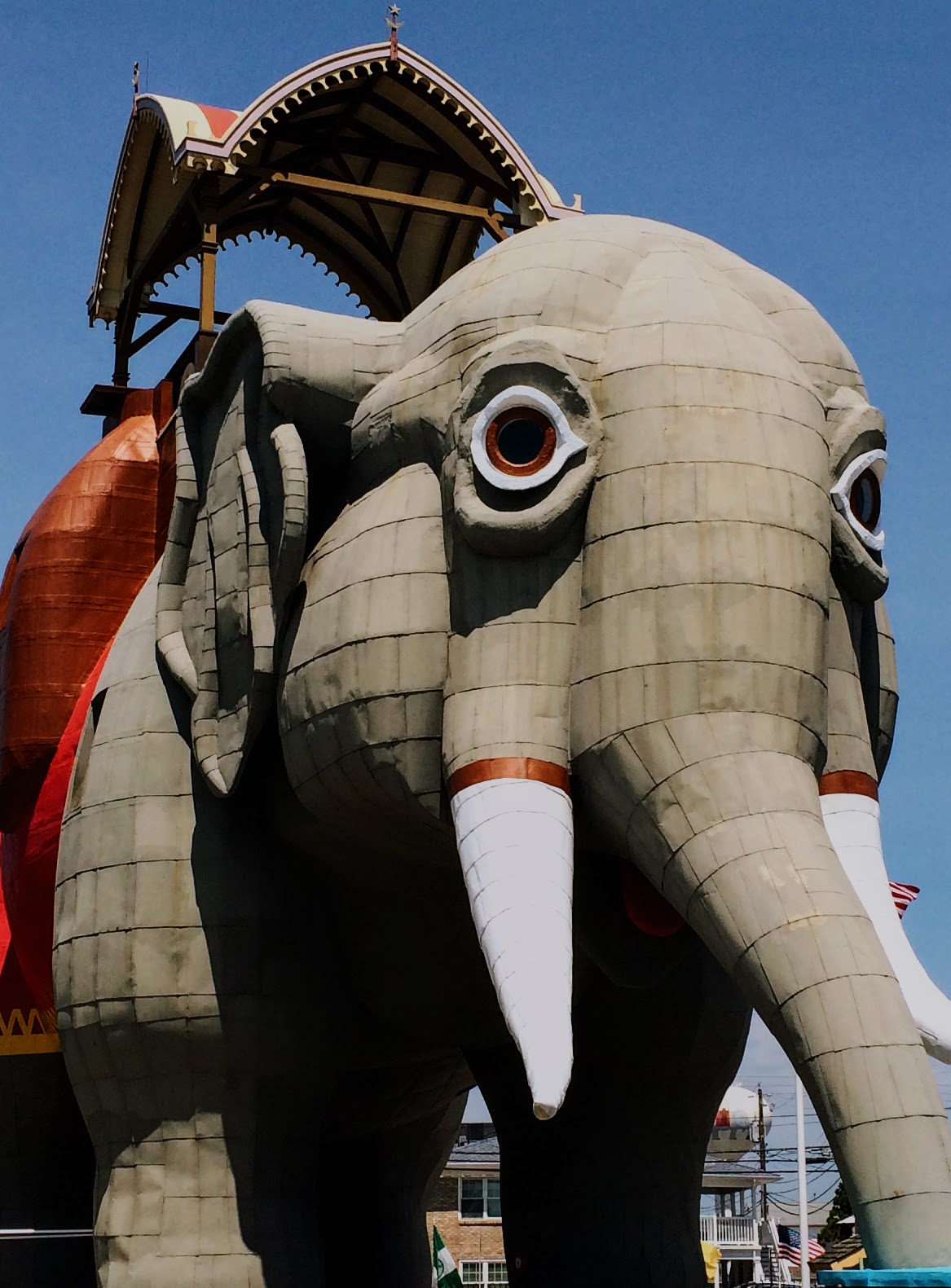
Lucy the Elephant: America's Oldest Roadside Attraction
On the New Jersey shore, in the town of Margate City, a six-story elephant has been staring at the Atlantic Ocean for 143 years. Lucy is made of wood and tin, stands 65 feet tall, weighs 90 tons, and has outlasted practically every building constructed in her era. She was built in 1881 to attract real estate buyers to a speculative beach community; when that failed, she became a tavern, then a summer cottage, then an abandoned eyesore scheduled for demolition. A group of locals saved her in 1969, moved her two blocks to safer ground, restored her to glory, and made her a National Historic Landmark. Lucy is the oldest surviving roadside attraction in America - proof that Americans have always loved giant weird things, and always will.
The Scheme
James V. Lafferty was a real estate developer with a problem: nobody wanted to buy lots in South Atlantic City (now Margate City). The beach was nice enough, but there was no reason to visit. Lafferty's solution was spectacular: build a six-story elephant on the beach. The elephant would attract tourists; tourists would see the beautiful shore; buyers would snap up lots. Lafferty even patented the idea of building structures shaped like animals (he planned more elephants, never built them). The elephant opened in 1882, and it worked - people came. But the real estate scheme failed anyway, and Lafferty sold the elephant in 1887 to pay debts.
The Lives
Lucy has been many things. After Lafferty sold her, she became a tavern - the Elephant Bazaar, serving drinks in the belly of a beast. Later she became a summer rental cottage; tenants climbed into the howdah (the platform on her back) for ocean views. During Prohibition, locals claimed bootleggers used her for storage. By the 1960s, Lucy was abandoned, her tin skin rusting, her wooden bones rotting, vandals stripping anything removable. Demolition was scheduled - she would become scrap metal - when a civic group intervened. The Save Lucy Committee raised money, moved the entire structure, and began the restoration that continues today.
The Architecture
Lucy is wooden frame covered in painted tin, standing on a brick foundation. Her legs are 10 feet in diameter; her eyes are windows; her howdah provides a viewing platform reached by spiral staircase. Architect William Free designed her; the construction was conventional framing shaped unconventionally. She's not sculpture but architecture - a building that happens to be elephant-shaped. The engineering is clever: the legs handle structural loads, the body provides interior space, the head is decorative. Lucy proved that buildings can be anything - a lesson roadside America would embrace wholeheartedly in the automobile age.
The Legacy
Lucy inspired generations of architectural novelty. The Elephant Hotel in Coney Island (bigger than Lucy, demolished in 1896) followed her example. The Brown Derby restaurants, the Big Doughnut, and every giant hot dog and enormous fish on American roadsides owe something to the idea that buildings can be billboards, that architecture can advertise through shape alone. Lucy is the grandmother of roadside attractions - not the first building shaped like something, but the oldest survivor, the National Historic Landmark that proves programmatic architecture has always been part of American culture. She's also proof that community preservation works: Lucy was saved by people who refused to let her become scrap metal.
Visiting Lucy the Elephant
Lucy the Elephant is located at 9200 Atlantic Avenue in Margate City, New Jersey, on the shore south of Atlantic City. Tours are offered regularly; you can climb inside, ascend the spiral staircase, and enjoy views from the howdah. The gift shop sells elephant-themed souvenirs. Lucy is a National Historic Landmark - the only elephant to earn that honor. The beach is adjacent; Atlantic City's casinos are a few miles north. Summer is peak season, but Lucy is accessible year-round (check hours). Philadelphia is 60 miles northwest. The elephant on the shore has outlasted empires; she'll probably outlast the casinos too.
From the Air
Located at 39.32°N, 74.51°W on the New Jersey Shore in Margate City. From altitude, Lucy is visible as an elephant-shaped structure near the beach - look for her just south of Atlantic City's casino towers. She's small from altitude but distinctive; nothing else on the Jersey Shore is elephant-shaped. The Atlantic Ocean stretches east to the horizon. Atlantic City's Boardwalk and casinos are visible to the north. The barrier island topography is clear: beach, development, bay, mainland. Lucy has watched this coast change for 143 years - longer than almost any other structure visible from altitude. She's a landmark in every sense: navigation point, historic site, and testament to American eccentricity.