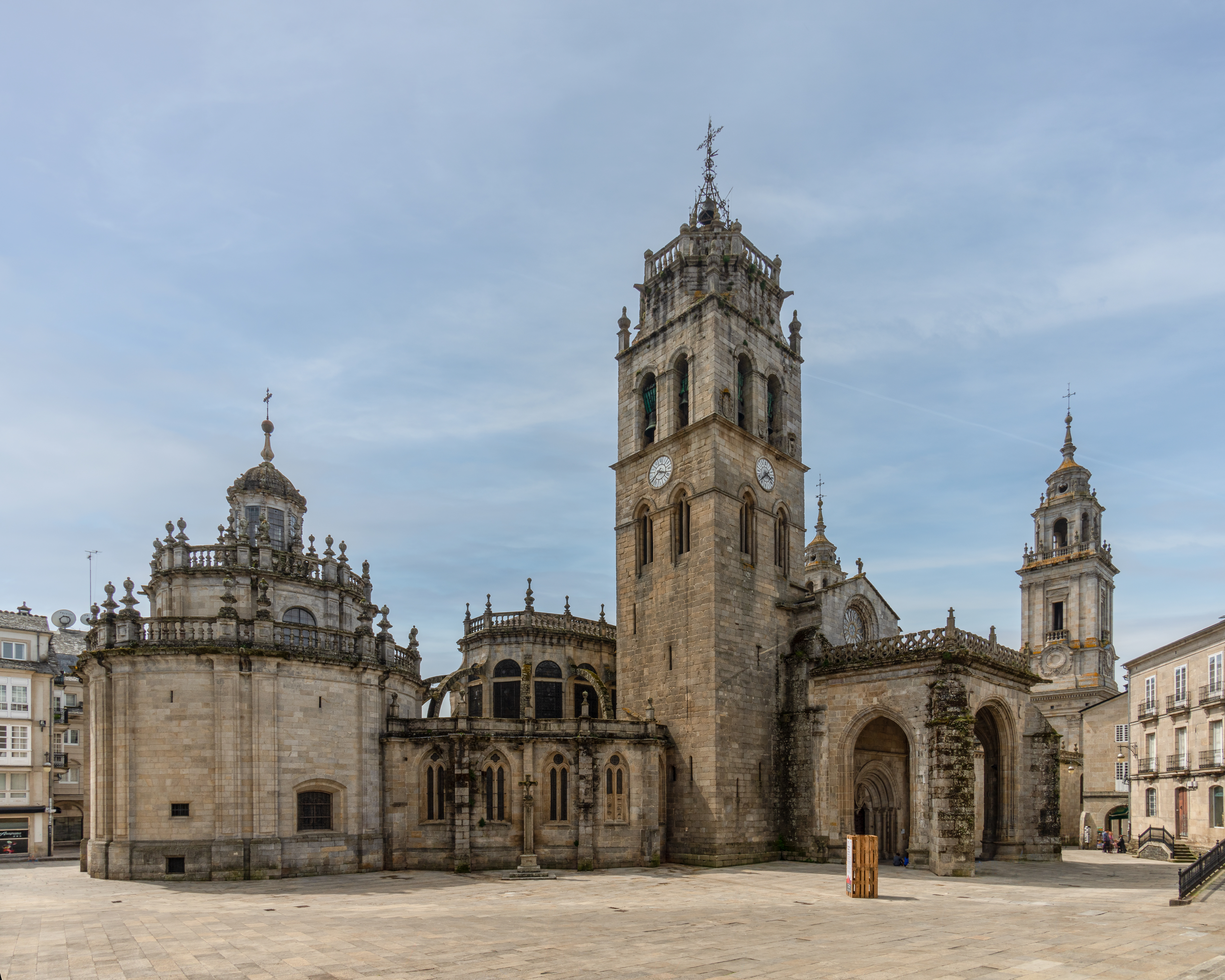
Lugo Cathedral
Only a handful of churches in the world hold the papal privilege of perpetual exposition of the Holy Sacrament -- a distinction that grants them the right to display the consecrated host at all hours, every day, without interruption. Lugo Cathedral is one of them. This rare honor suits a building that has itself been almost perpetually under construction, reinvention, or repair since Bishop Peter III commissioned its Romanesque foundations in 1129. Standing within the circuit of Lugo's Roman walls -- themselves a UNESCO World Heritage Site -- the cathedral is a palimpsest of nearly every major European architectural movement of the past nine centuries.
The Bishop's Commission
A church had occupied this site since at least 755, but by the early 12th century it was no longer adequate for a diocese of growing ambition. In 1129, Bishop Peter III hired a local architect named Raimundo to design a replacement in the Romanesque style then sweeping through the pilgrimage routes of northern Spain. Construction took nearly a century and a half: the structure was not completed until 1273. What Raimundo built was substantial -- an 85-meter-long Latin Cross plan with a barrel-vaulted nave, two side aisles, an ambulatory, and five apse chapels. The proportions are heavy and grounded, as Romanesque churches tend to be, with thick walls doing the structural work that Gothic flying buttresses would later make unnecessary. The triforium, however, hints at the transition already underway: its triple ogival mullioned windows belong more to the Gothic vocabulary than the rounded arches below.
Centuries Written in Stone
The cathedral's history reads like a timeline of architectural fashion. The northern entrance, added between 1510 and 1530, is pure Gothic: three archivolts frame a lintel carved with Christ Pantocrator, and a pinjante -- a distinctive glove-shaped pendant -- hangs from the vault, depicting the Last Supper in miniature. Beside it stands the Torre Vella, the Gothic bell tower, topped with a Renaissance fourth floor finished by Gaspar de Arce in 1580. The sacristy arrived in 1678, Baroque in every detail, followed by the cloister in 1714 and a Baroque chapel in the triforium in 1726. The Renaissance chapel of Saint Froilan dates to the 17th century, and the choir -- carved by the sculptor Francisco de Moure -- fills the nave with elaborate early-17th-century woodwork.
Shock Waves from Lisbon
On 1 November 1755, one of the most powerful earthquakes in recorded history struck Lisbon, sending tremors across the Iberian Peninsula. In Lugo, more than 500 kilometers to the north, the cathedral's Renaissance retablo at the high altar shattered. The loss was irreversible: only fragments of the original altarpiece survive today, housed elsewhere in the church. The destruction prompted a new phase of rebuilding. The current facade, a Neoclassical design inspired by a plan that Ventura Rodriguez had proposed for the Cathedral of Pamplona, was not finished until the late 19th century, when the two side towers were finally completed. The result is a front elevation that looks nothing like the Romanesque interior behind it -- a disconnect that tells the story of the building more honestly than any single style could.
A Quiet Authority
Lugo Cathedral lacks the soaring verticality of Leon or the ornamental excess of Santiago de Compostela's Baroque facades. Its power is quieter and accumulative. Each century left something behind without erasing what came before, and the result is a building that teaches architectural history simply by being walked through. The Romanesque bones are still visible in the nave's barrel vault and heavy columns. Gothic tracery appears in the windows. Baroque gilt gleams in the side chapels. The Neoclassical facade greets visitors with Enlightenment symmetry before they step into a space shaped by medieval geometry. Above it all, the privilege of perpetual exposition continues unbroken -- a small, steady flame of ritual continuity in a structure that has otherwise never stopped changing.
From the Air
Located at 43.01N, 7.56W in the city of Lugo, inland Galicia, northwestern Spain. The cathedral sits within Lugo's complete Roman-era city wall, visible as a roughly circular fortification from altitude. Nearest airport: LEST (Santiago de Compostela Airport, ~95 km west). The Roman walls encircling the old town provide a distinctive visual reference from the air.