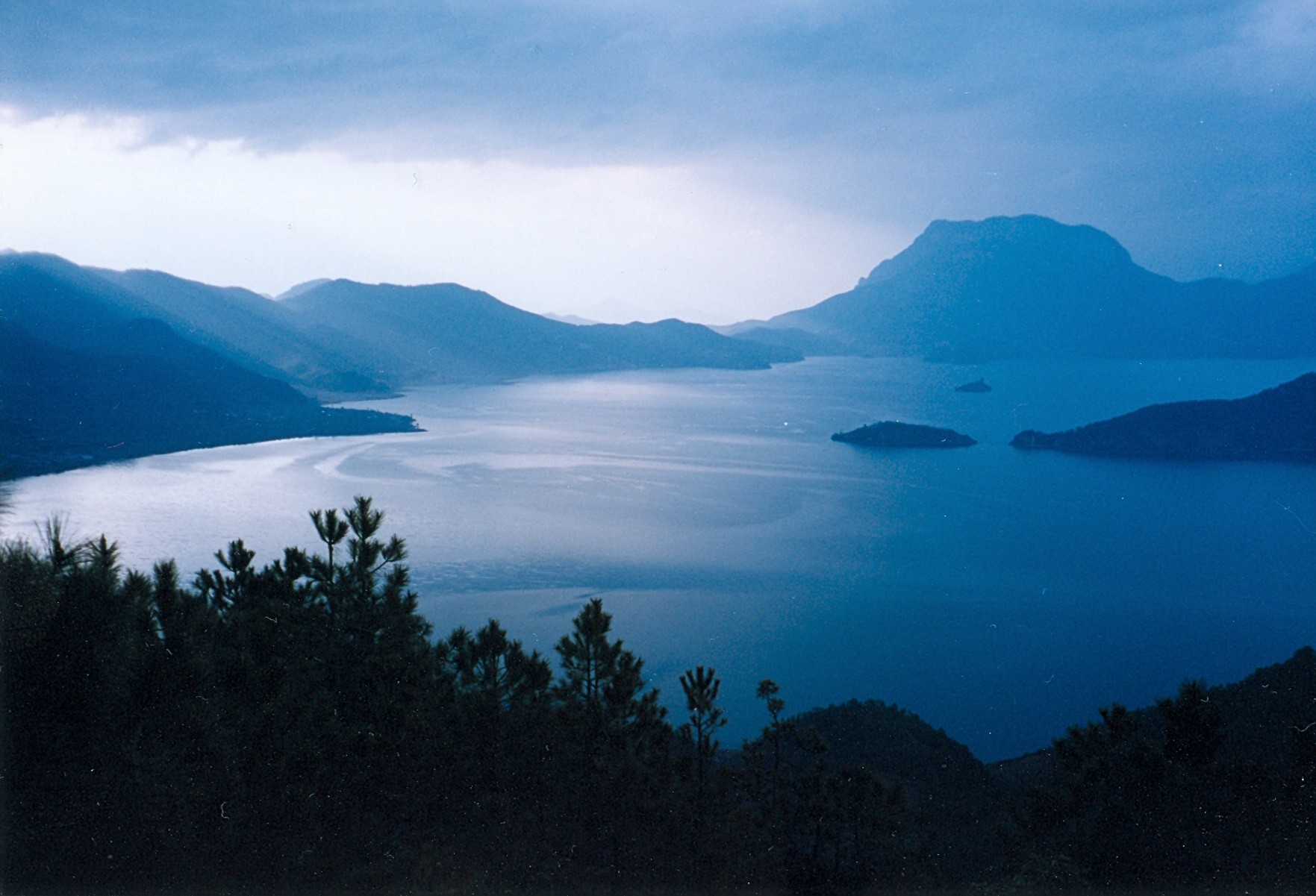
Lugu Lake
In the Mosuo language, lugu means "falling into the water" -- an apt name for a place that swallows your assumptions about how societies organize themselves. Lugu Lake sits at 2,685 meters on the Yunnan plateau, straddling the border between Yunnan and Sichuan provinces, and until 1982 no road reached its shores. That isolation preserved something extraordinary: the Mosuo people, whose matrilineal family structure has endured here for centuries, making this one of the last places on Earth where women hold the primary authority in household and inheritance.
The Kingdom of Women
Chinese travel pamphlets call Lugu Lake the "Kingdom of Women" and the "Home of the Matriarchal Tribe," labels that simplify a far more nuanced reality. The Mosuo people -- sometimes classified as a sub-group of the Naxi, though they maintain a distinct identity -- organize their families around the maternal line. Property passes from mother to daughter, and the grandmother typically heads the household. The Chinese government has described this family structure as "a live fossil for researching the marital development history of human beings," a clinical phrase for something deeply human. The Mosuo share these shores with the Yi, Pumi, and Norzu peoples, each bringing their own traditions to the lake's ecosystem of cultures. Together they have treated the lake as sacred ground, maintaining taboos against killing animals and felling trees along its banks.
Water, Mountains, and Isolation
The lake itself is a geological artifact of the Late Cenozoic, formed along a fault line and now the highest lake in Yunnan Province. Five islands rise from its surface, four peninsulas jut into its waters, and fourteen bays scallop its shoreline. The Gaizu River drains the lake from the southeast, but its outlet is controlled -- open only during the rainy season, sealed from September to May. For three months each winter, snow locks the lake into silence. In spring and autumn, the days warm while the nights stay cold, and the water achieves the clarity that once sustained four endemic fish species: three Schizothorax and one loach. That clarity has become fragile. After exotic species were introduced in 1958 for commercial fishing, three of those native species are now endangered. Deforestation in the 1970s and again in the 1980s sent silt advancing 100 meters into the lake, burying spawning grounds.
The 35-Mile Prayer
Every year, the Mosuo walk the entire perimeter of the lake in a clockwise direction -- roughly 33 miles of prayer through temples, villages, pebble beaches, and marshland. The circumambulation is a parikrama, a devotional circuit rooted in Tibetan Buddhism. Most pilgrims cover it in a single grueling day, though some stretch it across three. The route passes through the Luoshui village, under the shadow of Mount Gama, past trees wrapped in multicolored cloths and pine groves hung with rainbow prayer flags. Pig-trough canoes rock on the water near wooden houses with upturned roofs. At the territory line between Yunnan and Sichuan, pyramidal stupas rise from flat stones inscribed with prayers. Near a wetland called the Grass Sea, a three-tiered Lama Temple in red and white houses a 15-foot fresco of a monk praying among mountains and clouds, flanked by altars, drums, and brass gongs.
Sacred Ecology
The Mosuo relationship with the lake is inseparable from their Buddhism. They consider animals and trees innocent, and anyone who desecrates the water must sacrifice a draft animal, feed its meat to the village, and summon a shaman to restore what they call "topo-cosmic harmony." A Tibetan Buddhist lama then performs additional rites of appeasement. The fisher folk who work zoned sections of the lake watch for the return of the black-footed crane each year -- its arrival signals prosperity. This interweaving of ecology and belief kept Lugu Lake relatively pristine for centuries. The road that finally arrived in 1982, connecting the lake to Lijiang 200 kilometers away, brought tourists and commerce. Commercial fishing yields that once reached 500 tonnes had dropped to just 30 tonnes by 1980, a collapse driven by overfishing and siltation long before the tourists came. Now the challenge is whether the Mosuo's sacred relationship with their lake can survive the very attention that relationship attracts.
From the Air
Lugu Lake is located at 27.70N, 100.80E at an elevation of 2,685 meters (8,809 feet) on the Yunnan-Sichuan border. The lake is roughly 48 square kilometers and clearly visible from above, surrounded by mountains. The nearest major airport is Lijiang Sanyi International Airport (IATA: LJG) approximately 200 km to the southwest. Ninglang Luguhu Airport (IATA: NLH) is much closer, roughly 30 km away. Expect mountainous terrain and variable weather; clear days offer stunning views of the lake's five islands and crenulated shoreline.