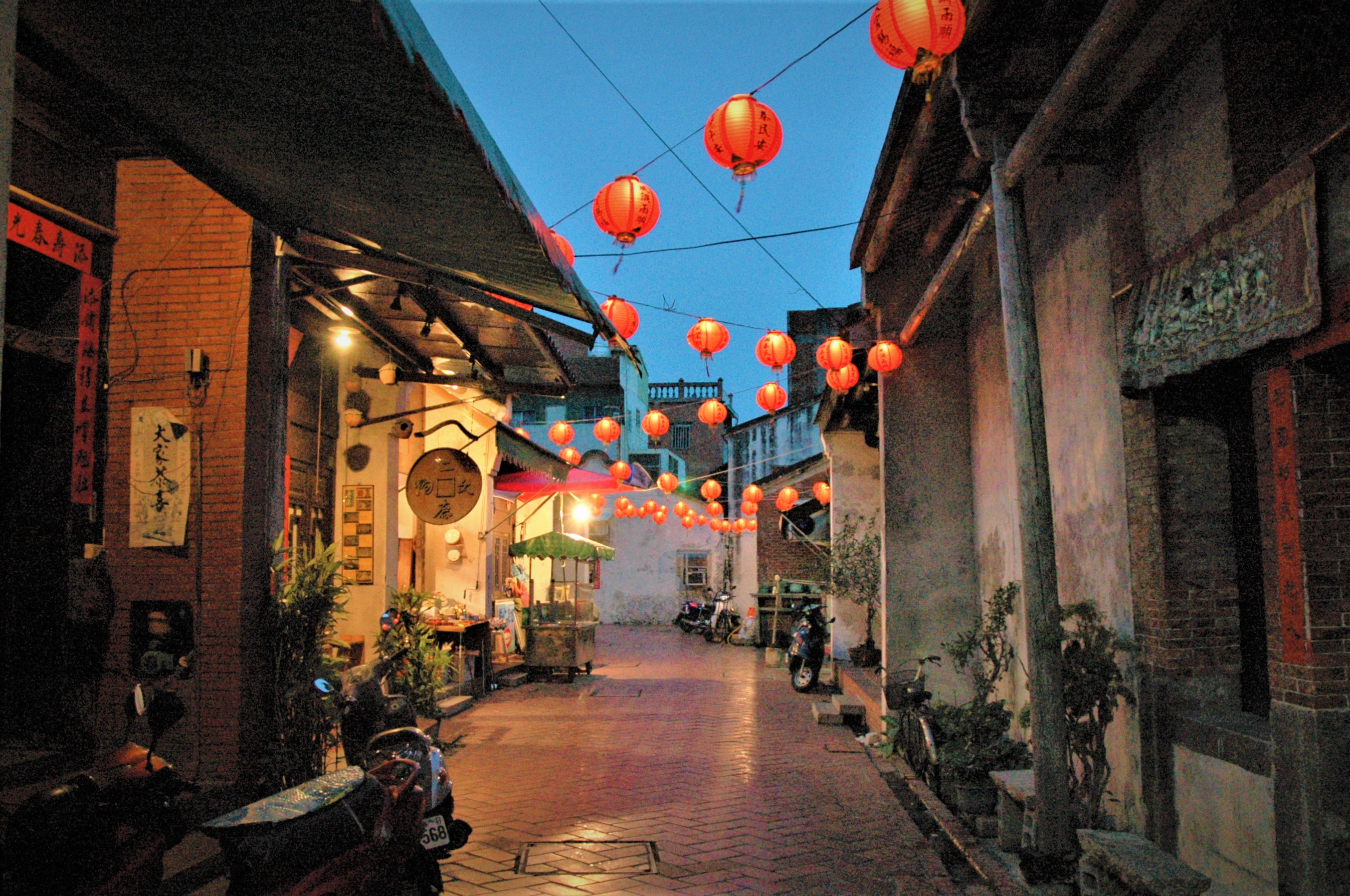
Lukang
Lukang's decline was its salvation. In the 19th century, as the harbor silted up and the city fathers refused to let railroads pass through town, this once-prosperous port on Taiwan's western coast watched its trade evaporate and its population stagnate. Other cities modernized, tearing down their old quarters for wider roads and taller buildings. Lukang could not afford to. By the time anyone thought to look back, the town had accidentally preserved what everywhere else had demolished: a streetscape of Qing-dynasty temples, merchant houses, and narrow lanes that today make it one of Taiwan's most atmospheric heritage destinations.
The Deer Port
The name tells the origin story. Lukang means Deer Port, a reference to the deerskin trade that flourished during the Dutch colonial period in the 17th century. When the Dutch East India Company controlled parts of Taiwan, Formosan sika deer roamed the western plains in enormous numbers, and their hides became a valuable export commodity. The port town that grew up around this trade took the deer as its identity. The old Taiwanese Hokkien name, Lok-a-kang, persists in various romanized forms. In 2011, the Ministry of Interior formally decided to retain the historical Wade-Giles spelling Lukang rather than adopt the newer Pinyin rendering Lugang, a small but telling act of heritage preservation applied to language itself.
Taiwan's Second City
During its heyday from 1785 to 1845, Lukang was Taiwan's second-largest city, behind only Tainan and ahead of Bangka, now a district of Taipei. Its population reached 20,000, sustained by the rice trade that brought great wealth to merchant families like the Huang and Koo clans. The Koo family would go on to produce some of Taiwan's most influential figures, including businessman Koo Hsien-jung and diplomat Koo Chen-fu. Stan Shih, co-founder of Acer, is also a Lukang native. The town punched far above its weight. But prosperity depended on the harbor, and when the harbor began to silt, the trade routes shifted to ports with deeper water and better rail connections.
Two Hundred Temples
What Lukang lost in commerce, it kept in faith. The town boasts over 200 temples dedicated to a wide variety of folk deities, an extraordinary concentration for a township of 85,000. Longshan Temple and the Tianhou Temple are the most celebrated, but smaller shrines occupy nearly every block, their incense smoke drifting into the narrow lanes. The town is also the origin of the Hokkien terms for southern and northern Taiwan: e-kang, meaning below the harbor, and teng-kang, above the harbor, a linguistic reminder that Lukang once sat at the center of the island's mental map. Nanguan music, a refined form of traditional Chinese music originating in Quanzhou, remains popular here, performed by local ensembles who maintain a tradition transplanted across the strait centuries ago.
Cakes, Songs, and Lanterns
Lukang's cultural footprint extends beyond temples. The Yu Jen Jai bakery has been producing its distinctive cakes since the Qing dynasty, and Lukang's ox tongue cakes and oyster pancakes are famous across Taiwan. In 1982, the musician Lo Ta-yu released a song called Lukang, The Small Town, a wistful ballad about urbanization and lost heritage that resonated with a generation of Taiwanese listeners and permanently associated the town with nostalgia for a vanishing way of life. In 2012, Lukang was named one of Taiwan's Top 10 Small Tourist Towns, and the same year it hosted the Taiwan Lantern Festival, beating out six other contenders. The recognition confirmed what locals had always known: Lukang's refusal to change was, in the end, its most valuable asset.
Preserved by Accident
Other Taiwanese cities demolished their historic quarters in the name of progress. Tainan and Taipei bulldozed old neighborhoods for modern development. Lukang, too poor and too stubborn to modernize, simply kept what it had. During the Japanese colonial period, the 1904 census counted 19,805 residents, making it the island's fifth most populous city. The Hoklo people who lived here were predominantly of Xiamen and Quanzhou origin, speaking the Quanzhou dialect of Hokkien. That cultural continuity persists. Walking through Lukang's old streets today, past carved stone doorways and smoke-darkened temple interiors, is as close as Taiwan gets to time travel. The town is not a reconstruction or a theme park. It is the real thing, preserved not by policy but by the slow, inadvertent kindness of economic neglect.
From the Air
Located at 24.06°N, 120.43°E on the western coast of Taiwan, facing the Taiwan Strait, in Changhua County. Lukang's dense historic town center is visible from altitude as a compact urban area on the flat coastal plain. Nearest airports: Taichung International Airport (RCMQ) approximately 30 km to the northeast. Best viewed at 2,000-4,000 ft AGL. The coastline of the Taiwan Strait is visible to the immediate west, and the flat agricultural landscape of Changhua County surrounds the town.