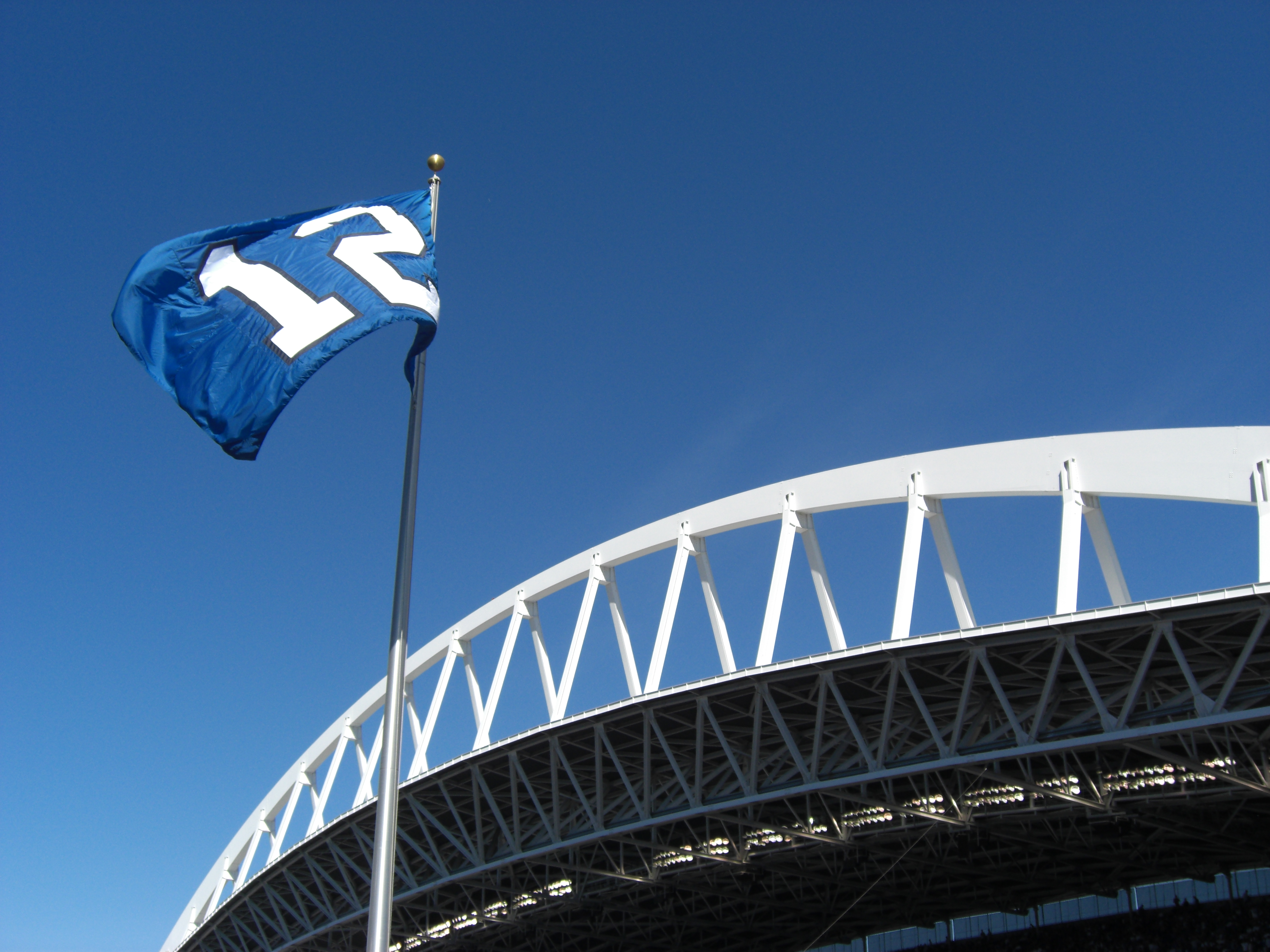
Lumen Field
On September 15, 2013, something registered on seismographs at a nearby university research station. It was not an earthquake. It was 67,000 Seattle Seahawks fans screaming at 136.6 decibels during a Sunday Night Football game against the San Francisco 49ers, shattering the Guinness World Record for the loudest crowd roar at a sports stadium. Lumen Field, perched at the southern edge of downtown Seattle between the industrial waterfront and the old Kingdome footprint, was purpose-built to channel that kind of energy. Its partially enclosed roof and steeply raked seating decks trap sound and hurl it back onto the field, turning every home game into an acoustic weapon that has tormented visiting teams for more than two decades.
Born from a Ballot Box
Lumen Field exists because Washington voters said yes. In 1997, a statewide referendum narrowly approved public funding for a new open-air stadium to replace the crumbling Kingdome, which had been home to the Seahawks since 1976. Microsoft co-founder Paul Allen, who had purchased the team to prevent its relocation to Los Angeles, backed the initiative and guaranteed a portion of cost overruns. The architect, Ellerbe Becket, designed a 67,000-seat venue with a distinctive partial roof that shields most spectators from Seattle's persistent rain while leaving the field open to the sky. Construction broke ground in 2000, and the stadium opened in 2002 under the name Seahawks Stadium. It has since cycled through corporate identities -- Qwest Field in 2004, CenturyLink Field in 2011, and finally Lumen Field in 2020 -- a naming-rights carousel that earned hundreds of millions of dollars earmarked for maintenance, upgrades, and youth athletic fields across the region.
The 12th Man's Fortress
The Seahawks' faithful earned their mythic status inside these walls. When CEO Tod Leiweke arrived in 2003, he installed a towering flagpole at the south end zone where a local celebrity raises the 12th Man Flag before each home game, honoring fans whose noise the team had already retired the number 12 to celebrate back in 1984. The stadium's acoustics are not accidental. The partial roof and concave seating geometry reflect crowd noise downward onto the field, and visiting teams have paid dearly for it. Between 2002 and 2012, opponents committed 143 false-start penalties in Seattle, among the highest totals in the NFL. In a notorious 2005 game, the New York Giants racked up 11 false starts, prompting their general manager to ask the league whether artificial crowd noise had been piped through the speakers. The NFL investigated and found nothing but genuine, earsplitting devotion. The Carolina Panthers, preparing for the 2005 NFC Championship Game here, practiced with the recorded sounds of jet engines.
More Than Football
Lumen Field was always meant to be a multi-sport cathedral. The Seattle Sounders of the USL played the stadium's very first sporting event in July 2002, and when MLS came calling in 2009, the Sounders FC drew 32,523 fans to their debut match, a 3-0 victory with Fredy Montero scoring the first goal. Average MLS attendance in Seattle has consistently ranked among the league's highest, and the Sounders won MLS Cup in 2016 and 2019. The stadium also welcomed Seattle Reign FC in 2022 after the NWSL club broke the league's attendance record with 27,248 fans for a match against Portland Thorns FC. Supercross races have packed in 50,000 spectators since 2005, requiring more than 650 truckloads of dirt to build the indoor course. Even the Dalai Lama has spoken here, addressing a crowd from the same turf where Beast Mode once rumbled.
A World Stage Beckons
The stadium's next chapter is global. In 2025, Lumen Field hosted six matches of the FIFA Club World Cup, drawing over 210,000 total spectators and requiring a temporary hybrid grass surface grown in Moses Lake, Washington, to be installed over the FieldTurf. That tournament served as a dress rehearsal for the 2026 FIFA World Cup, where Lumen Field is one of sixteen venues across the United States, Canada, and Mexico. It will host four group-stage matches, including a United States game from Group D, and two knockout-round matches. Alongside BC Place in Vancouver, it makes the Pacific Northwest a twin hub for the world's biggest sporting event. The Muckleshoot Heritage Plaza at the north entrance, part of a naming-rights agreement with the Muckleshoot Indian Tribe that brought indigenous Coast Salish artwork to the grounds, will greet World Cup visitors with a reminder that this land has been a gathering place far longer than any stadium has stood on it.
Wind, Rain, and Roar
From above, Lumen Field sits like an open bowl tilted toward Elliott Bay, its partial roof a white crescent against the gray-green of the Seattle waterfront. The open north end frames the downtown skyline, but it also funnels winds off Puget Sound that have bedeviled kickers for years, making field goals an unpredictable affair. The FieldTurf surface, first installed in 2002 when Seahawks Stadium became the NFL's first venue to use it, gets replaced every four years under the Sounders' lease agreement. Converting the field between football and soccer takes 14 hours in dry weather, using a specially formulated paint that is, by design, easy to wash off. The concourses serve Pacific Northwest staples alongside the usual stadium fare -- Dungeness crab cakes, local salmon sandwiches, and craft microbrews -- a nod to a city that demands its food scene follow it even into the cheap seats.
From the Air
Lumen Field sits at 47.5952N, 122.3316W in Seattle's SoDo district, immediately south of downtown and west of the railroad tracks. From the air, the distinctive partial roof and open north end are clearly visible along the waterfront. The stadium is roughly 2 nautical miles south of the Space Needle. Nearest major airport is Seattle-Tacoma International (KSEA), about 10nm south. Boeing Field/King County International (KBFI) is just 3nm to the south. Recommended viewing altitude: 2,000-3,000 feet AGL for stadium detail. The stadium complex, including the adjacent Event Center and T-Mobile Park (baseball), forms a recognizable sports district cluster visible on approach to KSEA runway 16L/R.