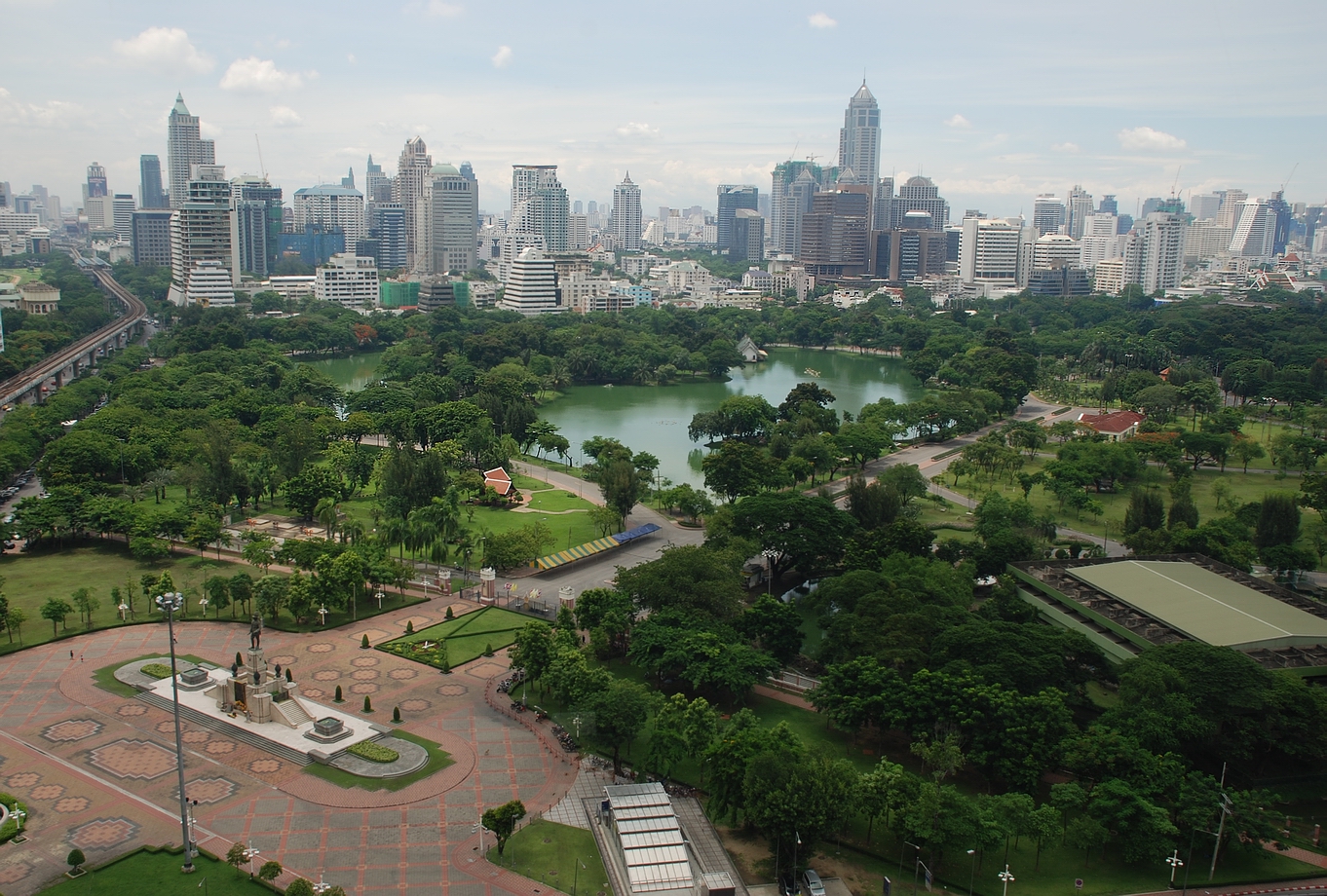
Lumphini Park
Four hundred monitor lizards live in central Bangkok. They bask on the banks of an artificial lake, swim alongside swan paddle boats, and occasionally startle joggers on the 2.5-kilometer loop path that rings Lumphini Park. The Asian water monitors, some stretching over a meter long, are the park's most unexpected residents -- and its most photogenic. But the lizards are latecomers. The park itself dates to 1925, when King Vajiravudh, Rama VI, donated a 360-rai plot of his private land to the nation. At the time, the area was considered the outskirts of the city. The king named it Lumphini after Lumbini in Nepal, the birthplace of the Buddha, hoping the association would bring prosperity. He died before construction was complete, but the park was finished and opened, becoming Bangkok's first public park.
From Trade Fair to Green Refuge
The land had once been called Thung Sala Daeng -- Sala Daeng Field -- and Rama VI initially used it for the Siamrat Phiphitthaphan Trade Fair, an event designed to promote Thai commodities and industrial products to both Thai and foreign audiences. After the fair, the king envisioned something more permanent. The park that took shape included a Chinese-styled clock tower built in 1925, what was Thailand's first public library, a public aquarium, sporting grounds, and a large swimming pool. During World War II, the Japanese Army requisitioned the park as a camp, one of the less remembered occupations in Bangkok's wartime history. After the war, a royal monument to Rama VI was erected at the park entrance. Today the statue stands watch over a green rectangle hemmed in by some of Bangkok's busiest roads -- Rama IV to the south, Ratchadamri to the west, and Witthayu to the east -- with the glass and steel towers of the Silom-Sathon business district rising on all sides.
The City Comes to Exercise
By dawn each morning, the park transforms into Bangkok's largest outdoor gym. Tai chi groups claim their sections of lawn while joggers circle the perimeter path. The cycling rules are strict -- bicycles are permitted only between 10 a.m. and 3 p.m. -- and there is a total smoking ban. Dogs are not allowed unless they are certified guide dogs. These rules reflect the park's status as a rare and carefully managed patch of open public space in a city of more than ten million people. On the lake, swan-shaped paddle boats can be rented for 40 baht per half hour, gliding across the same water where a floating restaurant called Kinnari Nava once stood in the 1960s. Known internationally as Peninsula, the restaurant featured a distinctive bow topped with a kinnari figure -- a half-woman, half-bird from Thai mythology. A fire eventually closed it, and the lake returned to the boats and the lizards.
Where Bangkok Gathers
Lumphini Park has served as more than recreation space. During the winter months, the Palm Garden hosts the annual Concert in the Park, featuring the Bangkok Symphony Orchestra performing classical music under the trees. Buddhist dharma sessions with monks take place on the last Sunday of every month. The park houses a Home of Hope shelter for homeless children and a Bangkok Elder Citizens Club offering daily activities and dance classes. A youth center provides swimming, basketball, and soccer facilities. But the park has also been a stage for political upheaval. In 2006, the People's Alliance for Democracy rallied here against Prime Minister Thaksin Shinawatra. In 2013-2014, the People's Democratic Reform Committee made the park one of its main protest sites against Prime Minister Yingluck Shinawatra. The park absorbs it all -- the concerts and the protests, the monks and the joggers, the paddle boats and the four hundred lizards sunning themselves on the shore.
Green Bridge to a Bigger Vision
Lumphini Park no longer stands alone. The 1.3-kilometer Green Bridge, an elevated pedestrian and bicycle path, now connects it to Benjakitti Park in the Khlong Toei District, beginning at the Sarasin Junction where Witthayu Road meets Sarasin Road. The link creates a continuous green corridor through one of Asia's densest urban landscapes. Two MRT stations -- Lumphini on the Blue Line and Si Lom at the Sala Daeng intersection -- and the BTS Skytrain's Sala Daeng station bring the park within easy reach of the entire city. At the Sala Daeng corner, the old Dusit Thani Hotel has given way to Dusit Central Park, transforming the neighborhood around the park's western edge. What King Rama VI envisioned as a gift of open space on what was then the city's fringe has become the breathing center of a metropolis that grew to surround it on every side.
From the Air
Located at 13.73N, 100.54E in central Bangkok, bounded by Rama IV Road, Ratchadamri Road, and Witthayu Road. From the air, the park is immediately recognizable as a large rectangular green space amid dense urban development in the Pathum Wan-Silom area. Best viewed at 2,000-3,000 feet. Nearest airports: Don Mueang (VTBD) approximately 15 nm north, Suvarnabhumi (VTBS) approximately 16 nm east-southeast.