Lunar Landing Research Facility
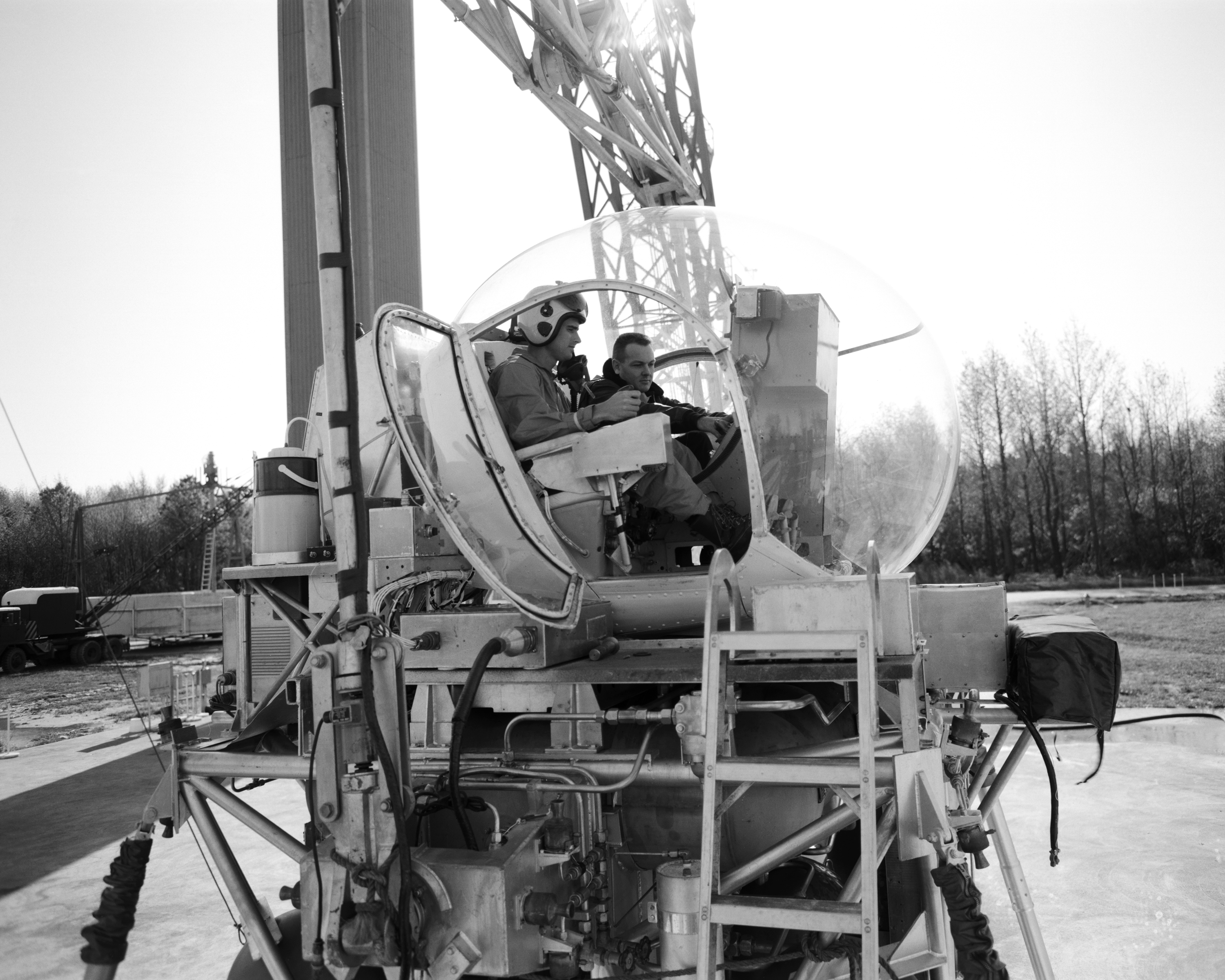
Twenty-four astronauts learned to land on the Moon without ever leaving Virginia. At NASA's Langley Research Center in Hampton, a towering A-frame gantry held a full-scale Lunar Excursion Module Simulator on cables, while a carefully sculpted landscape below mimicked the lunar surface. Neil Armstrong practiced here. Buzz Aldrin practiced here. Before they could attempt the real descent in one-sixth gravity with no atmosphere, no second chances, and the whole world watching, they rehearsed it over and over in the humid Tidewater air, dangling from a crane above fake craters. The Lunar Landing Research Facility cost $3.5 million when it was completed in 1965 - a modest investment for a contraption that helped ensure the most audacious journey in human history would end with a safe touchdown rather than a catastrophic crash.
Rehearsing the Impossible
The engineering challenge was deceptively simple: simulate the final moments of a Moon landing on Earth. The solution was a massive gantry structure at Langley Research Center that suspended a full-scale Lunar Excursion Module Simulator from an overhead bridge crane. A small rocket motor on the mock lander provided thrust while the cable system compensated for five-sixths of Earth's gravity, giving astronauts the sensation of descending in lunar conditions. Below the dangling spacecraft, technicians had constructed a simulated lunar landscape - craters, boulders, and dust carefully arranged to approximate what Apollo crews would see through their tiny windows as they guided the lander down. The astronauts practiced solving the specific piloting problems of that final descent, learning to read the terrain, manage their fuel, and control a vehicle that handled like nothing else ever built.
Three Lives of a Gantry
After the Apollo program ended, NASA did not tear down the gantry. Instead, in 1974, it was re-designated the Impact Dynamics Research Facility and repurposed for crash-testing aircraft. For nearly three decades, researchers dropped helicopters and small planes from the structure, studying how airframes crumble on impact and how crashworthy designs could save lives. When funding dried up in 2003, the facility was shuttered and slated for demolition. But in 2004, NASA realized the old Moon-landing gantry could serve the Constellation program's Orion capsule development. Renamed once more as the Landing and Impact Research Facility - LandIR - the structure was fitted with a new parallel winch system and a hydro-impact basin for splashdown testing, completed in 2011. Even after Constellation was cancelled, LandIR continued performing impact testing for the Orion capsule that would service the International Space Station. One structure, three names, six decades of service.
Where History Touched Down
In 1985, the facility was designated a National Historic Landmark, recognizing its irreplaceable role in the space program. The original Lunar Excursion Module Simulator that once swung from the gantry's cables is now on display at the Virginia Air and Space Center in downtown Hampton, where visitors can see the machine that helped put humans on the Moon. The gantry itself still stands at Langley Research Center, a skeletal silhouette against the Virginia sky. It remains one of the most tangible connections between Earth and the lunar surface - not a rocket or a capsule, but the practice field where astronauts drilled the most critical minutes of the most watched event in history. Roger Chaffee trained here too, receiving instruction from Langley scientist Maxwell W. Goode, before the Apollo 1 fire took his life in 1967. The facility carries that weight as well - the memory of those who prepared for the Moon but never got to go.
A Landmark in the Tidewater
Hampton, Virginia has been home to Langley Research Center since NACA - NASA's predecessor - established the facility in 1917. The area's flat terrain and proximity to the coast made it ideal for aeronautics research, and later for the space program. The Lunar Landing Research Facility sits within this broader campus of hangars, wind tunnels, and test rigs that have shaped American aviation and spaceflight for over a century. From above, the gantry's A-frame structure is distinctive amid the surrounding buildings and runways. Nearby, the Reduced Gravity Walking Simulator - another part of the original LLRF complex - let astronauts practice moving in simulated lunar gravity, shuffling and hopping across a tilted surface while suspended by cables. Together, these facilities ensured that when Apollo 11's Eagle finally descended toward the Sea of Tranquility in July 1969, Armstrong had already made that landing dozens of times in Virginia.
From the Air
Located at 37.10°N, 76.39°W within NASA Langley Research Center in Hampton, Virginia. The A-frame gantry structure is visible from low altitude. Best viewed at 2,000-3,000 ft AGL. Langley Air Force Base (KLFI) is immediately adjacent - active military airspace, check NOTAMs. Newport News/Williamsburg International (KPHF) is 8nm northwest. Hampton Roads area can have marine layer and haze, especially summer months. The broader Langley campus with its distinctive hangars and wind tunnels is recognizable from above.