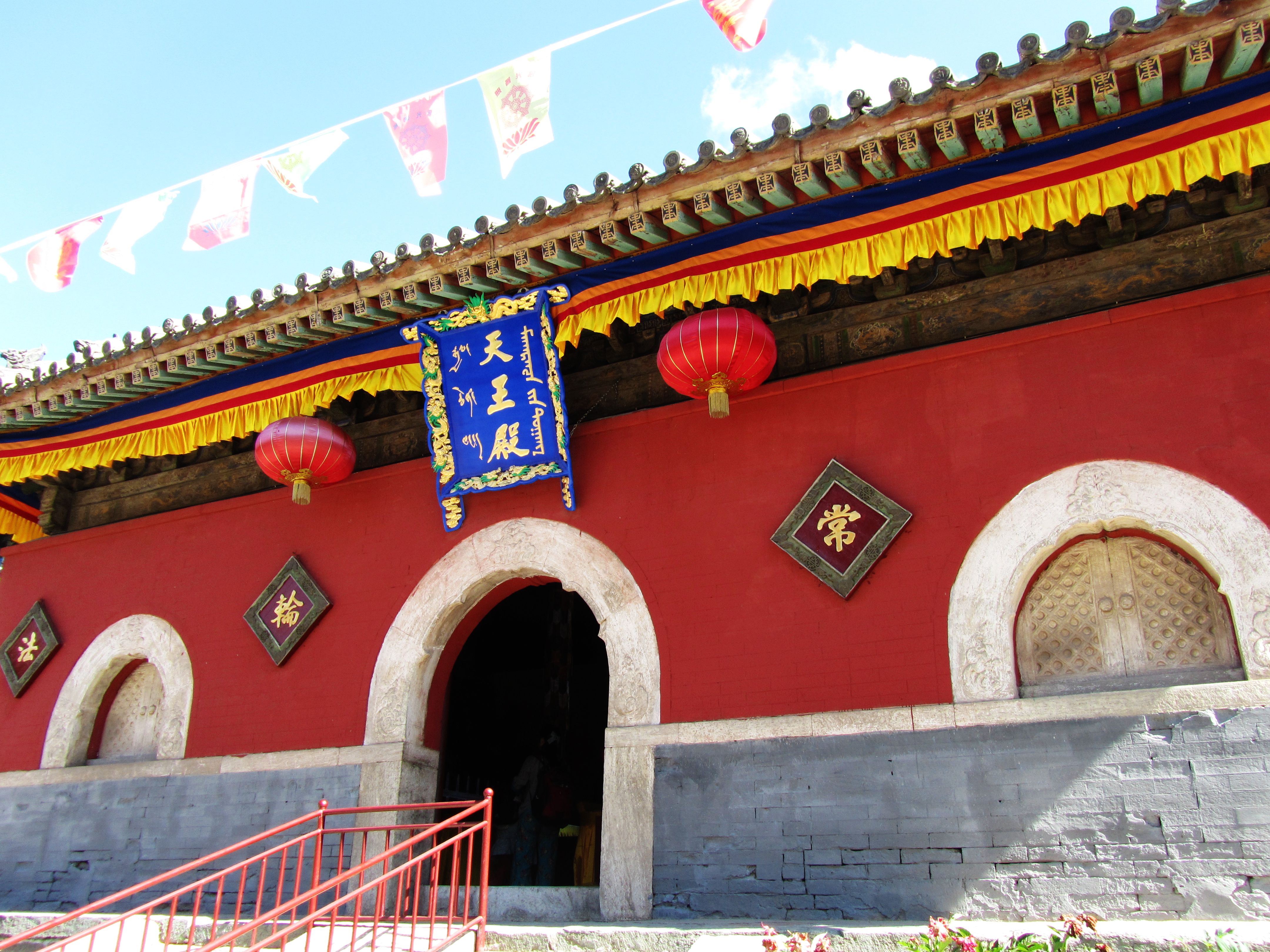
Luohou Temple
Rahula was the only son of Siddhartha Gautama -- the man the world would come to know as the Buddha -- and his wife Princess Yasodhara. In Chinese Buddhist tradition, his name is shortened to Luo Hou Luo, and it is from this name that Luohou Temple takes its own. Naming a temple for the Buddha's child rather than the Buddha himself suggests something about this place: it has always been concerned with lineage, with what gets passed down.
From Tang to Tibet
Luohou Temple was first established during the Tang dynasty (618-907), when it was called Shanzhu Geyuan. It was rebuilt in 1492, during the Hongzhi period of the Ming dynasty, and during the Wanli period (1572-1620), Concubine Li Yanfei donated her personal wealth to restore the buildings. But the temple's most significant transformation came in 1705, during the Kangxi Emperor's reign, when it converted from Chinese to Tibetan Buddhism. This shift was not merely theological -- it reflected the Qing dynasty's deliberate policy of promoting Tibetan Buddhist institutions on Mount Wutai as a way to strengthen ties with Mongolia and Tibet. The temple was reconstructed again in 1792 under the Qianlong Emperor, solidifying its identity as a Gelug school monastery.
A City Within a Temple
With more than 118 buildings, Luohou Temple operates on the scale of a small village. The complex unfolds along a central axis from the paifang entrance gate through the Tianwang Dian (Hall of the Four Heavenly Kings), past the Mahavira Hall, the Hall of Manjushri, and the Great Buddha Hall, to the Zangjing Ge scripture library and the communal dining hall. In the Tianwang Dian, the Four Heavenly Kings stand at their directional posts: Dhritarashtra in the east, Virudhaka in the south, Virupaksha in the west, and Vaishravana in the north. In the Hall of Manjushri, the bodhisattva of wisdom lies on a lotus in a rare reclining posture -- an unusual depiction that draws particular attention from visiting pilgrims and scholars.
Protections Old and New
In 1983, Luohou Temple was classified as a National Key Buddhist Temple in Han Chinese Area, a designation that provides both recognition and government protection. Three decades later, in 2013, the State Council of China listed it among the seventh batch of State Cultural Protection Relics Units, the country's highest level of heritage preservation. These modern protections layer on top of the temple's own history of survival through imperial patronage and institutional resilience. The Great Buddha Hall at the complex's heart still enshrines statues of Shakyamuni, Amitabha, and Yaoshi (the Medicine Buddha), maintaining the devotional program that has operated here, in one form or another, for over a thousand years.
From the Air
Located at 39.01N, 113.59E in the Taihuai Town temple valley on Mount Wutai, Shanxi Province, China. The 118-building complex is one of the larger temple compounds and occupies a notable footprint visible from the air. Elevation approximately 1,700 meters. Nearest airports: Wutai Mountain Airport (ZBWT) at roughly 50 km and Taiyuan Wusu International Airport (ZBYN) at approximately 230 km southwest. Recommend 3,000-5,000 feet AGL. The temple complex is identifiable by its scale relative to neighboring temples.