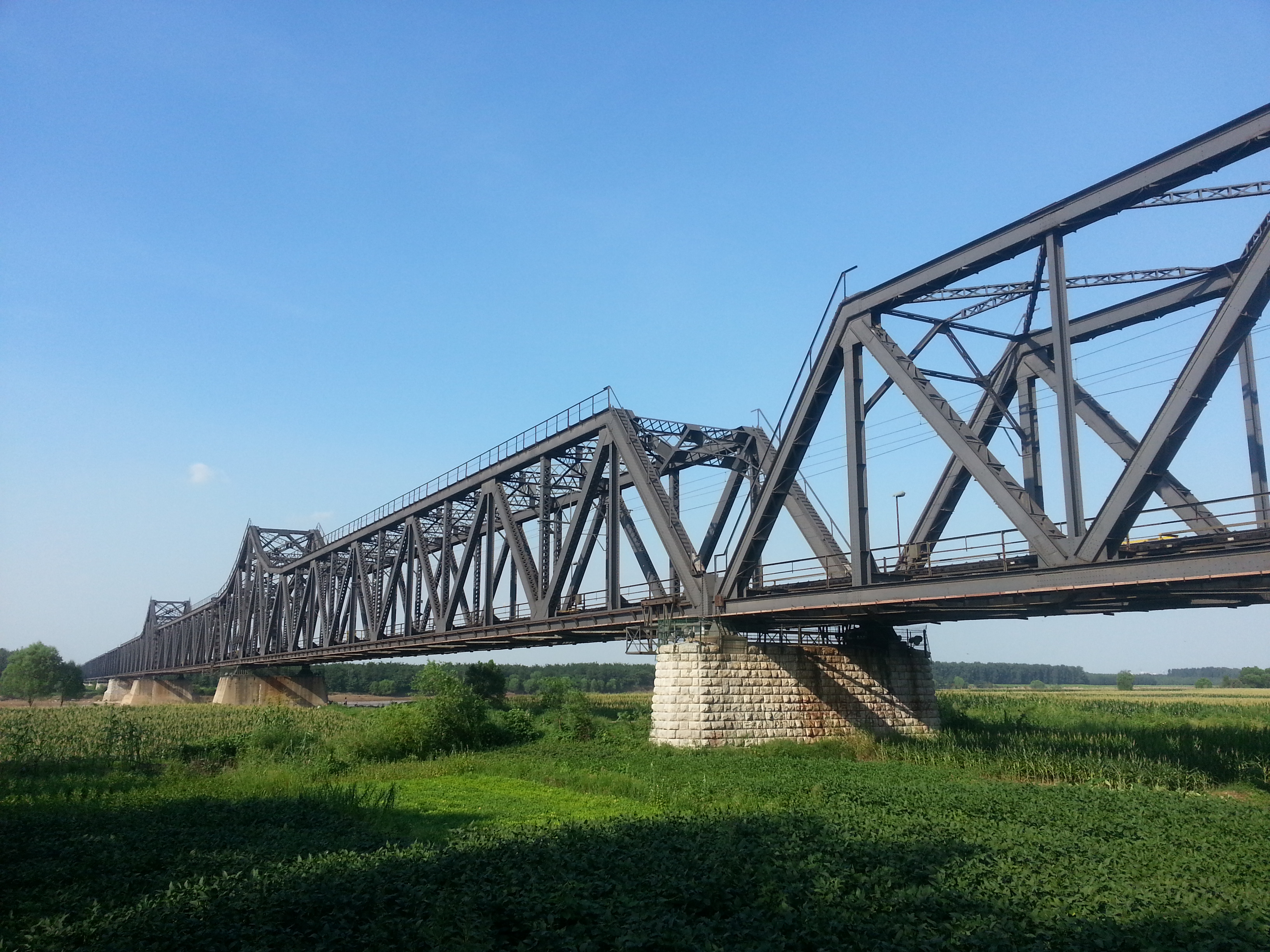
Luokou Yellow River Railway Bridge
The Luokou Yellow River Railway Bridge has been damaged five times in combat and once by flood, and it is still standing. Built by the German engineering firm MAN between 1909 and 1912, the bridge spans 1,255 meters across the Yellow River at Jinan in twelve steel spans supported by eleven pillars. It was designed as a key link in the Tianjin-Pukou Railway, and its strategic importance turned it into a target for every faction that fought for control of northern China during the first half of the twentieth century. Warlords detonated explosives on it. Armies shelled it. Bombers strafed it. Each time, someone repaired it and put the trains back on.
German Steel on Chinese Water
On January 13, 1908, the Qing government signed the Tianjin-Pukou Railway Loan Agreement, dividing construction of the line between German and British companies. The Germans took the northern section, a 626-kilometer stretch from Tianjin to Hanzhuang in Shandong, and the Yellow River crossing at Jinan was the project's most daunting engineering challenge. Surveyors chose a site where Que Hill to the north and an existing dam to the south constrained the river's notoriously unpredictable course. MAN of Gustavsburg signed the construction contract on August 12, 1908, broke ground on October 15, and began major construction in July 1909. The bridge was completed and officially opened on November 16, 1912, at a total cost of 11.66 million German marks. At 1,255 meters long and 9.4 meters wide, it was the most ambitious engineering achievement in the region.
A Bridge That Would Not Stay Broken
In 1928, the warlord Zhang Zongchang -- the same "Dogmeat General" who wrote bad poetry about Daming Lake -- tried to halt the Kuomintang's Northern Expedition by detonating explosives at the bridge's eighth pillar. The pillar cracked over a length of 3.8 meters, but the bridge was repaired within eight months. Two years later, during the Central Plains War of 1930, artillery shells from the forces of Chiang Kai-shek, Yan Xishan, and Feng Yuxiang pocked the steel beams. The Jin-Pu Railway Administration repaired the damage in 1931 for 26,700 yuan. In November 1937, the Kuomintang governor Han Fuju severely damaged the bridge to slow the Japanese advance, and when Japanese forces attacked the northern bridgehead, more than fifty villagers around Que Hill were killed in the fighting.
Repair, Flood, and Reinvention
The Japanese repaired the bridge in 1938, a six-month project requiring 4,000 tons of steel at a cost of 3.76 million yuan. The last combat damage came in February 1949, when Kuomintang aircraft strafed the bridge during the Chinese Civil War -- minor damage that was quickly fixed. Then nature took its turn. During the Yellow River flood of 1958, Premier Zhou Enlai personally rushed to Jinan to coordinate the bridge's defense. A major overhaul followed in 1959. Although the bridge had originally been designed for two tracks, engineers determined it could not safely carry both, and a new bridge -- the Caojiaquan Yellow River Bridge -- was completed in 1976 to carry the Beijing-Shanghai railway's second track. In 1991, the old bridge was closed to passenger trains when silt buildup around it became dangerous.
Still Crossing the River
The story might have ended there -- an historic bridge, retired and slowly deteriorating. But in 1992, plans for a new railway line between Jinan and Handan gave the old bridge a second life. Reinforcement work began in 1998, and on May 31, 2000, the Luokou Yellow River Railway Bridge reopened to traffic. Nearly a century after German engineers placed its first steel spans across the Yellow River, the bridge was carrying trains again. From warlord explosives to Japanese shells to Communist-era floods, the bridge has absorbed everything the twentieth century could deliver. Its eleven pillars still stand in the river, and the twelve spans still carry their loads, a monument to both the quality of the original engineering and the stubborn human refusal to let a useful bridge die.
From the Air
Located at 36.73N, 117.00E, spanning the Yellow River north of central Jinan. The bridge is a prominent linear feature visible from moderate altitude. Jinan Yaoqiang International Airport (ZSJN) is approximately 25 km to the east. Que Hill lies to the north of the bridge. The Yellow River itself is the dominant landscape feature in this area, with the bridge spanning its full width. A newer parallel bridge (Caojiaquan) runs nearby.