Luray Caverns: The Cave Where Rocks Make Music
Leland Sprinkle heard music where others heard stone. In 1954, the Pentagon mathematician began a three-year project to turn Luray Caverns into a musical instrument. He tested thousands of stalactites, selected those with the right pitch, shaved some for tuning, and wired them to a custom organ console. The result is the Great Stalacpipe Organ - rubber mallets striking stalactites across 3.5 acres of cave, producing tones that resonate through the underground chambers. The instrument is played daily for visitors, the world's largest musical instrument by area, a merger of geology and ingenuity that transforms cave formations formed over millions of years into something like a cathedral pipe organ playing in perpetual twilight.
The Discovery
Luray Caverns was discovered in 1878 when a local tinsmith noticed cool air rising from a sinkhole. Digging through, explorers entered chambers decorated with stalactites, stalagmites, and flowstone formations of unusual size and variety. The caverns opened to tourists within months, becoming one of Virginia's first commercial caves. The formations accumulated over 400 million years - limestone dissolved by groundwater, redeposited drip by drip into columns and curtains. The cave maintains constant 54°F temperature and high humidity, conditions that preserved the formations and enable continued growth. What visitors see today is still forming, imperceptibly slowly.
The Organ
Leland Sprinkle's son struck a stalactite during a 1954 visit, and the resulting tone sparked obsession. Sprinkle spent three years testing over 2,500 stalactites, mapping their natural frequencies. Those with usable pitches were selected; some were shaved to tune them precisely. He wired 37 stalactites across 3.5 acres to a console resembling a traditional organ. Rubber-tipped mallets, activated by the console's keys, strike the stalactites. The tones resonate through the cave, ethereal and slightly eerie. The organ has no pipes in the traditional sense - the stalactites themselves vibrate, the cave amplifying their natural voice.
The Experience
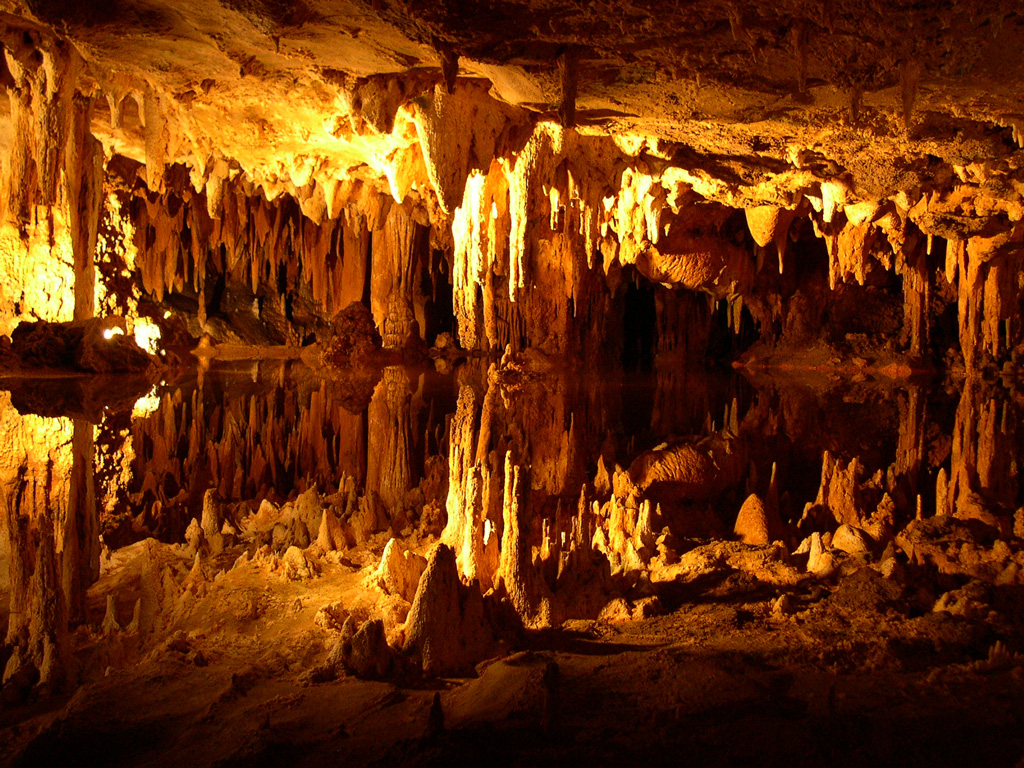
Guided tours pass through multiple chambers: Dream Lake with its mirror-still water, Giant's Hall with ceiling 140 feet high, Saracen's Tent with flowing draperies of stone. The lighting is theatrical, designed to emphasize formations. The path is paved and accessible, covering approximately 1.25 miles. Near the tour's end, the Stalacpipe Organ plays - sometimes automated, sometimes performed live. The music echoes through chambers, produced by rock struck with rubber, sounding like nothing else on Earth. Visitors describe it as haunting, otherworldly, appropriate for a concert hall formed by water over epochs.
The Science
Stalactites form as carbon dioxide escapes from groundwater saturated with dissolved limestone. The water leaves behind tiny mineral deposits; millions of deposits create the formations visitors see. Growth rates average less than an inch per century; the largest formations in Luray took millions of years to develop. The formations are living in geological terms - active cave systems continue creating new features, while broken stalactites can slowly regenerate. Touching damages the formations; human skin oils inhibit mineral deposition. The cave's constant conditions preserve what water created over geological timescales.
Visiting Luray Caverns
Luray Caverns is located in Luray, Virginia, approximately 90 miles west of Washington, D.C., in the Shenandoah Valley. Tours run continuously throughout the day, lasting approximately one hour. The path is paved and mostly level; wheelchairs are available. Temperature is constant 54°F - bring a jacket. Admission includes the caverns, Car and Carriage Caravan Museum, and historic gardens. The nearby town of Luray offers restaurants and lodging. Shenandoah National Park's Skyline Drive is accessible nearby. Allow half a day for the cave and related attractions. The Stalacpipe Organ performance occurs during tours - hearing ancient rock sing is the unique experience that distinguishes Luray from other show caves.
From the Air
Located at 38.66°N, 78.48°W in the Shenandoah Valley of Virginia. From altitude, the Luray Caverns site appears as a developed commercial area beside the town of Luray. The caverns themselves are entirely underground, invisible from altitude. The Blue Ridge Mountains and Shenandoah National Park rise to the east; the Massanutten Mountain divides the valley. The town of Luray is modest, oriented around tourism. The landscape is pastoral Shenandoah Valley - farms, forests, the meandering Shenandoah River. What millions of visitors experience underground leaves no trace from altitude; the musical stalactites and cathedral chambers exist in a subterranean world that flight passes over without revealing.