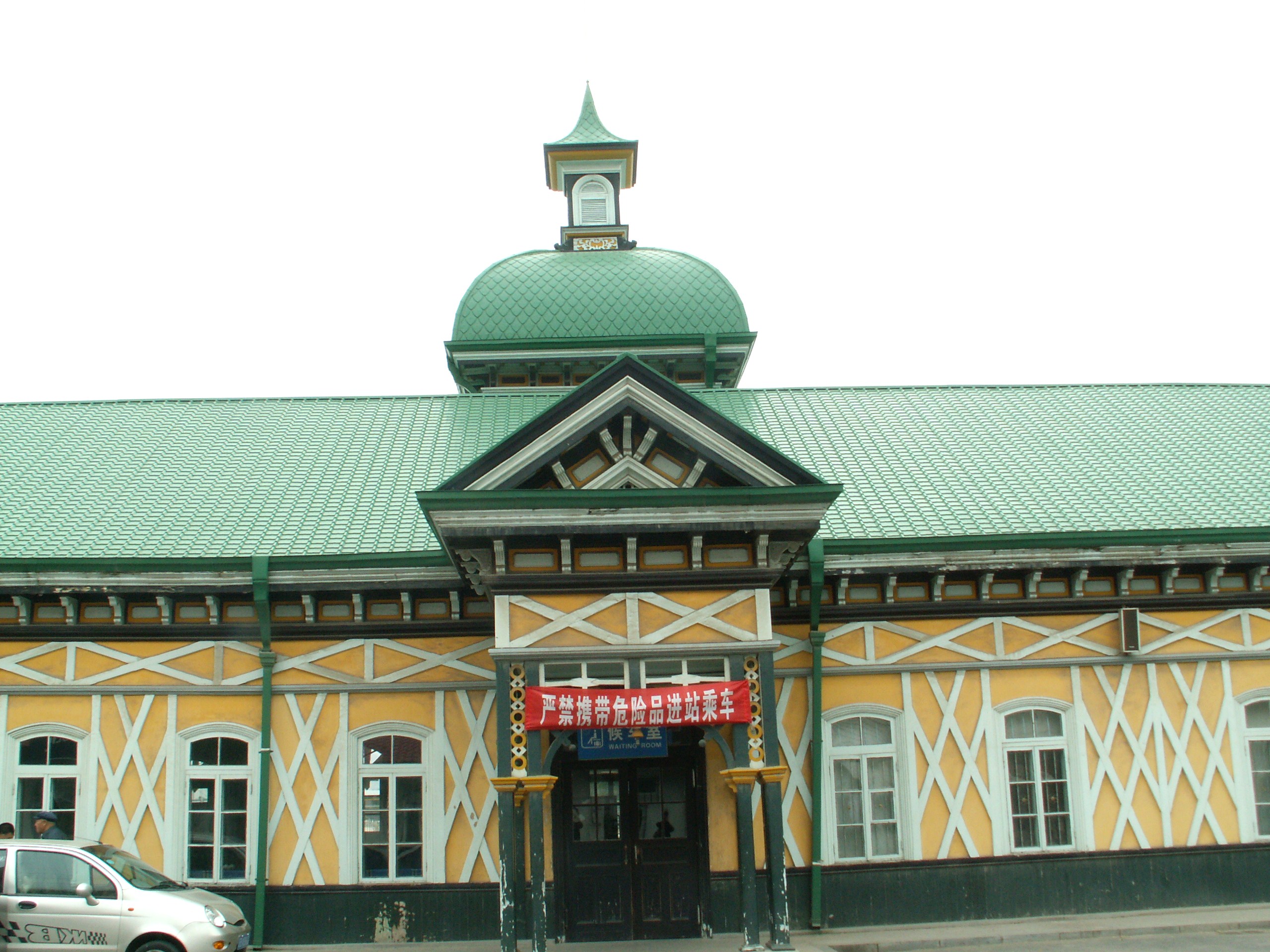
Lushun Railway Station
The wooden eaves and ornamental trim of Lushun Railway Station look distinctly Russian -- which is exactly what they are, even though the station sits on the coast of northeast China, was rebuilt by the Japanese, and now serves passengers traveling to Dalian on Chinese trains. Completed in 1903 as part of the Russian Empire's Chinese Eastern Railway, the station perches on the east bank of the Long River, within a hundred meters of the Lushun Naval Port. It is the final stop on the Dalian-Lushun branch line, a terminus in every sense.
Three Empires on One Platform
Russia obtained the Kwantung Leased Territory in 1898 and immediately began constructing a railway to link Port Arthur with its trans-Manchurian rail network. Construction of Lushun station started in 1900 and was completed in 1903. Operations halted almost immediately when the Russo-Japanese War erupted in 1904. After Japan captured Lushunkou in 1905, the broad Russian gauge tracks were ripped up and replaced with narrow Japanese gauge. In 1906, the line was placed under the South Manchuria Railway, Japan's powerful colonial railway company. The following year, the tracks were changed again -- this time to standard gauge. After Japan's defeat in 1945, the station was operated jointly by China and the Soviet Union before being returned fully to China in 1952. Three empires built, modified, and administered the same small station in less than fifty years.
The Gauge That Kept Changing
Few railway stations anywhere in the world have had their tracks ripped up and relaid as many times as Lushun. The Russian broad gauge of 1,524 millimeters was designed to be incompatible with other rail networks -- partly as a deliberate defensive measure against invasion by rail. When Japan took over, it initially converted the line to its own narrow gauge of 1,067 millimeters, reflecting the gauge used across Japan's domestic network. Just two years later, the decision was made to convert to international standard gauge of 1,435 millimeters, aligning the branch line with the broader South Manchuria Railway network. Each change required relaying every meter of track on the Dalian-Lushun branch. The station building endured all of it, its Russian-style wooden architecture persisting through Japanese occupation, Soviet administration, and Chinese governance.
A Heritage Terminus
In 1985, Lushun Railway Station was designated a Cultural Heritage site of Dalian City, recognizing both its architectural distinctiveness and its layered history. The station was rebuilt in 2005, but the reconstruction retained the original Russian design -- an unusual act of preservation in a country that has more often demolished colonial-era architecture than honored it. Today, just two passenger trains per day connect the station to Dalian, a service level that reflects Lushun's quieter modern reality compared to the frenzied military importance it once held. In 2006, a separate station -- Lushun West -- opened on another branch to serve the Bohai Train Ferry. The old station remains the more atmospheric of the two, a wooden time capsule where the ghosts of Russian engineers, Japanese administrators, and Soviet soldiers once passed through the same ticket hall.
From the Air
Located at 38.81N, 121.25E on the east bank of the Long River in central Lushunkou. The station is within 100 meters of Lushun Naval Port and is identifiable as a small, distinctive wooden building amid the urban area. Dalian Zhoushuizi International Airport (ZYTL) is approximately 37 km northeast. The Dalian-Lushun railway branch runs northeast from the station along the peninsula coast.