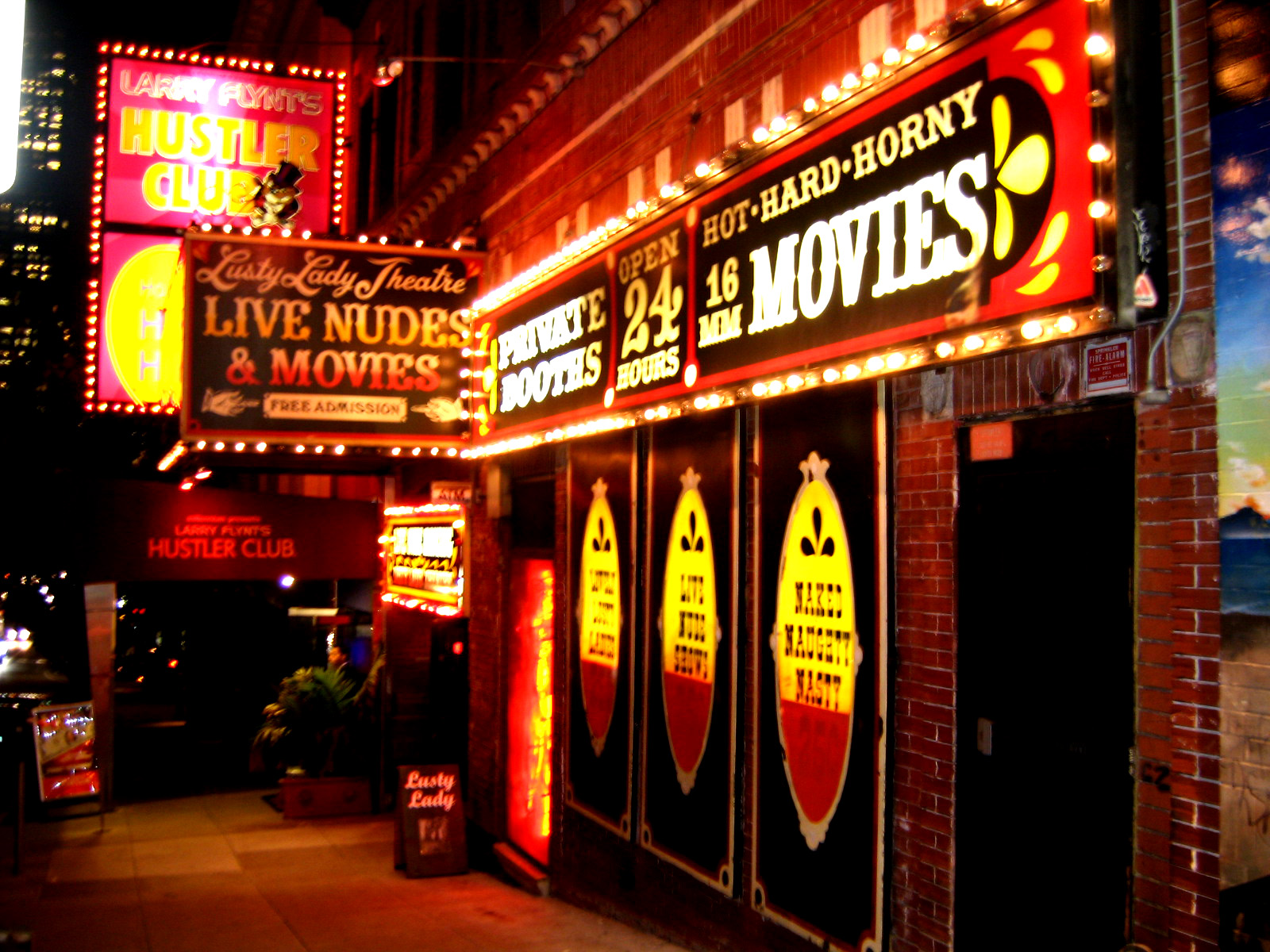
Lusty Lady
The marquee changed every few days, and Seattleites loved it. Across the street from the Seattle Art Museum and its towering Hammering Man sculpture, the Lusty Lady's reader board traded puns and commentary with the cultural establishment next door. Mimi Gates, stepmother of Bill Gates and director of the museum, once called the marquee "a Seattle landmark." When developers offered a multimillion-dollar buyout in 2006 to tear the building down for a Four Seasons Hotel, the owners declined, took $850,000 for air rights instead, and the staff celebrated with a new message on the board: "We're Open, Not Clothed!" The Lusty Lady was never just a peep show. It was a strange, brilliant piece of Seattle's downtown soul.
Behind the Glass
The original Seattle location opened in the 1970s under the name the Amusement Center, launched by two business partners who soon opened a second Lusty Lady in San Francisco's North Beach district. Both venues started with 16mm peep show films, but in 1983 live dancers became the main attraction. The setup was distinctive: several nude women danced on a main stage behind glass windows while customers watched from individual booths, paying by the minute. Private booths offered more personalized shows. Dancers earned an hourly wage -- up to $27 per hour in Seattle by 2001 -- rather than relying solely on tips, a pay structure unusual in the industry. The club also hosted occasional art days, exhibiting erotic photographs and paintings in its hallways, and in 2002 both locations screened a video art exhibition called "Peepshow 28," a sequence of 64 short films exploring voyeurism and exhibitionism.
Picket Lines and Solidarity
The San Francisco Lusty Lady made national headlines in 1997 when its dancers voted to unionize, making it the first successfully unionized sex business in the United States. The organizing drive was sparked by several grievances. African American feminist sociologist Siobhan Brooks, who worked at the club, filed a complaint about racial discrimination against Black dancers. The precipitating event was the installation of one-way mirrors in booths, which allowed customers to secretly photograph and record performers. Stripper Julia Query documented the struggle on video, producing the documentary Live Nude Girls Unite! The workers organized under the Exotic Dancers Union, an affiliate of the Service Employees International Union, AFL-CIO Local 790. It was a milestone that drew attention far beyond the adult entertainment world, raising questions about labor rights, workplace dignity, and who gets to organize.
The Cooperative Experiment
In 2003, when management at the San Francisco location cut hourly pay, the workers struck and won. But the owners announced closure soon after. Rather than accept the end, the dancers bought the business for $400,000, borrowing the money from the departing owners, and transformed it into a worker cooperative. Revenue had already fallen 40 percent from a peak of nearly $3 million in 1996, and monthly rent had doubled to over $13,000. Led by a dancer and English graduate student who went by the stage name Donna Delinqua, the cooperative replaced managerial evaluations with a peer review system and elected team leaders from among the dancers for six-month terms. Other cooperatives, including the worker-owned San Francisco sex-toy business Good Vibrations, provided guidance. The experiment lasted a decade, ending when the landlord refused to renew the lease in August 2013.
Final Curtain and Afterlife
The Seattle Lusty Lady closed first, shutting its doors in June 2010 as the economic downturn and the rise of internet pornography eroded its customer base. NPR's All Things Considered marked the occasion with a feature story about the club's relationship to the broader downtown community. The famous marquee was removed on June 28, 2010, and acquired by the Museum of History and Industry, where it is now displayed in their South Lake Union location -- a former peep show sign preserved as a cultural artifact. The San Francisco location followed in September 2013, closing at 3:00 a.m. on Labor Day, a fitting if unintentional punctuation mark for a business defined by its labor activism. In March 2023, Andrew Conru, founder of Friend Finder Networks, bought the Seattle building for $3 million, calling it "a gift to the city," though plans soon shifted toward demolition when a seismic retrofit proved unfeasible.
Written Into the Record
The Lusty Lady generated a remarkable body of literature for a peep show. Photographer Erika Langley, who had danced at the Seattle location since 1992, published The Lusty Lady in 1997, a photo book documenting life behind the glass. Some of her images were later exhibited at the Seattle Art Museum across the street. Elisabeth Eaves stripped there in 1997, went to graduate school, returned in 2000, and wrote Bare: On Women, Dancing, Sex, and Power. Lily Burana chronicled her time at the San Francisco branch in Strip City. Carol Queen contributed Real Live Nude Girl. Jennifer Worley, who participated in both the unionization and the cooperative transformation, published Neon Girls: A Stripper's Education in Protest and Power in 2020. The club also appeared in the 1992 film American Heart and inspired a location in the pilot of the television series Millennium.
From the Air
The former Lusty Lady site is at 47.6069N, 122.3385W in downtown Seattle, on First Avenue directly across from the Seattle Art Museum. From the air, it is located roughly one block east of the waterfront piers, between Pike Place Market to the south and Belltown to the north. Nearest major airport is Seattle-Tacoma International (KSEA), approximately 11nm south. Boeing Field (KBFI) is about 4nm south. The building sits in the dense downtown core, so it is not individually distinguishable from altitude, but the waterfront and Pike Place Market provide strong visual references. Recommended viewing altitude: 1,500-2,500 feet AGL to appreciate the downtown context.