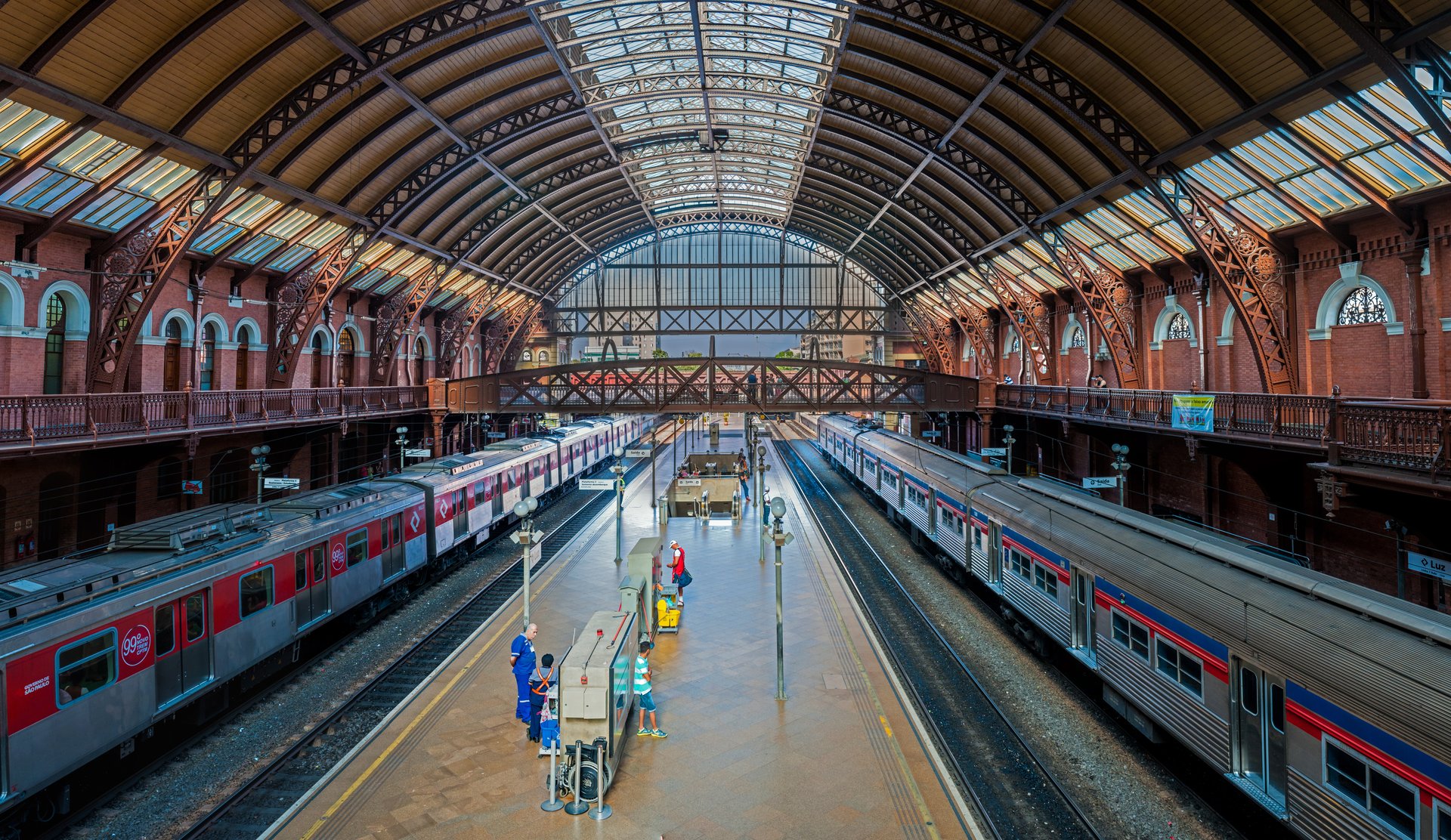
Luz Station
The station was built twice before it was built for good. First came a modest single-story block in the 1860s, headquarters of the newly founded São Paulo Railway. Then a neoclassical expansion in 1888 added a second floor and iron canopies over the platforms. But neither version survived the ambitions of a city growing rich on coffee. In 1901, the third and final Luz Station opened — designed by British architect Charles Henry Driver, manufactured by Walter Macfarlane & Co. at the Saracen Foundry in Glasgow, assembled in Scotland to make sure the pieces fit, then disassembled, crated, shipped across the Atlantic, and put back together in São Paulo. It was an extraordinary act of Victorian engineering confidence: build a train station on one continent, then mail it to another.
Gateway to a Coffee Republic
To understand Luz Station, you have to understand coffee. In the late nineteenth and early twentieth centuries, São Paulo's wealth flowed along a single rail line: from the coffee plantations of the interior to the port of Santos, and back again with imported European goods. The São Paulo Railway, a London-based company, controlled that line. Luz Station was its headquarters — the point where coffee money entered the city and the place where São Paulo met the world. The station's clock tower, which rose above the surrounding neighborhood, served for years as the city's unofficial timekeeper. Residents set their watches by it. In a city still finding its identity, the British-built station provided something to orient by: a fixed point in a place that would soon become famous for relentless reinvention.
Two Fires and a Museum
Luz Station has burned twice. In 1946, a fire destroyed the clock tower and much of the building. During reconstruction, a new floor was added, and the tower was rebuilt — completed five years later. But the real blow came not from fire but from obsolescence. As rail transport in Brazil declined through the mid-twentieth century, the surrounding Luz neighborhood declined with it. The station degraded. By the time repairs began in the 1990s, the building had become a symbol of São Paulo's complicated relationship with its own past — too important to demolish, too neglected to celebrate. Then in 2006, the station found a second purpose when the Museum of the Portuguese Language opened inside it. The museum became one of São Paulo's most visited cultural institutions. On December 21, 2015, fire struck again, devastating the museum and the station's main building and killing one firefighter. The museum was rebuilt and eventually reopened, adding another layer of survival to a building that has made a habit of it.
147,000 Passengers a Day
Luz Station is not a monument in mothballs. It is the second-busiest station on São Paulo's metro-rail network, handling 147,000 passengers daily — trailing only Brás station's 150,000. Three CPTM commuter lines pass through it: Line 7-Ruby, Line 11-Coral, and Line 13-Jade, the airport express to Guarulhos. Below ground, connections to São Paulo Metro's Line 1-Blue and ViaQuatro's Line 4-Yellow funnel additional crowds through the complex. The station is under railway heritage protection, which means it cannot be expanded — a fact that creates growing tension as ridership increases. Planned improvements, including higher train frequencies after the future deactivation of nearby Julio Prestes station on Line 8-Diamond, will push even more passengers through a building designed in the age of steam.
A Botanical Garden Became a Train Station
Before Luz Station existed, its site was a botanical garden — enlarged by Governor João Teodoro Xavier de Matos and connected to São Paulo's downtown by a large embankment leading to the Grande Bridge. Land for the station was carved from the Botanical Garden Square, though the exact placement was debated for years. Superintendent J.J. Aubertin, with the support of construction engineer Daniel Fox, lobbied the governor to build on the corner of Rua Brigadeiro Tobias. The alternative would have pushed the station to the far side of the garden, requiring two access gates instead of one. Practicality won. What had been a place of cultivated greenery became a place of iron, steam, and commerce. Today the station anchors a cultural corridor that includes the Pinacoteca do Estado art gallery nearby, marking the boundary between the Bom Retiro and Campos Elíseos districts.
The Slow Train to the Fruit Circuit
Since 2009, Luz has served as the terminus of the Touristic Express — a slow diesel-powered train carrying up to 170 passengers at a maximum speed of 40 kilometers per hour to the historic railway village of Paranapiacaba and the city of Jundiaí. The route connects to São Paulo's Fruit Circuit, a region of rural tourism and orchards spanning towns like Atibaia, Valinhos, and Vinhedo. It is a journey that deliberately reverses the velocity of modern São Paulo, trading the metro's 147,000-passenger daily crush for a window seat and a pace that lets you watch the city give way to countryside. For a station that once handled the economic lifeblood of a coffee republic, the touristic express is a gentler calling — but a fitting one for a building that has outlived every era that tried to define it.
From the Air
Located at 23.54°S, 46.64°W in the Bom Retiro district of São Paulo. The station's clock tower and Victorian iron-and-glass train shed are distinctive from the air, set near the Pinacoteca do Estado art gallery. The rail corridors radiating from the station provide clear visual reference lines. Nearest airports: Congonhas (SBSP) approximately 8 km south, Guarulhos International (SBGR) approximately 25 km northeast. Best viewed at 2,000-4,000 feet AGL, where the station's heritage architecture contrasts with surrounding modern development.