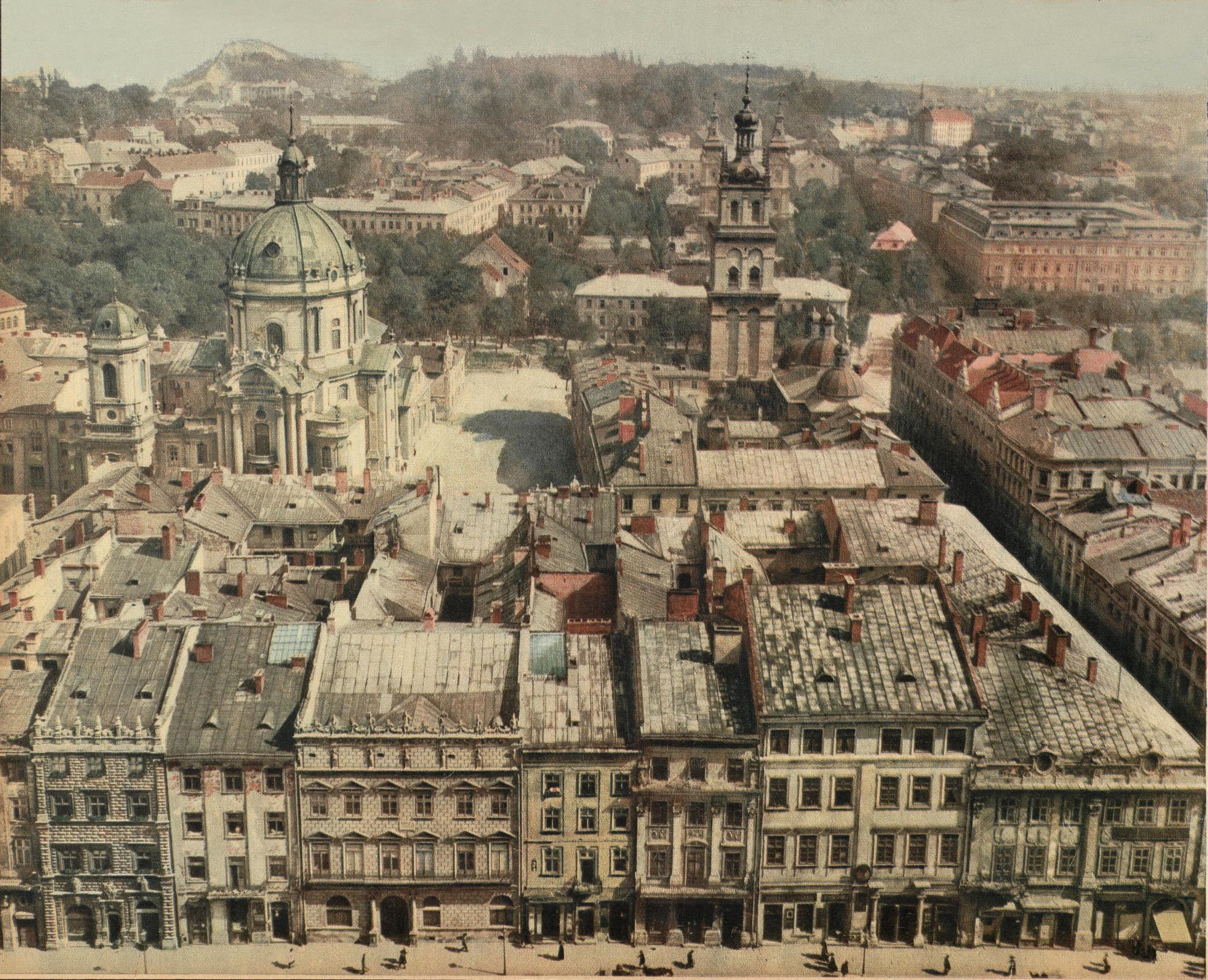
Lviv
Every morning at nine o'clock, traffic stops on Prospekt Svobody. People pause on the sidewalks. On most mornings, a funeral procession passes, carrying a fallen soldier to rest. Then the city moves again -- to its coffee houses, its craft breweries, its festival stages, its cobblestone squares lined with Renaissance facades that were old when the Habsburgs arrived. Lviv has been Polish Lwow, Austrian Lemberg, Soviet Lvov. It has been fought over, renamed, emptied of entire populations, and reinvented each time. What it has never been is forgettable.
Seven Centuries of Changing Hands
King Daniel of Galicia founded the city in 1256, but it was the Polish king Casimir III the Great who reshaped it in the 14th century, laying out the market square that remains its center today. For centuries, Poles, Jews, Ukrainians, Armenians, and Germans lived alongside one another in a density of languages and faiths that defined the city's character. The Polish king John II Casimir founded Lviv University in the 17th century, and Lviv ranked among the great cities of the Polish-Lithuanian Commonwealth alongside Krakow, Warsaw, and Vilnius. In 1772, the Habsburgs took it and made it the capital of Galicia. After World War I, it returned to Poland. After World War II, Stalin pushed the Soviet border west, and Lviv became Soviet. With Ukrainian independence in 1991, the city finally bore the name its Ukrainian-speaking residents had always used.
The Communities That Vanished
Before World War II, roughly a third of Lviv's population was Jewish and about 65 percent was Polish. The war obliterated the Jewish community -- Germans, with the help of Ukrainian collaborators, murdered the vast majority. At war's end, the Soviet government expelled the remaining Polish population westward to Poland's new borders. The multicultural city that had existed for centuries was, within a few years, made almost entirely Ukrainian. The Polish and Jewish heritage survives in fragments: faded inscriptions on shopfronts in Polish, Yiddish, and German; the ruins of synagogues; churches that changed denominations when their congregations disappeared. Walking through the Old Town, you encounter these traces constantly, each one a quiet reminder that the beautiful facades were built by communities no longer present to claim them.
The Capital of Ukrainian Culture
Lviv holds the strongest sense of Ukrainian identity of any city in the country. Even under the Soviet Union, most signs here were in Ukrainian rather than Russian. The city has a Catholic majority -- unusual in a country dominated by Eastern Orthodoxy -- a legacy of centuries under Polish and Habsburg rule. Its Central European architectural character, with Renaissance, Baroque, and Art Nouveau buildings clustered in the UNESCO-listed Old Town, gives it a feel more akin to Krakow or Prague than to Kyiv or Kharkiv. Leopolitans take language seriously: many shops display signs stating they will not conduct business in Russian. Since 2014, this linguistic pride has intensified, bound up with the broader struggle for Ukrainian sovereignty that shapes daily life.
Coffee, Craft Beer, and Cobblestones
Lviv has been called the Queen of Festivals, and the claim is not exaggerated -- the city hosts a different festival nearly every other week, from the Chocolate Festival to the Coffee Festival to the Alpha Jazz Festival. The craft beer scene has exploded since 2014, with brands like Pravda, whose flagship bar sits at the base of Rynok Square, producing beers with legendary bottle art alongside serious brewing. Ukrainian wine, too, has undergone a transformation, and bars like Vynolovy offer tastings from vineyards across the country. A full meal costs around 200 UAH, and a half-liter of excellent craft beer tops out at roughly four euros. The cobblestone streets of the Old Town are walkable and dense, filled with the kind of cafes and hidden courtyards that reward the traveler who wanders without a plan.
A City at War and at Peace
Lviv is lightly touched by the ongoing war compared to cities further east -- missile or drone strikes occur perhaps two or three times a year, versus the near-nightly raids on Kyiv. But the war is present everywhere. Internally displaced people from the eastern regions have swelled the population. The nightly curfew runs from midnight to five in the morning. Conscription officers patrol the streets, checking draft cards. The Air Raid Alert app, voiced by Mark Hamill, warns residents when threats are incoming. Through all of this, Lviv operates with a determination that feels less like defiance and more like muscle memory -- a city that has endured Mongol raids, Polish suppression, Nazi occupation, and Soviet control, and has learned to carry grief and celebration in the same breath.
From the Air
Located at 49.843N, 24.032E in western Ukraine, roughly 70 km from the Polish border. The city center and its UNESCO-listed Old Town are identifiable from the air by the grid of Rynok Square, the green ribbon of Prospekt Svobody, and the prominent dome and roofline of the Opera House. The nearest major airport was Lviv Danylo Halytskyi International (UKLL/LWO), though Ukrainian airspace is currently closed to civil aviation due to the war. The Carpathian Mountains are visible to the south and west.