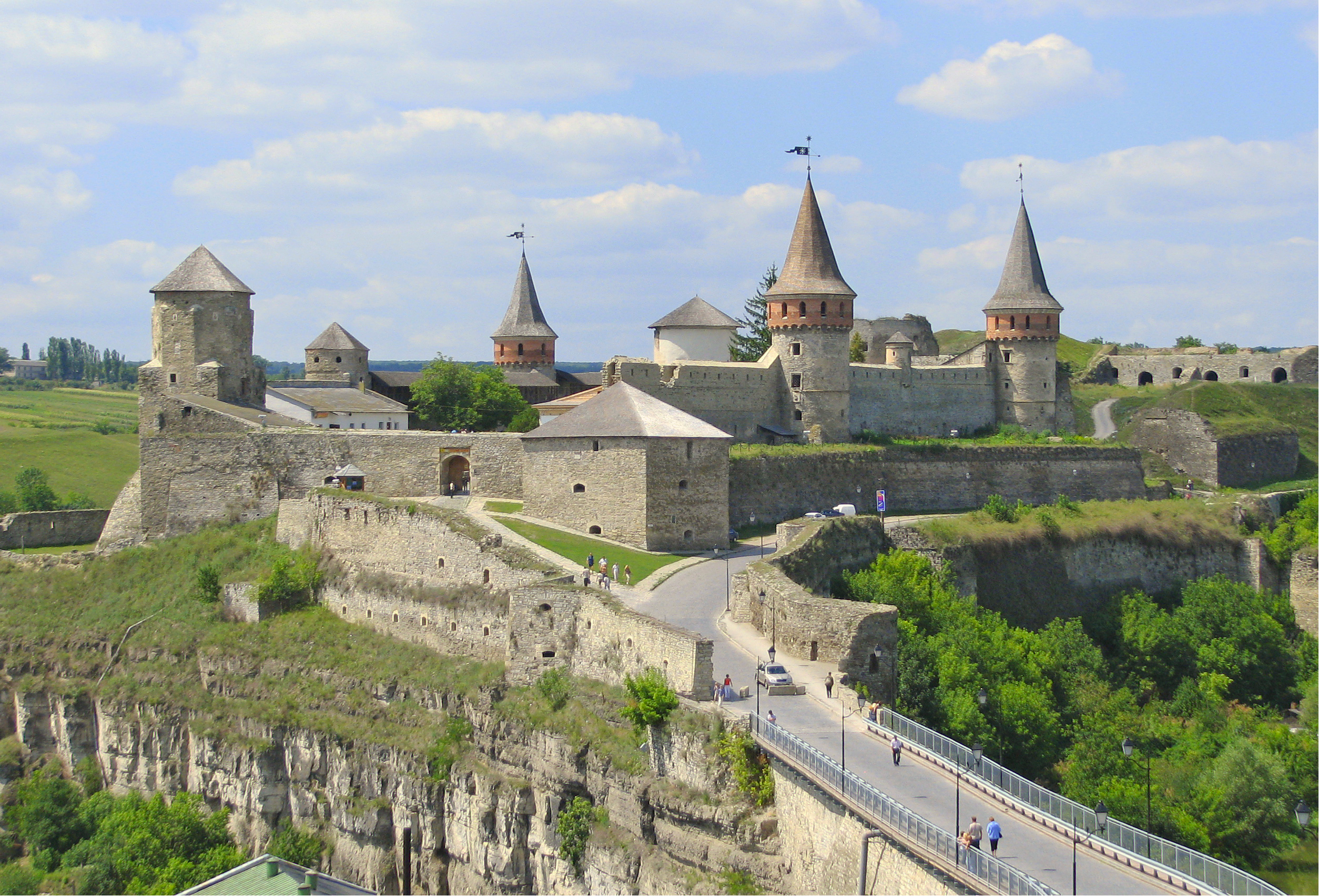
Lviv High Castle
The castle is gone. What remains is a hill -- 413 meters above sea level, the highest point in Lviv -- crowned by a grassy mound, a Soviet-era television tower, and one of the finest views in western Ukraine. For seven centuries, whoever controlled Castle Hill controlled the city below. Mongols demanded its fortifications be torn down. Polish kings rebuilt them in stone. Cossacks stormed them, Swedes shattered them, and Austrians dismantled what was left. Today, couples stroll paths where garrisons once drilled, and the only battles are for the best bench at sunset.
Built by a Prince, Demanded by a Khan
The first wooden fortifications on Castle Hill were raised by Leo I of Halych, the prince who gave Lviv its name. In 1261, the Mongol commander Boroldai demanded their destruction, and they were duly torn down. Before 1283, they were rebuilt, and within their walls lay the treasury of the Kingdom of Rus -- crowns, thrones, and precious crosses said to contain fragments of the True Cross. When Casimir III of Poland captured Lviv in 1340, he ordered the fortifications dismantled. The Lithuanian prince Liubartas burned the city in 1351 and returned to destroy it completely two years later. Casimir rebuilt on the Poltva River, granted the new settlement Magdeburg rights in 1356, and around 1362 raised a stone and brick castle on the hill. Its elevated position earned it the name "High Castle," distinguishing it from the "Lower Castle" in the city below.
The Strongest Walls in Ruthenia
By the 15th century, the High Castle was recognized as the most powerful fortification in the Ruthenian lands. Its cellars doubled as a prison -- Teutonic knights captured at the Battle of Grunwald in 1410 were held in its towers. As Tatar raids intensified at mid-century, Casimir IV Jagiellon reinforced the defenses. The castle withstood Moldavian and Ottoman sieges in 1498 and 1509. A devastating citywide fire damaged its main tower in 1527, and a decade later the castle witnessed one of the more colorfully named rebellions in Polish history: the Chicken War of 1537, a gentry uprising against King Sigismund I the Old and his wife, the Italian-born Bona Sforza. Between a Hungarian garrison occupying it from 1379 to 1387 and Cossack forces under Colonel Maksym Kryvonis seizing it in 1648, the fortress changed hands with a regularity that reflected Lviv's position at the crossroads of competing powers.
From Fortress to Park
The castle's final centuries were ones of slow subtraction. Swedish forces heavily damaged it during their occupation in 1704. In 1777, the Austrian authorities -- who preferred orderly administration to medieval battlements -- began systematically taking the fortifications apart. By the 19th century, the ruins were cleared entirely. Trees were planted on the slopes, walkways laid out, and the hilltop transformed into a public park. In 1869, on the very spot where the castle had stood, the city erected the Union of Lublin Mound, commemorating the 300th anniversary of the union that joined the Polish Crown and the Grand Duchy of Lithuania. The mound remains, and an observation platform at its summit offers a 360-degree view of the city and surrounding hills.
A Hill That Remembers
In 1957, a 141-meter television tower was built on a ridge of Castle Hill, adding a modern vertical accent to a skyline that had been shaped by church domes and bell towers for centuries. Proposals in the early 2000s to rebuild a stone castle on the hill drew both support and opposition, and the plans never advanced beyond conversation. Perhaps that is fitting. The hill's power today lies not in walls but in what their absence reveals -- the rooftops of the Old Town, the green copper of church spires, the distant Carpathian foothills. Stanislaw Lem, the science fiction writer born in Lviv, titled his 1966 autobiographical novel Highcastle: A Remembrance, threading his childhood memories through the landscape of this very hill. The castle may be gone, but the high ground endures.
From the Air
Located at 49.848N, 24.039E, Castle Hill rises to 413 meters above sea level and is the highest point in Lviv. The 141-meter television tower on the ridge is a prominent visual landmark from any altitude. The nearest major airport was Lviv Danylo Halytskyi International (UKLL), located approximately 6 km southwest of the city center, though Ukrainian airspace is currently closed to civil aviation. The hill is clearly distinguishable from the surrounding Old Town district, sitting just north of Rynok Square.