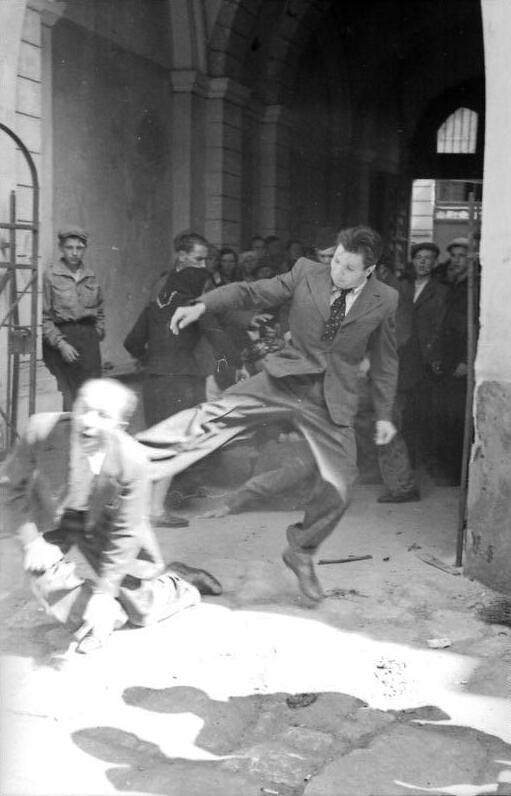
Lviv pogroms (1941)
Before the killing began, Lviv was a city of three peoples. Of its 312,231 residents in 1939, just over half were ethnic Poles, 32 percent were Jewish -- nearly 100,000 people -- and 16 percent were Ukrainian. They shared streets, markets, and neighborhoods, if not always trust. By the time Soviet forces reached Lviv on 21 July 1944, less than one percent of the city's Jewish population had survived. The destruction began not in the distant machinery of extermination camps but in the city itself, in the last days of June 1941, when German forces arrived and the killing started in the streets, the courtyards, and the prisons where Jewish men, women, and children were dragged by their neighbors.
A City Caught Between Empires
Lviv -- known as Lwow in Polish, Lemberg in German -- had changed hands repeatedly. Part of the Second Polish Republic from 1918 to 1939, the city was annexed by the Soviet Union after the joint German-Soviet invasion of Poland in September 1939. Soviet rule brought the NKVD secret police, mass arrests, and deportations. When the Germans invaded the Soviet Union on 22 June 1941, the retreating Soviets murdered thousands of prisoners held in Lviv's jails -- an estimated 4,000 people killed in a frenzy of executions before the NKVD fled east. The bodies were left in three prisons. The discovery of these corpses in the last days of June provided the pretext -- though not the cause -- for what followed. German propaganda and Ukrainian nationalist leaders blamed the murders on what they called Jewish Bolsheviks, despite the fact that the NKVD's victims were overwhelmingly Ukrainian and Polish.
The Days of Blood
German forces entered Lviv in the early hours of 30 June 1941. That same day, a Ukrainian People's Militia formed in the city, incorporating members of the Organization of Ukrainian Nationalists (OUN), former Soviet policemen who switched sides, and local volunteers wearing yellow-and-blue armbands. OUN flyers had been explicit: "Moscow, the Hungarians, the Jews -- these are your enemies. Destroy them." During the afternoon of 30 June, violence against Jewish residents began. Jewish people were dragged from their homes, beaten in the streets, and forced to carry the decomposing bodies of the NKVD's victims from the prisons with their bare hands. Some were murdered on the spot. The violence was not spontaneous in the way a riot is spontaneous; it was encouraged, organized, and in some cases directed by both German military personnel and Ukrainian nationalist leaders. When sub-units of Einsatzgruppe C arrived on 2 July, the killing escalated further. Jewish people were herded into a stadium, loaded onto trucks, and taken to execution sites.
Petliura Days
A second pogrom struck in late July. Named for Symon Petliura, the assassinated Ukrainian nationalist leader, the so-called Petliura Days began on 25 July when militants assembled at police stations across the city. Accompanied by the Ukrainian Auxiliary Police, they attacked Jewish residents with clubs, axes, and knives. Ukrainian militants from the countryside joined the violence, arriving with farm tools. Consulting prepared lists, police arrested Jewish people in their homes while civilians beat and killed Jews in the streets. According to Yad Vashem, approximately 2,000 people were murdered in roughly three days. The total number of Jewish victims across both pogroms and the Einsatzgruppen killings that accompanied them is estimated at between 6,000 and 8,000 people. Each of these was a person who had lived in this city -- had worked, raised children, attended synagogue, argued with neighbors, planned for a future that was taken from them.
The Ghetto and the End
The pogroms were only the beginning. In November 1941, SS-Brigadefuhrer Fritz Katzmann ordered the establishment of the Lwow Ghetto. At its peak, the ghetto held some 120,000 Jewish people, most of whom were deported to the Belzec extermination camp or murdered locally over the next two years. The Janowska concentration camp, on the outskirts of the city, became another site of mass killing. By July 1944, Lviv's prewar Jewish community of nearly 100,000 -- augmented by tens of thousands of refugees from German-occupied Poland -- had been almost entirely annihilated. The scale of this destruction defies comprehension, but its mechanism does not: it began with dehumanization, escalated through organized violence, and ended in industrial murder. The people who died were not abstractions. They were the one-third of Lviv that no longer exists.
Memory and Its Distortions
For decades, the pogroms received limited scholarly attention. Soviet historiography erased the ethnicity of both victims and perpetrators, folding Jewish dead into the category of undifferentiated Soviet civilian casualties. Ukrainian nationalist organizations worked actively to distance themselves from responsibility, rewriting documents, controlling archives, and promoting sympathetic accounts through diaspora academics. After the Soviet archives opened in the 1990s, historians including John-Paul Himka and Per Anders Rudling documented the OUN's role and its subsequent efforts at denial. The debate remains contested: other scholars emphasize the complexity of events, noting that Poles also participated in the violence and that similar killings occurred in areas where the OUN had no presence. Modern Lviv is 90 percent Ukrainian. As of 2014, no memorial to the Jewish victims of the pogrom existed at the site of the Prison on Lacki Street, where some of the worst violence occurred. The city's lost Jewish and Polish populations have been largely absent from its post-Soviet commemorative practices.
From the Air
Located at 49.51N, 24.01E. Lviv is a major city in western Ukraine, its historic center a UNESCO World Heritage Site. The sites of the 1941 pogroms -- the three prisons, the city streets, the stadium -- are within the urban core. The city sits on the Poltva River at the edge of the Podolian Upland. Best approached at 3,000-5,000 feet AGL. Nearest airport: Lviv Danylo Halytskyi International Airport (UKLL), located approximately 6 km southwest of the city center.