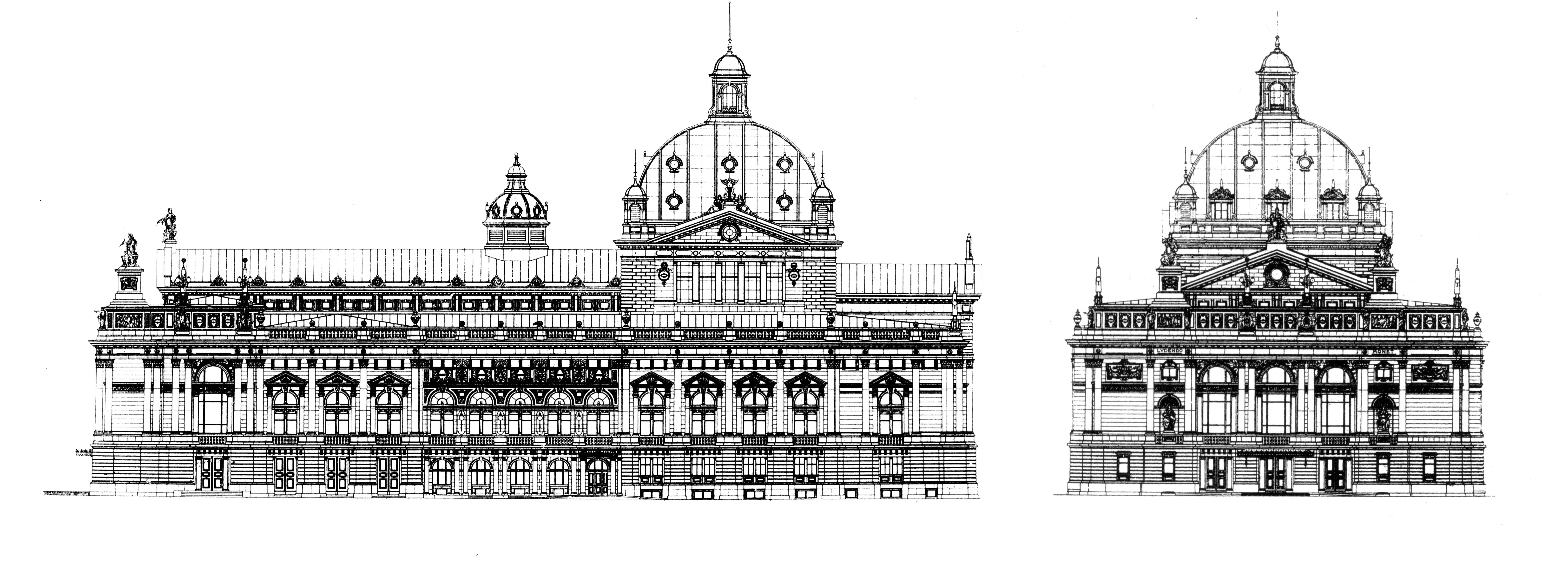
Lviv Theatre of Opera and Ballet
The architect who won the commission to build Lviv's opera house proposed something audacious: bury the Poltva River underground, pour a reinforced concrete foundation -- the first of its kind in Europe -- and erect a temple to the arts in the middle of an already densely built-up city. Zygmunt Gorgolewski's plan worked. The building opened on October 4, 1900, to a crowd that included a Nobel Prize-winning novelist, a composer who would become prime minister of Poland, and three clergymen of three different faiths who blessed the structure because the two archbishops who would normally have done so had recently died. Then rumors started that the building was sinking. It was not.
A River Runs Beneath It
At the end of the 19th century, Lviv was the capital of the autonomous province of Galicia within the Austro-Hungarian Empire, and its civic leaders wanted a theatre worthy of the role. In 1895, the city announced an architectural design competition. Among the rejected entries was one from the prominent Viennese firm Fellner and Helmer, dismissed as too international and eclectic. The jury instead chose Gorgolewski, a graduate of the Berlin Building Academy and director of the city's Engineering Academy, whose design solved a fundamental problem: where to put a grand building in a city with no room for one. His answer was to enclose the Poltva River in an underground tunnel and build on the reclaimed ground using reinforced concrete, a technique that was still experimental. The foundation held. It continues to hold.
An Opening Night for the Ages
The guest list for the October 1900 opening reads like a roster of Central European cultural aristocracy. Writer Henryk Sienkiewicz, who would win the Nobel Prize in Literature in 1905, attended. So did composer Ignacy Jan Paderewski, who would later serve as Poland's prime minister. Painter Henryk Siemiradzki, who had decorated the main curtain, was present alongside provincial governor Leon Pininski and chief magistrate Godzimir Malachowski. Because both the Roman Catholic and Greek Catholic archbishops had recently died, the building was blessed by an unusual trio: the Armenian Catholic archbishop Izaak Mikolaj Isakowicz, rabbi Ezechiel Caro, and a Protestant pastor named Garfel. The evening's program wove together ballet, opera, and comedy -- three art forms sharing a single stage, as if to demonstrate the breadth of what this building was meant to hold.
Empires Come and Go
The building has been renamed more times than most theatres have mounted productions of Carmen. Under Austro-Hungarian rule, it anchored the end of Archduke Karl Ludwig Avenue. During the Second Polish Republic, it was known as the Grand Theatre. Under the Soviets, patrons entered past a towering statue of Lenin, and for four decades the building bore the name of Ivan Franko, the Ukrainian poet and political activist, after being renamed in 1956 on the centenary of his birth. In 2000, the opera was renamed for Solomiya Krushelnytska, a celebrated soprano of the early 20th century. Each renaming erased a layer and added another, but the building itself remained unchanged -- the Corinthian columns, the stucco garlands, the bronze statues of Glory, Poetry, and Music crowning the roofline.
A Catalogue of Polish Masters
The interior is a showcase of late 19th-century Polish art. Sculptor Stanislaw Wojcik created allegorical figures of Poetry, Music, Fame, Fortune, Comedy, and Tragedy. Antoni Popiel and Tadeusz Baracz carved the figures of Comedy and Tragedy that flank the main entrance, while muses by Popiel embellish the cornice above. Inside, the painters Tadeusz Popiel decorated the staircases, Stanislaw Rejchan worked the main hall, and a team including Stanislaw Debicki, Stanislaw Kaczor-Batowski, and Marceli Harasimowicz filled the foyer with murals. The architectural style blends Renaissance Revival and Neo-Baroque with touches of Art Nouveau, creating interiors that feel less like a theatre and more like an inhabited painting. Siemiradzki's curtain, painted by one of the era's most celebrated artists, remains the centerpiece.
The Anthem and the Architect
Gorgolewski did not live to see the opera's greatest symbolic moment. He died in July 1903 of aortic paralysis, just three years after the opening, while rumors persisted that his building was slowly sinking into the buried riverbed below. The building settled initially but then stopped, vindicating his engineering. Nearly nine decades later, in April 1990, as the Soviet Union was on the verge of collapse, the Lviv Opera hosted the first public performance of Ukraine's national anthem -- a song that had been banned for decades. The theatre that had been Austro-Hungarian, Polish, and Soviet was becoming something else entirely. Gorgolewski built on a river. Ukraine built on his foundation.
From the Air
Located at 49.844N, 24.026E on Prospekt Svobody, the tree-lined central boulevard of Lviv's UNESCO-listed Old Town. The opera house is one of the most prominent buildings in the city center, recognizable from the air by its grand Neo-Baroque roofline and surrounding formal gardens. The nearest major airport was Lviv Danylo Halytskyi International (UKLL), though Ukrainian airspace is currently closed to civil aviation. The building sits atop the underground course of the Poltva River.