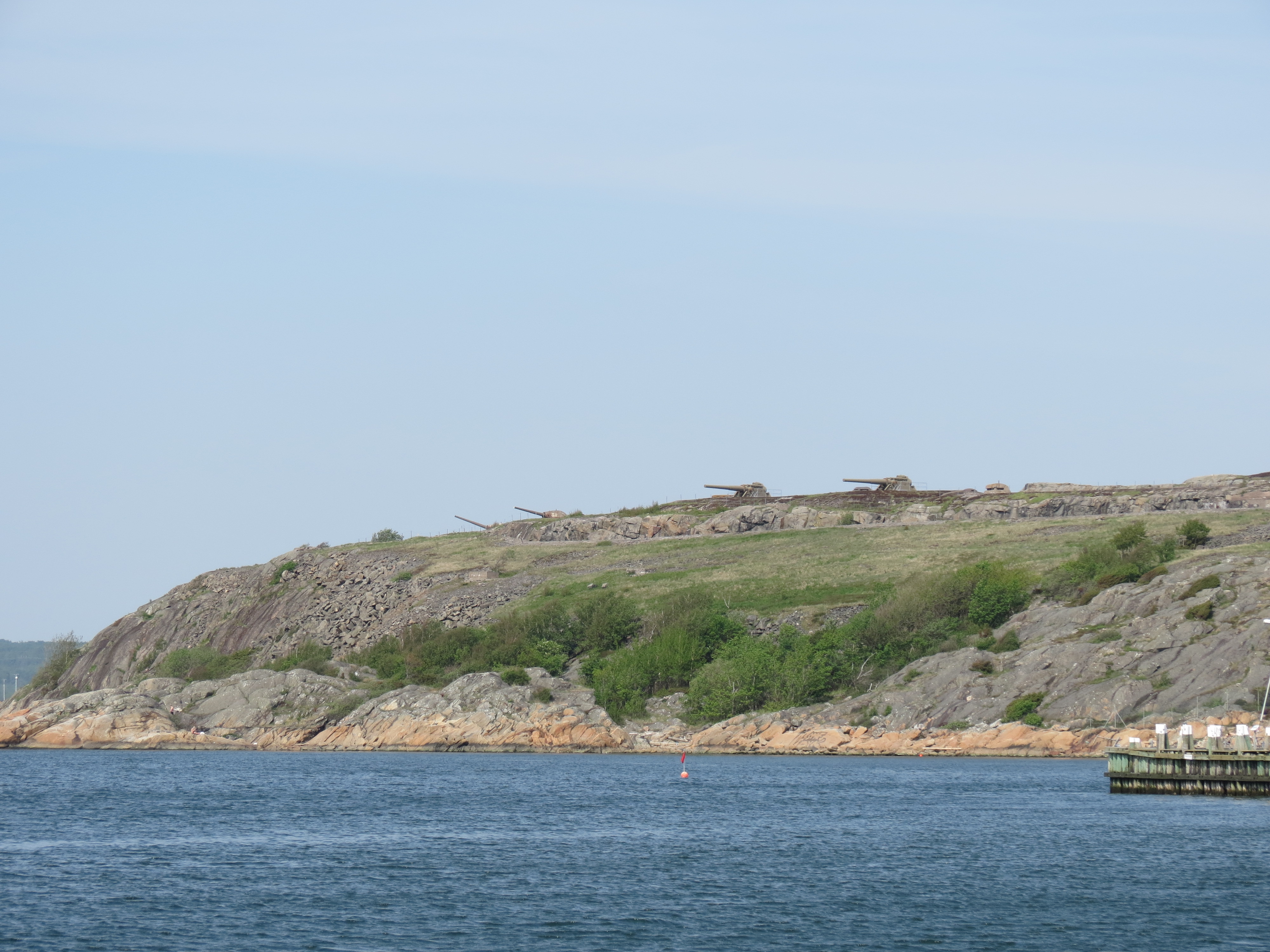
Alvsborg Fortress
The massive guns would rise from the rock, fire, then vanish back into the earth before enemy ships could target them. Oscar II's Fort, the heart of Alvsborg Fortress, was Sweden's answer to the dreadnought age: a coastal defense system built directly into Vasterberget at the mouth of the Gota River. Between 1899 and 1907, engineers carved several hundred meters of tunnels into the basement rock, creating quarters for 300 soldiers and mounting artillery that could disappear at will. The fortress guarded Gothenburg, Sweden's main port, for four decades before the defense lines pushed outward to the archipelago and the guns fell silent.
A Fort Carved from Living Rock
Construction began in 1899 on Vasterberget, a rocky outcrop overlooking the river mouth. The engineers faced a unique challenge: create a fortress that could withstand modern naval bombardment while delivering accurate fire. The solution lay underground. Workers excavated deep into the bedrock, hollowing out passages for offices, lodgings, mess halls, and ammunition stores. The entire complex could house 300 personnel, connected by walkways that kept soldiers protected from shelling. Above ground, the guns sat on disappearing carriages, mechanisms that allowed the heavy weapons to rise above their armored pits, fire on enemy vessels, then sink back below the surface to reload in safety.
Armament of the Modern Age
By 1907, Alvsborg Fortress bristled with the latest coastal artillery. Two 24-centimeter guns, model of 1904, formed the main battery. These heavy weapons mounted on disappearing carriages represented the cutting edge of coastal defense technology. Smaller 15-centimeter turret guns provided additional firepower, along with lighter weapons for close-range defense. Naval mines protected the flanks, creating deadly obstacles for any ship attempting to slip past. The Geatish Society, a patriotic cultural organization, donated one battery, named Gotiska batteriet, to the national defense. The fortress achieved its design goal: no enemy ship could reach Gothenburg without passing through a gauntlet of plunging fire.
Commanders of the Gateway
A succession of officers commanded this critical post. Sam Bolling served first, from 1908 to 1914, overseeing the fortress during its peak years. Arthur Edstrom held the longest tenure, a full decade from 1914 to 1924, guiding the fortress through the Great War when Sweden's neutrality kept the guns silent but ready. Subsequent commanders, Hans Malmberg, Karl Noren, Gustaf Peterson, Folke Eriksson, and Sigge Hultkrantz, maintained readiness through the interwar years. When war returned to Europe in 1939, Ake Wockatz and then Rudolf Kolmodin commanded the fortress through its final active period before absorption into a larger defensive structure.
The Defense Line Moves Outward
As Europe slid toward war in 1939, Alvsborg Fortress was placed on defensive alert. But military planners recognized that modern naval warfare had changed. The main guns, except for the Gotiska batteriet, were removed in 1939-1940 and relocated to new positions in the Gothenburg archipelago, pushing the defensive perimeter farther from the city. The fort served as accommodation during World War II, its tunnels sheltering soldiers rather than sheltering artillery. In 1942, the fortress was formally amalgamated into Gothenburg Coastal Artillery Defence, which took over the traditional task of protecting the port with batteries and mine barriers scattered across the archipelago islands.
From Fortress to Memory
After the war, the underground passages found a mundane second life as storage spaces. For decades, the tunnels that once echoed with military boots served as warehouses. But moisture and neglect took their toll. By the 1970s, the internal passages had deteriorated significantly, and the fortress was completely disbanded. Today, the preserved guns stand as monuments to early 20th-century coastal defense, while the underground spaces remain closed to casual visitors. The fortress site, now within the Alvsborg district of Gothenburg, offers views across the harbor where it once watched for enemy sails.
From the Air
Located at 57.67N, 11.85E at the mouth of the Gota River in western Gothenburg. The fortress sits on Vasterberget near Langdrag harbor. Best viewed at 1,500-3,000 feet; look for the preserved coastal artillery guns pointing seaward. The nearby Gothenburg archipelago islands are visible stretching westward. Nearest major airport is Gothenburg-Landvetter (ESGG). Gothenburg City Airport (ESGP) is closer but smaller.